Welcome back! Last week, we talked about Sir Geoffrey Luttrell, the patron who commissioned the Luttrell Psalter. So it’s only natural that we now talk about…
THE PSALTER
The way that the Luttrell Psalter is written and constructed is kind of unique in that the text is rather large and in a pretty specific, clear style. One reason for this is that it was probably shown to multiple people- if you spent a lot of money on something, you wanna show it off- most likely to allow for it to be used as a family bible, or to teach people how to read. Most literate people were clergymen, people that had to write and make things like the Luttrell Psalter on commission. Some nobles were literate, too, usually functionally literate, which meant they could recognize certain words or write their name. Some nobility, however, valued and desired literacy, not just for themselves, but for their families, especially their children, and the best way to do this was through a book they were already familiar with- the Bible, especially the psalms.
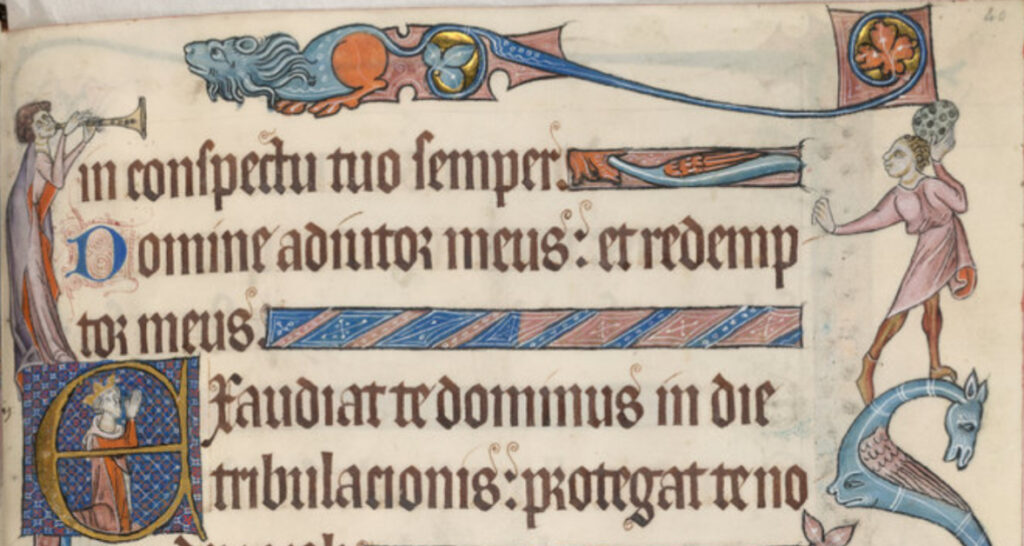
Some of the large text displayed in the psalter. Note the decorations and marginalia surrounding it.
Religious study, and religion as a whole, really, was a huge part of medieval people’s lives. Church wasn’t just a place to recite psalms and attend services like Mass, but also a center of socialization, a way to display status and piety, and a source of entertainment and a break from work. Feast days granted delicious meals, rest, fairs, and a chance to mingle for the lower classes, and chances to display wealth and status as an upper-class individual. It only makes sense, then, that you and your children learn to read from things so familiar to you that you likely know them from memory.
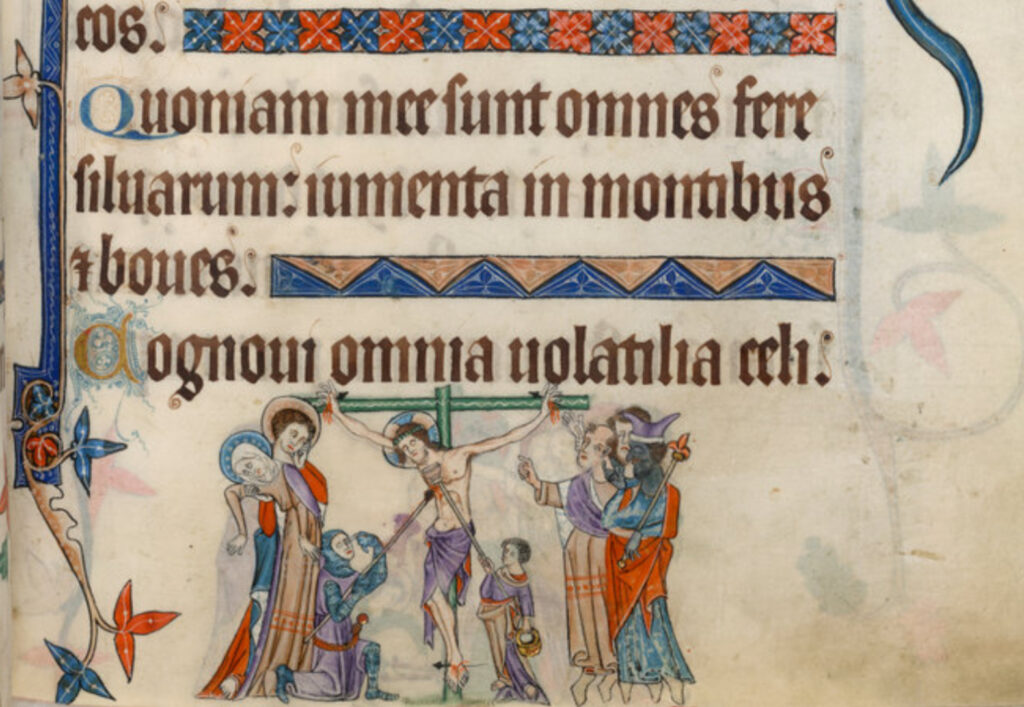
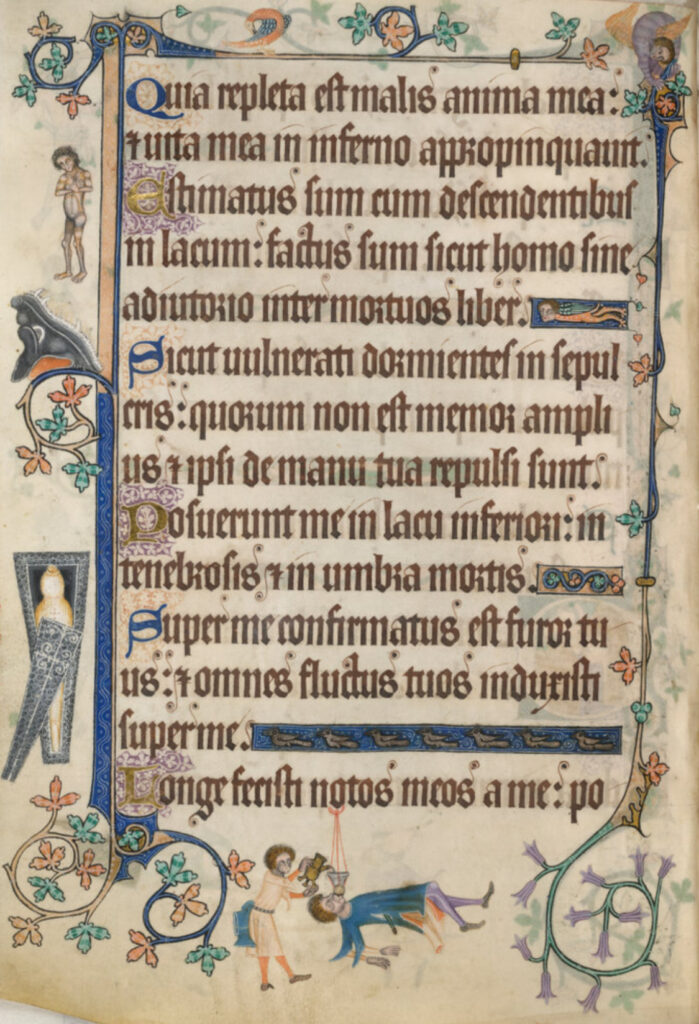
There’s a wealth of religious imagery here. As previously mentioned, the Luttrell Psalter was a book likely intended for religious study. It was pretty common to commission psalters, prayer books, and books of hours, but the Luttrell Psalter stands out even in this regard. Beginning with a calendar, the Psalter contains psalms, canticles, the Mass, and a chant for the dead, complete with musical notation. What’s interesting is the way that the imagery lines up with the text; sometime it’s obvious, like images of the Crucifixion. Other times, there’s a more metaphorical approach; Psalm 94, about persecution and vengeance, shows a man sowing seeds as crows harry him and his dog to eat them, and Psalm 88 has an image of an enshrouded corpse in a coffin accompanying a line regarding the dead and slain in the grave.
An image of the Crucifixion of Christ from the psalter. Notice the intricate artwork in which the artist pays careful attention to rendering the human form and details in the clothing, like embroidery
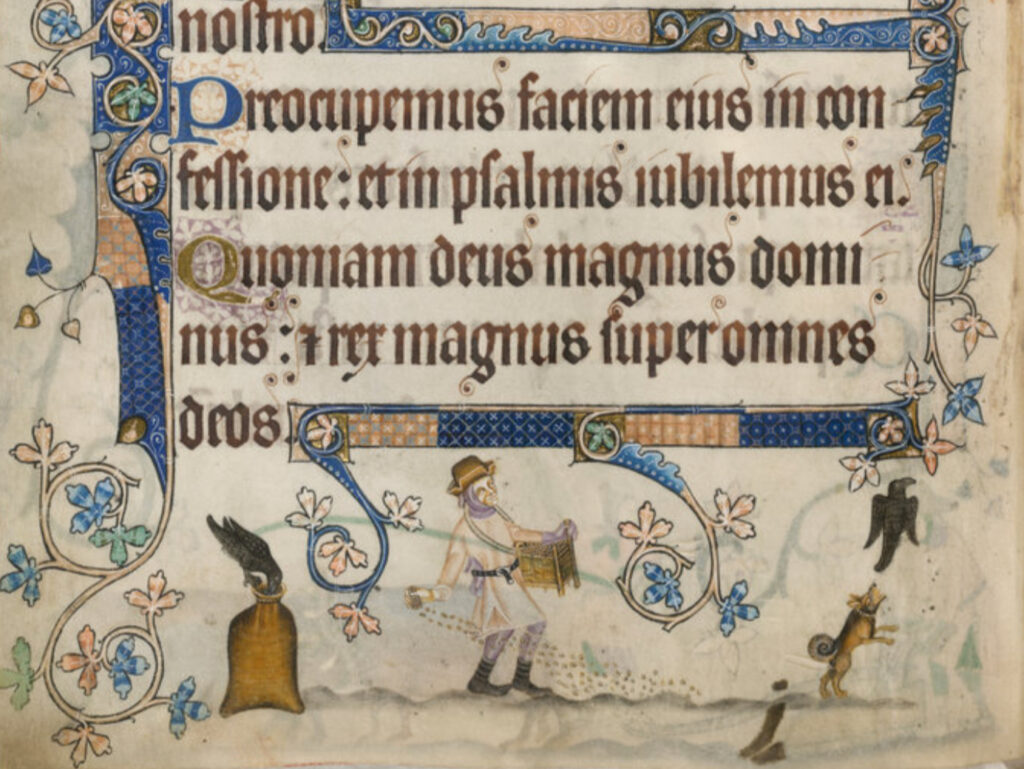
Psalm 94. I like the dog’s curly tail in this one. Everything here feels very much lovingly rendered. Check the detail in the marginal decorations!
There’s so much going on with this page that I’m including the whole thing. There’s a naked person above one of the mouths of hell, a corpse in a casket, and some kind of… thing happening at the bottom. Our best guesses as to what it could be include a weird forgotten feat of skill, a drinking game, or some kind of medieval waterboarding…? You can thank the British Library’s tags for that last one.
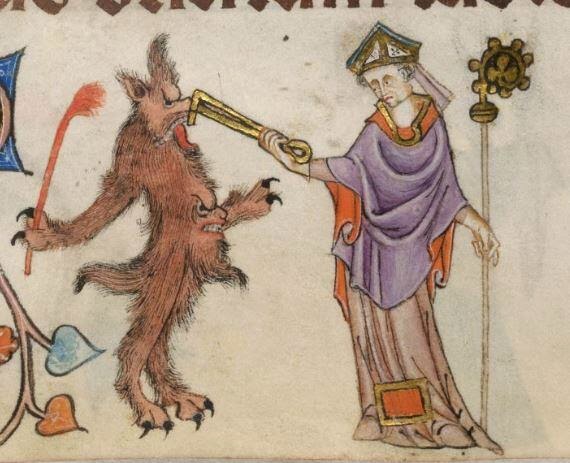
A bishop pinching the nose of a devil with a pair of gilded tongs. This could potentially allude to a legend about St. Dunstan, the reason we might hang horseshoes up for good luck or to fend off evil. Regardless of who the devil’s pincher is, neither of his faces seem too happy about it.
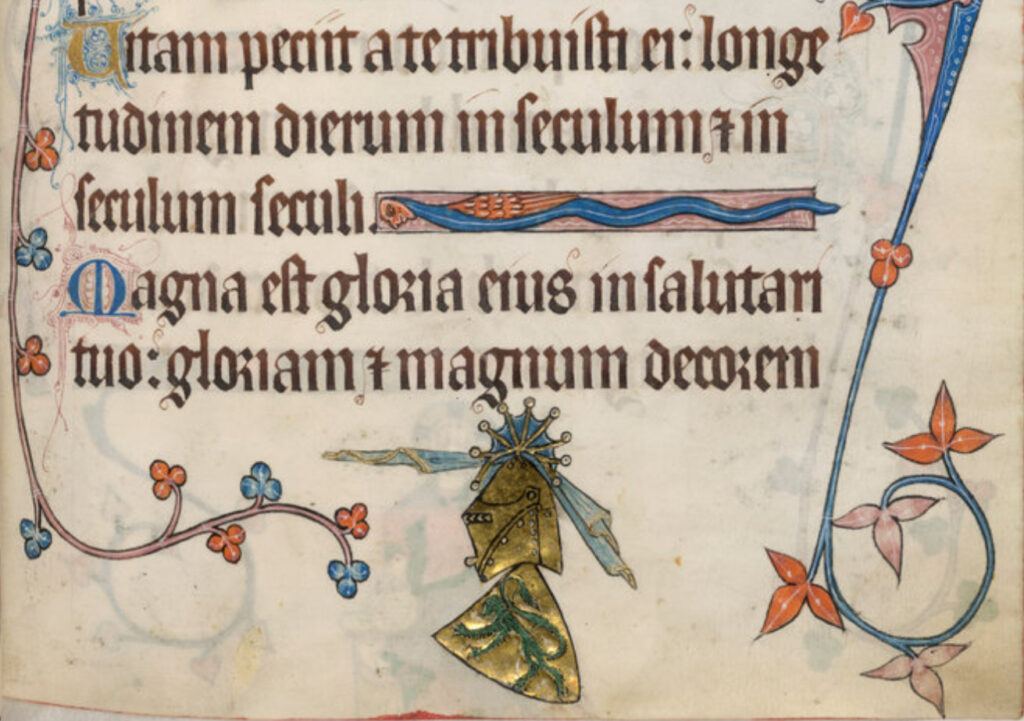
Speaking of wealth, that’s another thing that a manuscript like the Luttrell Psalter could be intended for. There’s a number of depictions of Sir Geoffrey Luttrell in the psalter, primarily the dedication page, and in them, he’s shown to be strong, wealthy, the head of his household. He’s surrounded by his family members and wearing fine clothes in all of them, and in the most flashy one, he sits armor-clad on a warhorse, with he and his family wearing his coat. He’s very clearly a knight, and very clearly wealthy. His achievements, status, and wealth are made obvious to any reading. Also, you’d want to spend so much money on a psalter because it was expensive in the first place. Everybody knows that. The vellum alone cost around £4- more than double what a commoner might see in a year! The more you commissioned for it- more pages, more illuminations, more gilded decoration- the more expensive it was. If you could afford to spend upwards of ten times what a commoner makes in a year on a personal prayer book, you had a fantastic way to show your wealth- piously, of course.
A gilded knight’s helm from the psalter. Kind of flashy if you ask me…
Aside from this, there’s his lands to take into account. Remember how we discussed his estates last week? Well, there are lots of depictions of farming and the countryside, including mills, windmills, and farmland. It even includes an image of Irnham Church in Lincolnshire, the church he would later be buried in and for which he provided money to remodel. We also discussed the portrayal of servants and of normal people working the land. All of these choices were likely dictated, at least in part, by the patron, considering the extensive illustration and the specificity of the farming and feasting sequences. Perhaps it was to preserve in illumination some of the things Sir Luttrell saw from day to day, the lands he owned, the places he visited, and some of the people who lived there.
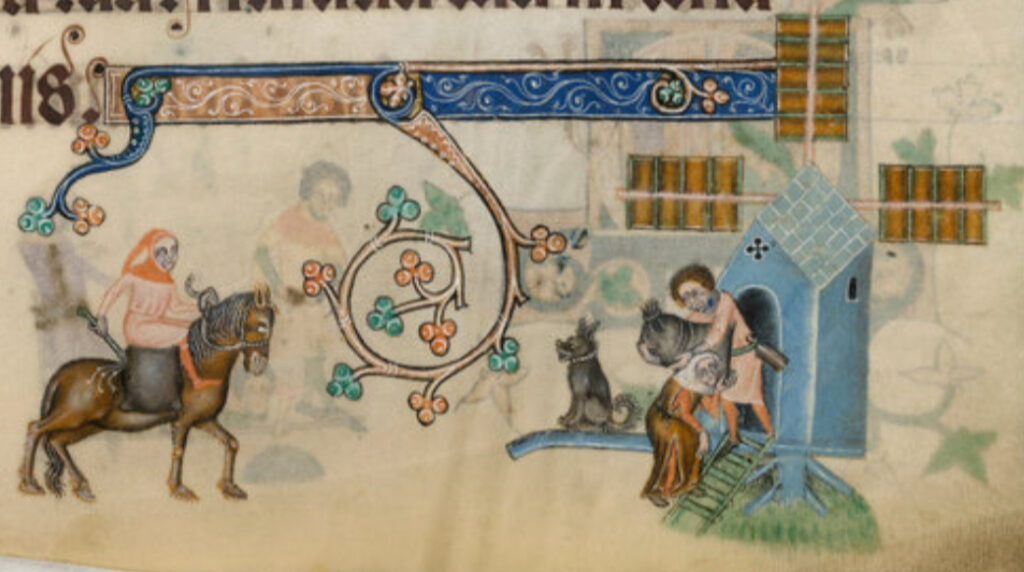
A picture of a windmill from the Luttrell Psalter. There’s some really great textiles here, and also a delightfully illustrated dog and horse complete with tack.
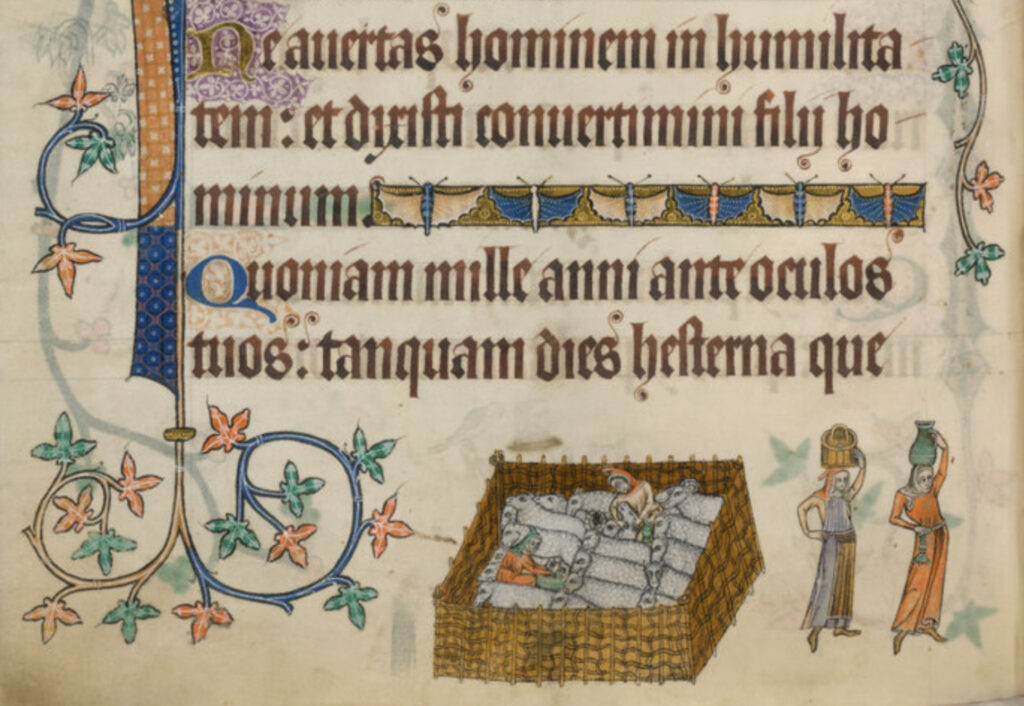
Two women next to a flock of sheep, enclosed in a fence. Two people are in there caring for them, and the women on the outside of the fence carry a basket and a jug on their heads.
About his family, too- you can see in the dedication page that his wife and daughter-in-law not only wear the coat of his family, but of theirs, too. Looking at his wife, Agnes Sutton, we see that she wears Sutton family coat colors with the Luttrell coat overlaid, with the lions of the Sutton coat on the opposite page below the Luttrell martlets. Aside from this, his daughter-in-law, Beatrice Scrope, wears the Scrope colors in a similar fashion to her mother-in-law- the Luttrell coat overlaid. This was a common purpose of commissioned manuscripts, too; they served as ways to demonstrate the status and nobility of your family line.
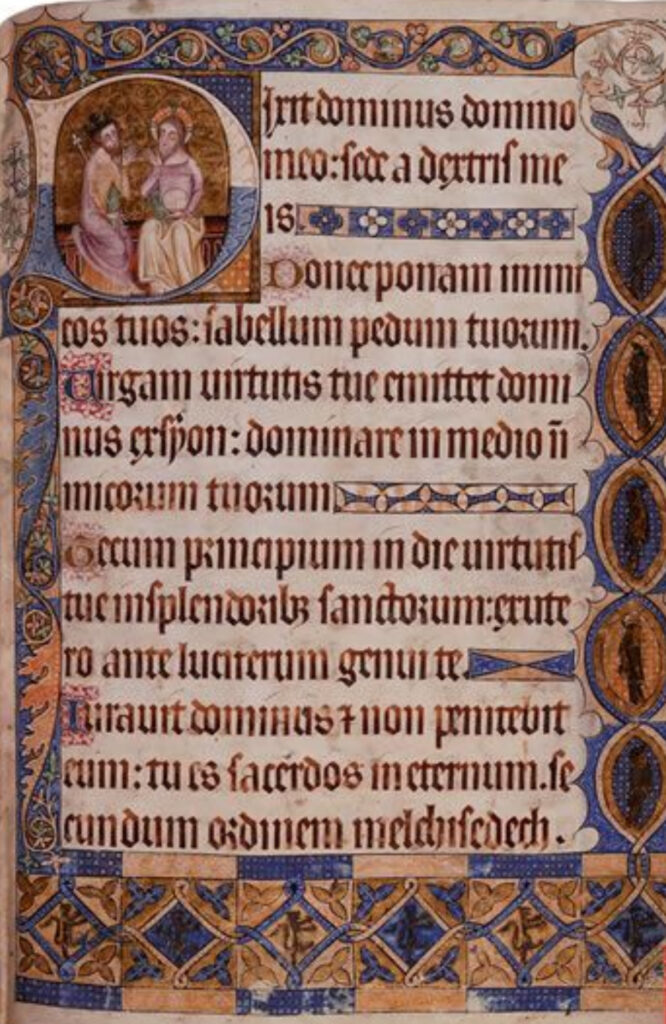
The page opposite the dedication page. See the lions (bottom) and the martlets (right)?
The psalter itself contains a striking variety of detailed imagery depicted in various illuminated scenes and grotesques: scenes from the bible, including apocrypha such as the death of the Virgin Mary, images of saints and ecclesia, images of mythical beasts and human hybrids, vignettes of the regular daily lives of everyone from the nobility to beggars, working, playing, eating, performing, living, and dying. The psalter does well to depict the most mundane, everyday tasks in great detail, contributing to the value of the Luttrell Psalter as a historical source: from studying how animals were used in farming alongside farming implements (due to the detailed illustrations showing just how these implements work and are constructed), to researching types of entertainment and performers (both of show and music) and how they looked, to the study of fashion and textile history (from the detailed images showing nearly every part of an outfit from rich to poor and from underwear to armor).
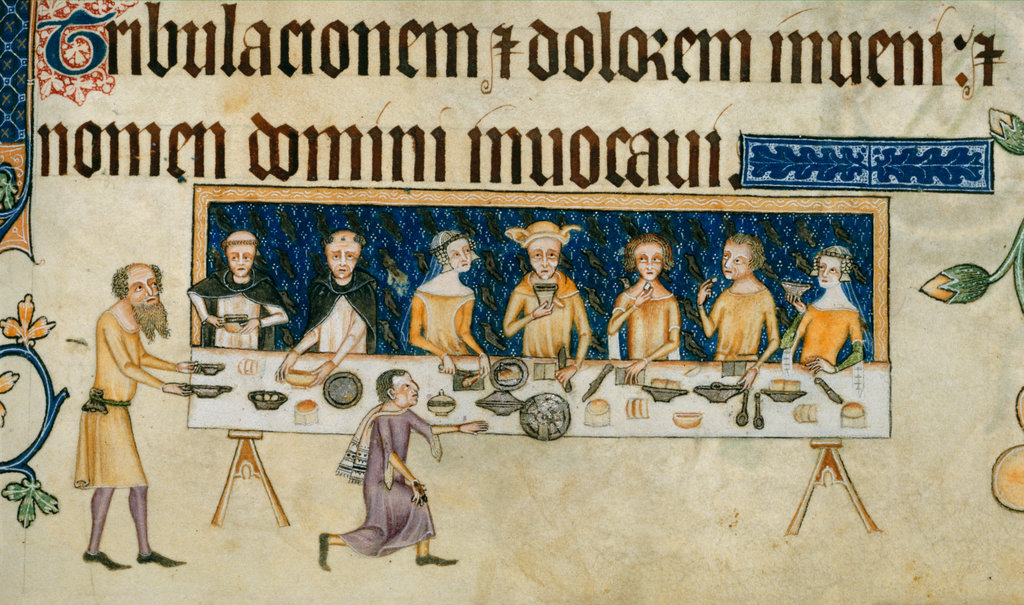
For example, the psalter, in one image, illustrates how younger generations followed fashion trends while older family members may not. Take a look at fol. 208, the dinner table scene. Sir Luttrell’s daughter wears hanging sleeves, a new fashion, while Lady Luttrell wears something more typical to the age.
The aforementioned dinner table scene. Sir Luttrell sits at the center, with Lady Luttrell to his left. To his right are his two sons and his daughter-in-law. The two tonsured figures in clerical clothing at the far left end of the table are friars.
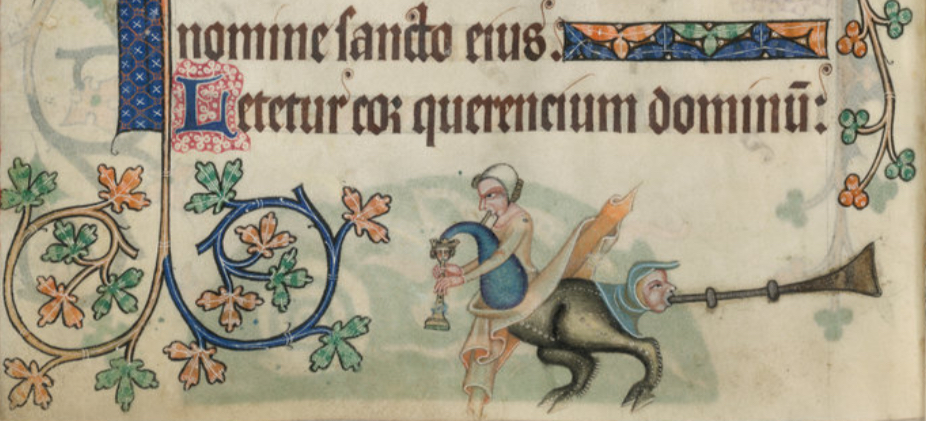
On top of that, there’s some… interesting stuff. A blue-legged hybrid spins thread from a distaff full of wool. Two hybrids fight one another. An armor-clad centaur slays a boar with a lance as if fencing, and various other weirdos decorate the bases of many of the pages, including a sort of two headed satyr that plays the bagpipes with his front and a trumpet with his rear. Most of these don’t mean anything- they’re purely for decoration, and the psalter is rich with that. Much more illustrated than the average psalter or prayer book commissioned in this era, the Luttrell Psalter has 309 leaves total, and 200 are decorated with florals, leaves, biblical scenes, everyday people, and fantastic beasts.
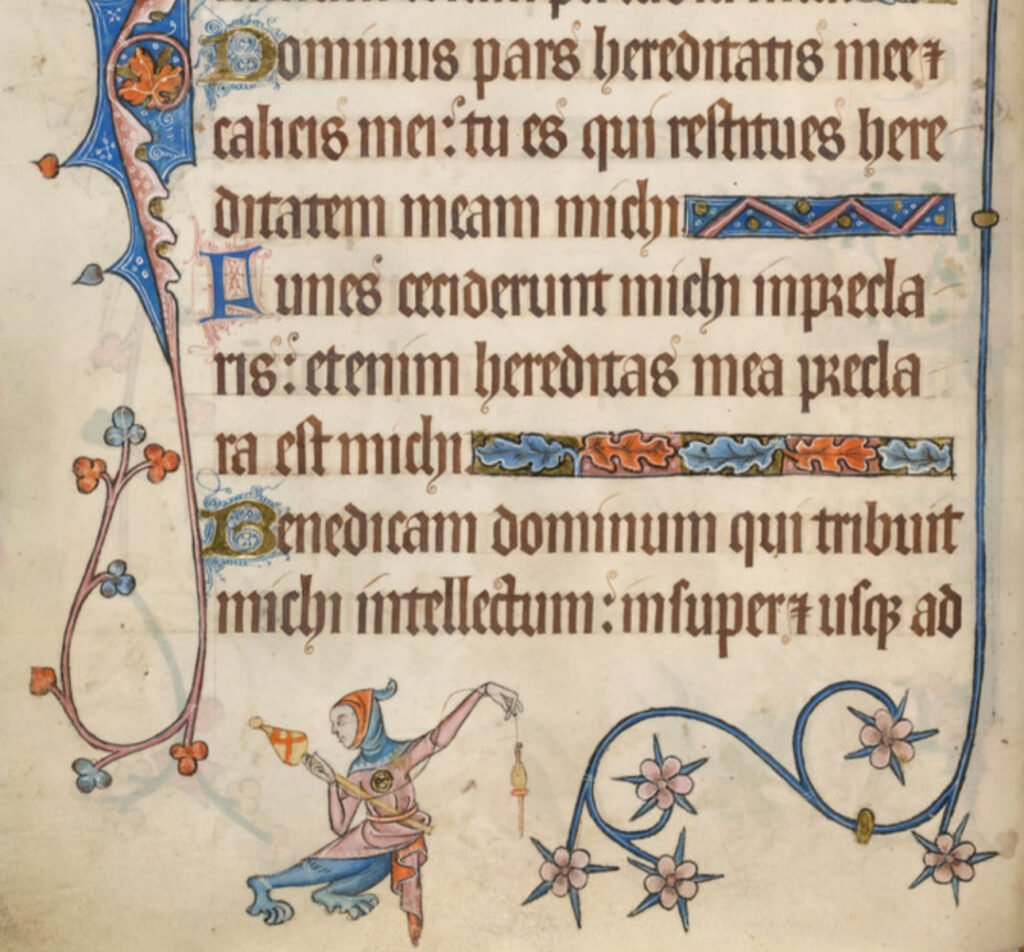
Pretty relatable, if you spin medieval-style and typically pull blue fur out of your shower drain.
I’m pretty fond of this one.
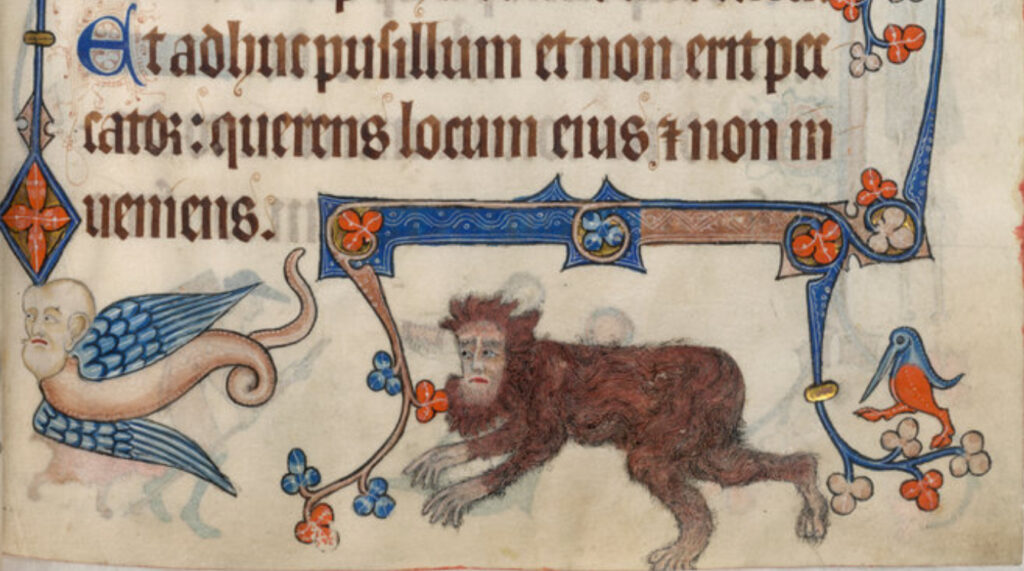
The British Library just tags this one “wildman.” I guess. 14th century Bigfoot sighting?
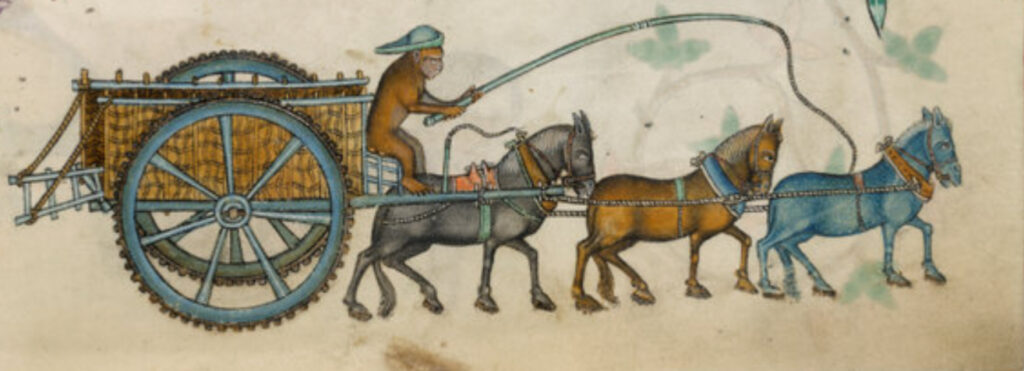
This is a monkey driving a horse cart. I really like this one. The horses seemed embarrassed about it, but look at his little hat.
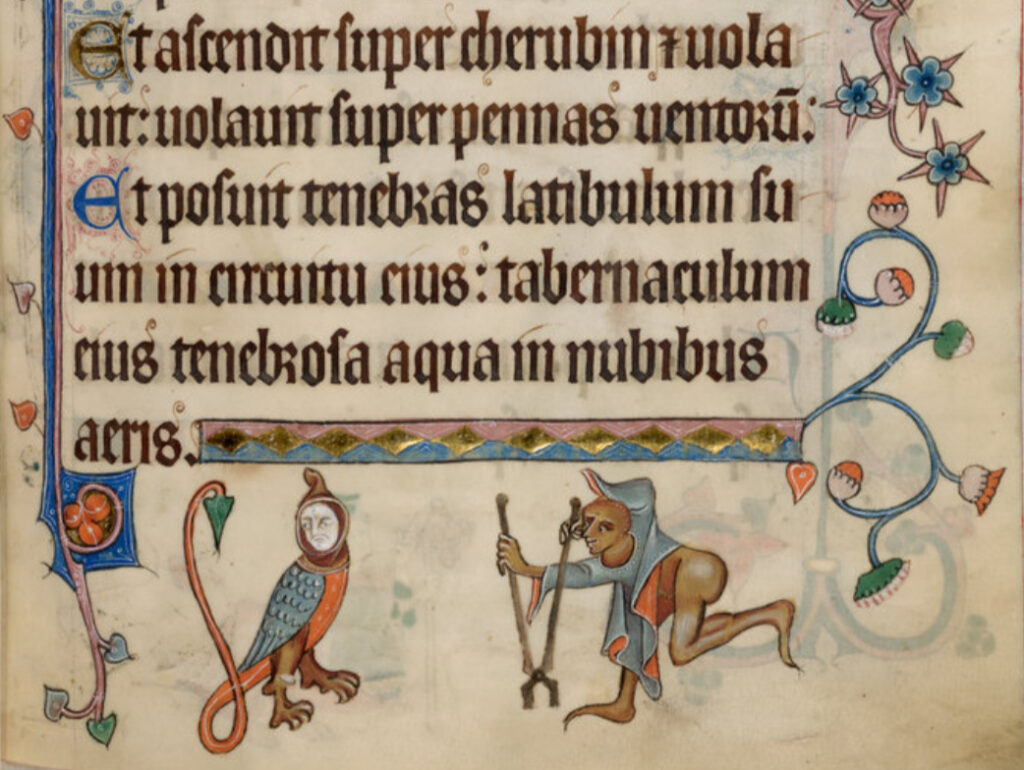
”Man with pincers” (British Library, not me) vs. fashionable falcon lady.
I couldn’t say no to this face. So fashionable, too. Look at that smile!
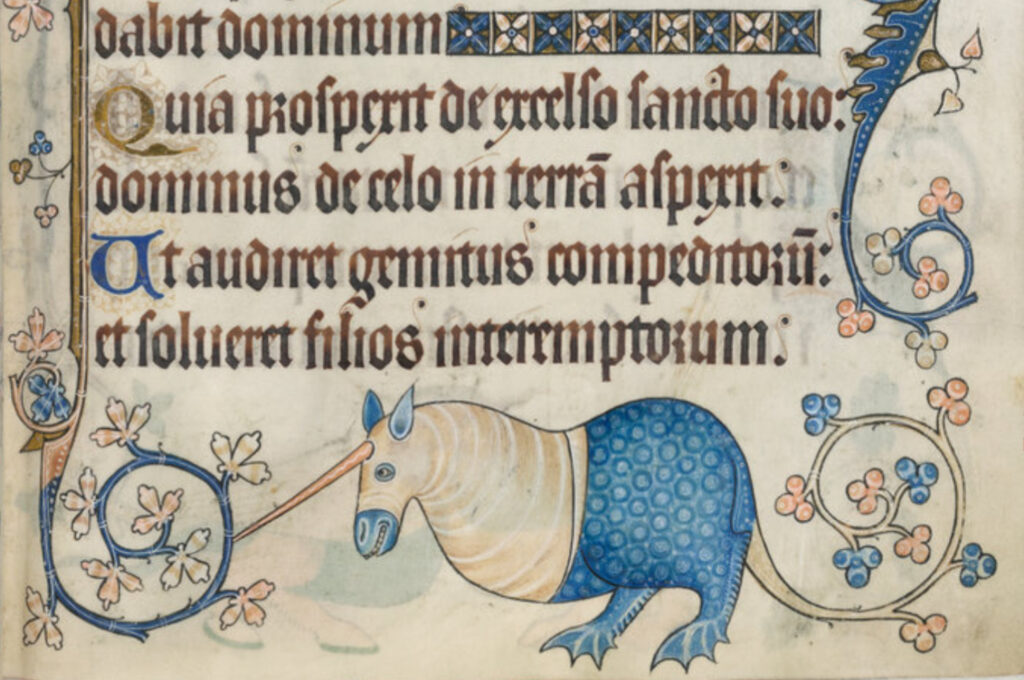
I mentioned this before, but the psalter also has quite a few depictions of common people doing mundane stuff. Farmers, of livestock and produce, plow their fields, shoo away birds, and tend to sheep. A woman feeds her chickens, a man shoos a hawk away from his geese. Two sections of note are the farming and feasting sections, which show an entire cycle of farming from planting to harvest and the preparation and serving of a great feast. I’ll include some images below, but you can see more pictures here, at the British Library Online.
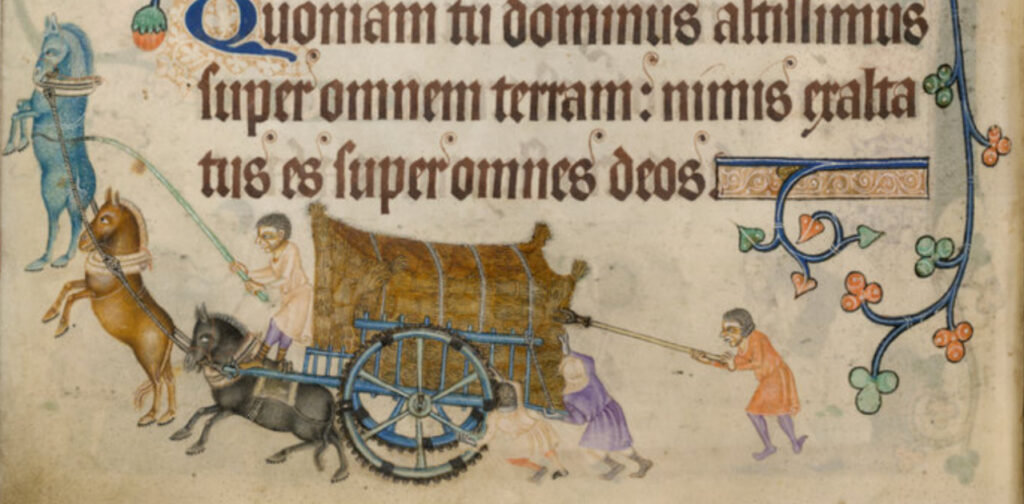
People hauling a wagon full of freshly harvested grain uphill. I love how horses are illustrated in the Luttrell Psalter. Look at how detailed the wagon and tack is! The two guys in the back have to push to help it uphill. Apparently, “dude, get in the back and push, I think we’re stuck” is a feeling that’s existed at least since the 14th century.
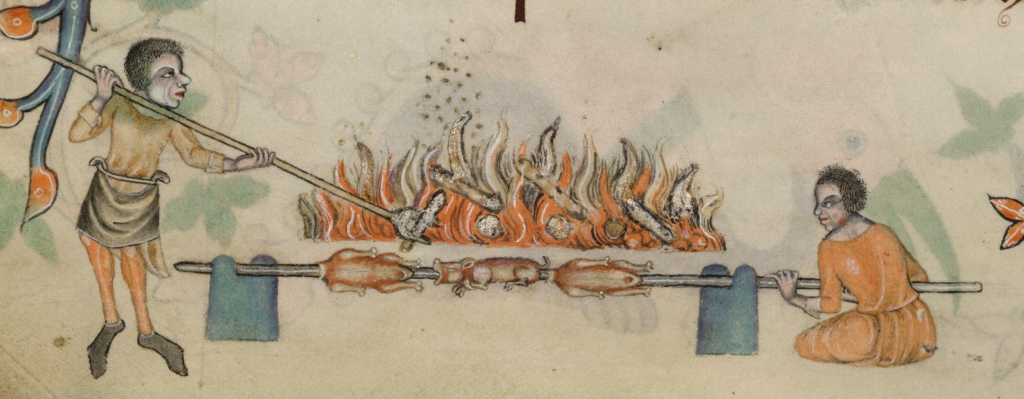
Two men preparing a feast, complete with little aprons. It makes me feel better that, again, the feeling of wanting to wreck a whole rotisserie chicken (maybe by yourself…) is timeless.
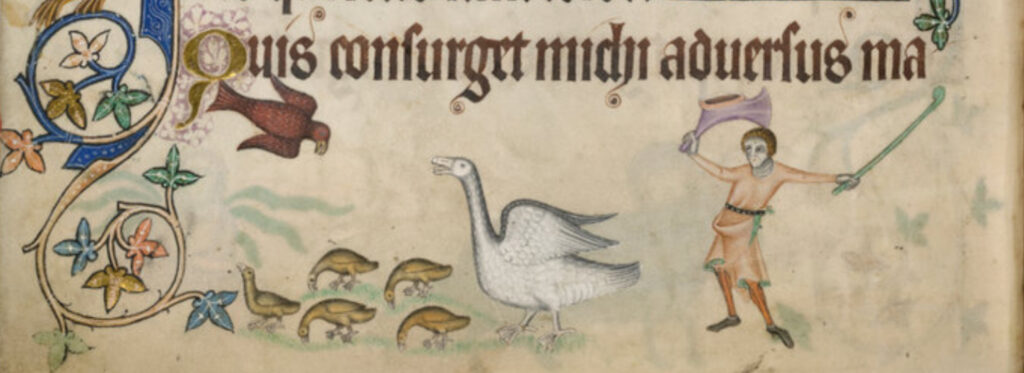
Aforementioned goose image. I like how scary the goose is. Very lifelike. Kinda looks like it has teeth.
The woman feeding her hen and her chicks. I really like the multitasking going on here with the distaff and spindle tucked under her arm. Also, I like the chick on the hen’s head.
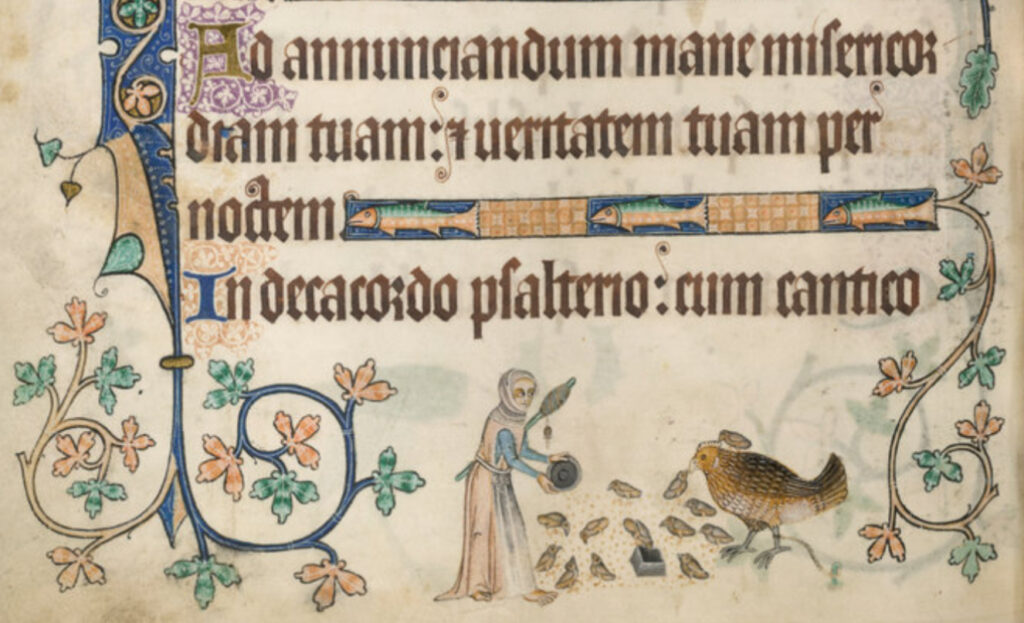
Speaking of the psalter’s depictions of the mundane, next time, I’ll be discussing our subject. From this image, we get the main source for our textile ventures, and the first leg of this project aside from research. Make sure to come back Wednesday to see what I’ll be proudly strutting about the Medieval Feast and likely Buskirk Field in. Again, thanks for reading- see you next week!
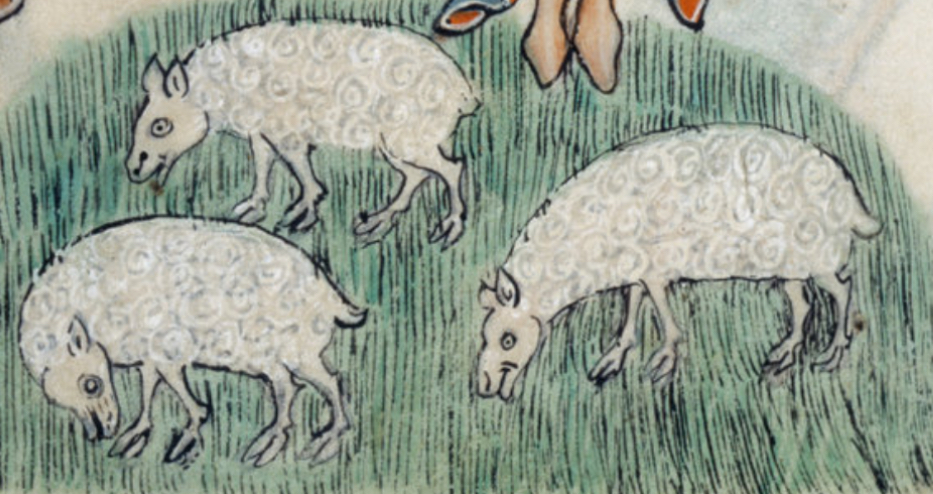
…A preview? They look so polite.
REFERENCES
Backhouse, Janet. The Luttrell Psalter. London: The British Library, 1989.
Brown, Michelle P. The World of the Luttrell Psalter. London: The British Library, 2006.
Camille, Michael. Mirror in Parchment : The Luttrell Psalter and the Making of Medieval England. Chicago: University of Chicago Press, 1998.
Loven, Pauline. Historical Background : Fourteenth Century Dress and the Luttrell Psalter. London: Bloomsbury Publishing, 2024.