Welcome back to the Norse Supper Club.
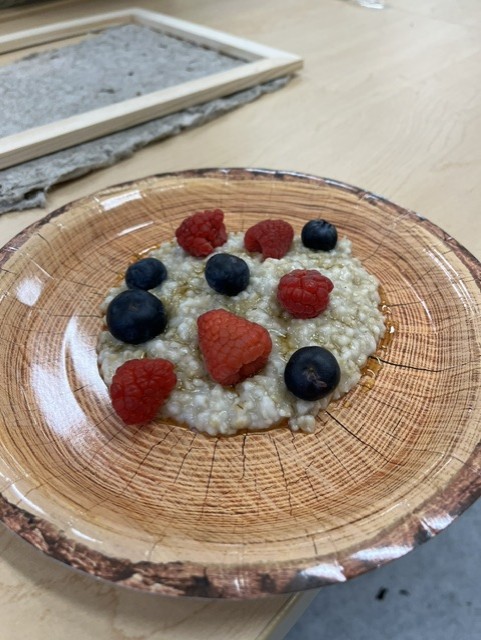
This week, we will be attempting to tackle a Norse staple that’s still commonly eaten: Porridge. All the ingredients used this week came from Walmart. I was originally going to make barley porridge, but once again, I was defeated by the lack of barley in this area. This recipe, in theory, is easy and straightforward (the opposite of the stew). However, before I made this recipe, I found myself asking the common question: What is the difference between porridge and oatmeal? I am a very picky eater, and oatmeal has always been on my list of things I wouldn’t touch with a nine-and-a-half-foot pole. To me, it just didn’t look very appetizing, just kind of like a wet mush. I don’t even eat cereal, as it has the same effect on me. However, the allure of making something that Harald Hardrada’s followers would have eaten on their way to invade England enticed me.
However, the allure of making something that Harald Hardrada’s followers would have eaten on their way to invade England enticed me.
This recipe seemed pretty straightforward, with only three major steps:
- Rinse the grain.
- Add grain to a pot of boiling water and simmer for 30-54 minutes (perhaps longer, as you will see below), while stirring.
- Add extras—berries, nuts, honey.
This simple recipe ended up taking three whole hours to finish. Once again, I was subject to a lack of material. The first step, rinsing the grain, had to be done in plastic cups I was able to find (definitely not steal) in Harris Hall. As I was using rather small plastic cups, I had to do a few batches to get the desired amount (about 1 cup). There was some debate among my colleagues and I as to how well the oats needed to be cleaned—we weren’t sure if they needed to be rinsed until the water was clear like rice or if “it would buff.” We arrived at the conclusion that the Vikings probably didn’t care that much, so we would do a rinse or two and call it a day.
While I was doing this, I was able to get some free entertainment. Another project going on next to me was paper making; Dr. Diener and Matthew Black were attempting to make paper out of flax. Up to this point, they had tried various methods, but they kept running into the problem of the fibers being too coarse. So their solution was to use a food processor…only the food processor, when filled with water and flax, wanted to jump off the table. It took the combined efforts of Dr. Diener, Matthew, and Noah to hold it down and together as it seemed to want to tear itself apart.
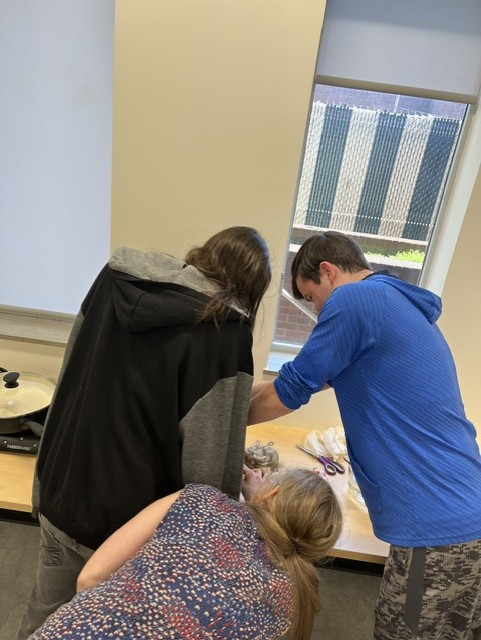
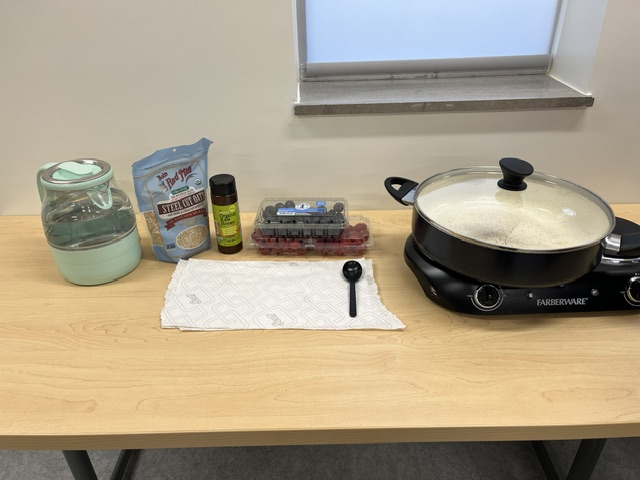
While witnessing the free entertainment, I waited (and waited) for the water to finally boil. Once I achieved a rolling boil, I added the oats and began stirring. It is very important to constantly keep the oats moving, otherwise they would stick to the pan. I just didn’t expect to stir for hours. As previously mentioned, I have never made oatmeal/porridge, or even really tried it. So, I had to have a tester. Luckily for me, though, Dr. Diener, oatmeal connoisseur, was stuck in the same room with me, working on another project. I believe she probably had about half a dozen samples before we finally called it a day. It took three hours to make this porridge. Three. For a civilization that lived, on average, to the age of 50, spending 3 hours per batch of porridge sounds like a heck of a long time. In hindsight, I was using a hotplate that couldn’t really keep heat, and a skillet that was too large, so I had to keep rotating it. I hope that, in the future, I’m able to make things more authentically, like cooking over open flame, and get more of an appreciation for how they would have cooked.
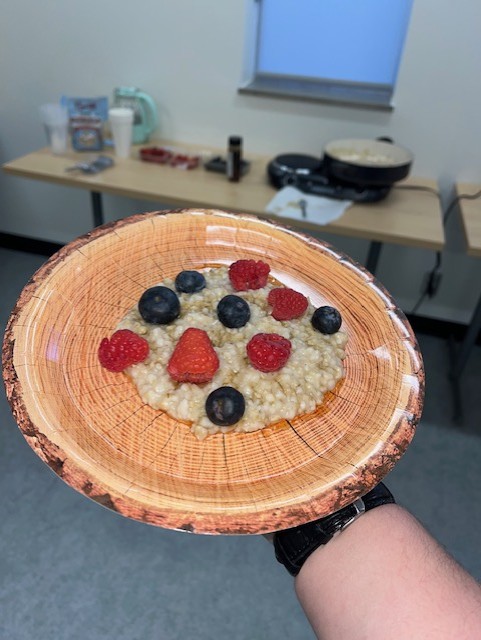
Once finished, I plated and added some fruit, raspberries and blueberries, along with some honey for additional flavor. It looked appetizing, and even smelled good. So, I tried it. As a very picky eater, I quite enjoyed it. It’s a very neutral flavor, perfect for mornings where a light meal is preferred. The texture wasn’t terrible, generally soft (with a bit of crunch, since remarkably, three hours was not enough to cook the oats all the way through); I did find myself underwhelmed, though. It was fine, but ‘fine’ isn’t exactly what I’m going for. The stew and the porridge are rather simple foods that are common today. I want to make something more unique, something unique to this culture. I know that the Norwegians today are renowned for their fish, which I imagine is deep-seated in their connections to the sea. I fancy myself as something of a canned sardine enthusiast and seafood lover, so I think one of the next couple of recipes may include fish.
As always, if you get the hankering to make this recipe yourself, comment on your experience below and include a picture!
In researching porridge, I was able to find a passage from Eyrbyggja’s Saga, that discusses the frustrations of making porridge:
“Thorleif Kimbi was the allotted mess-ward, and had to make porridge. Arnbiorn was aland and made porridge for himself, and had the mess-kettle which Thorleif was to have afterwards. Then went Thorleif aland and bade Arnbiorn give him his kettle, but he had not yet made his own porridge, but stirred the kettle while Thorleif stood over him. Now the Eastmen called aland from the ship and bade Thorleif get ready the meat, and said that he was just an Icelander because of his laziness. Then Thorleif lost his temper, and caught up the kettle and cast out Arnbiorn’s porridge, and then turned away. Arnbiorn had the stirring-stick in his hand, and therewith he smote at Thorleif and caught him on the neck, and the blow was not great, but whereas the porridge was hot, Thorleif was scalded on his neck. Then Thorleif said: “These Northmen shall not mock us, since we be here two fellow- countrymen together, that they must needs drag us apart like dogs; but I shall mind me of this when we are together in Iceland.”
Or, in modern English:
Thorleif drew the short stick to be the cook for the crew, meaning he had to make a large batch of porridge. Arnbiorn, already ashore, was using the only cooking kettle they had to make porridge for himself. Ever the rowdy, boisterous bunch of seafaring Eastmen, they began shouting and taunting Thorleif from the ship, calling him a ‘lazy Icelander’, and ‘good for nothing’. Fed up with waiting to make crew’s meal and the taunting, Thorleif grabs the kettle, and dumps Arnbiorn’s porridge right onto the ground. In retaliation, Arnbiorn gives Thorleif a good whack on the neck with the scalding hot stirring stick, burning him. Thorleif’s response of “These Northmen aren’t going to make us look like idiots. We’re countrymen, and they’re making dogs out of us. But once we’re back in Iceland, you better watch your back.” I think I would probably beat someone with a spoon if they dumped out the porridge I had spent hours on, too.
References
Viking Ship Museum, Roskilde. “Food in Viking Times.” Viking Ship Museum, n.d., www.vikingeskibsmuseet.dk/frontend/Dokumenter/Food_2_EN.pdf. Accessed 24 May 2026
Eyrbyggja Saga (The Saga of the Ere-Dwellers). Translated by William Morris and Eirikr Magnusson, Icelandic Saga Database, sagadb.org/eyrbyggja_saga.en. Accessed 8 April 2026.
Porridge
Cook time: 35-65 minutes (or 3 hours)
Prep Time: 10 minutes
Serves: 2-4
Ingredients:
- 1 cup steel-cut oats
- 3 cups water
- Pinch of salt
- Raw honey
- Blackberries and raspberries
- Nuts (choose from hazelnuts, walnuts, or almonds)
Instructions:
- Rinse the oats. Place steel-cut oats in a bowl or strainer. Rinse once or twice with cold water.
- Boil the water – Bring 3 cups of water to a rolling boil. Add a pinch of salt.
- Add oats and simmer uncovered, stirring frequently to prevent sticking.
- Cook until tender for 5 minutes, then rest for 30-60 minutes.
- Finish and serve. Once the oats are soft, spoon them into bowls. Top with blackberries, raspberries, a drizzle of raw honey, and a sprinkle of crushed hazelnuts or other period and location-appropriate fruits/nuts.
I think I would probably beat someone with a spoon if they dumped out the porridge I had spent hours on, too.