“Who in life we dearly cherished and who in death we cannot cease to love.” – King Edward 1
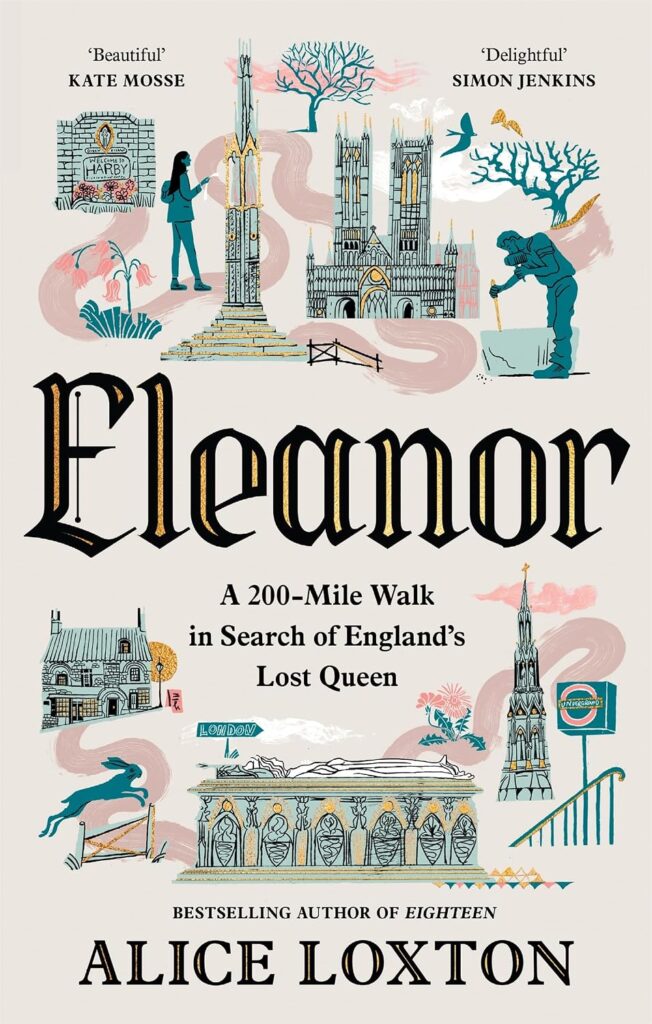
Nearly a year ago, I had the pleasure of reading Alice Loxton’s novel Eighteen: A History of Britain in 18 Young Lives. The book was a brilliantly subversive take on the academic genre, in which the British historian, author, and broadcaster undertook the daunting task of shepherding her readers through thousands of years of British history within a single work. I am sure both instructors and students alike can appreciate the labor of this endeavor. Even so, Loxton stepped up to the challenge of maintaining her reader’s attention through a sea of facts and figures. She imbued her book with humor, wit, curious facts, storytelling, and a little splash of historical fiction to render the experience so enjoyable that the reader feels as if they bounded rather than trudged across the moors of British history.
Loxton uses the same stylistic approach in her latest book, Eleanor: A 200-Mile Walk in Search of England’s Lost Queen. Here, she exemplifies the concept of ‘living history’ by traversing on foot the same path from Lincoln to London that Queen Eleanor of Castile’s 1290 funeral cortege followed; a melancholic display of the ever-present shadow of death over love, forever commemorated by the construction of twelve stone crosses. Loxton chose this unorthodox method of historical inquiry because of the fresh insights gained through kinesthetic modes of learning Loxton explains:
I am not a man and my talents are questionable, but I hope these observations may do just that: bring history out of the gloomy shade and inspire you to uncover the stories that lie in your town, wherever in the world that may be. These are stories to be celebrated, cherished and passed down through generations. . . It was only by walking, by travelling the natural human pace, that these unexpected revelations arrived. I saw so many things I wouldn’t have done from a bike, car, or library desk (14-16).
And what more immersive and intimate way to learn history than through the eyes of a woman who, despite her royal titles and the tumultuous events that occurred during the time she walked this earth, was, in many ways, much like the modern reader?
And what more immersive and intimate way to learn history than through the eyes of a woman who, despite her royal titles and the tumultuous events that occurred during the time she walked this earth, was, in many ways, much like the modern reader? Through Eleanor’s eyes, readers get to perceive the intensity of the Reconquista, the Crusades, and the Second Barons’ War. Yet, we also get to see a woman who was very much real rather than simply legendary. Based on what source material is available, Eleanor was likely an independent, firm-minded, business-savvy woman, a Miranda Priestly if you will, who faced the same misogynist, religious vilification and condemnation that today’s women of the workforce still strive to overcome. A woman who suffered the anguish of miscarriages and stillbirths, as well as the uncertainty of being an immigrant in a foreign land. A woman who loved beyond measure a man who was her soulmate in every sense of the word. This focus on Eleanor’s story reflects Loxton’s distinct stylistic framework of using a single individual’s experience to humanize the past; their life’s story becomes the keyhole readers use to peek beyond the closed door of bygone eras and get a glimpse of what the world was like back then.
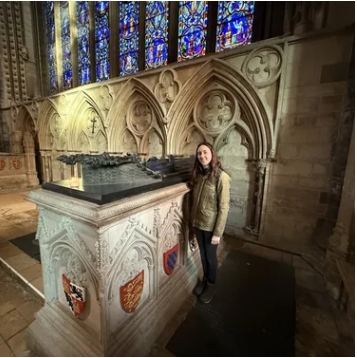
https://aliceloxton.com/eleanor-book
As Loxton reflects:
I find this comforting. The past is full of ordinary people like you and me, driven by the same emotions. Have you ever felt the desperate ache of unrequited love? Or the deep humiliation and sorrow on realising a partner has been unfaithful? Perhaps a particular scent catches you off guard, bringing memories of a loved one, no longer around. All these emotions we share with ancestors past. These are moments of vulnerability that bind us across time (16).
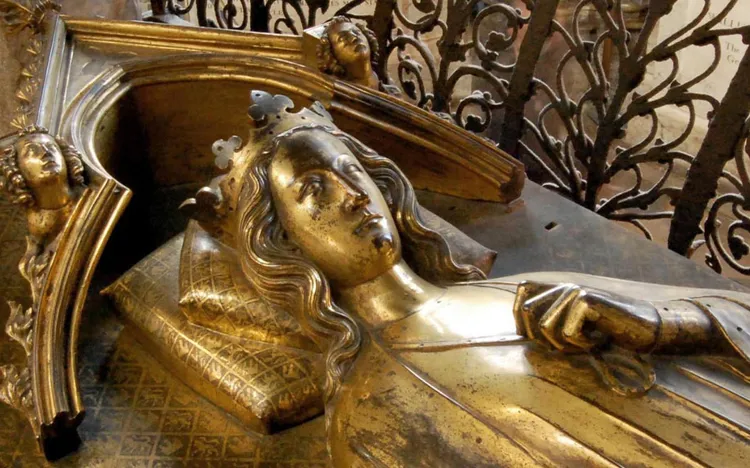
Readers may be surprised to find a sympathetic and human portrait of Edward I, whose character is often simplified in the interest of storytelling, such as in Mel Gibson’s 1995 hit film Braveheart. While the movie casts Edward as a purely tyrannical figure, a man whose only personality traits were cruelty and military dominance, Loxton draws attention to the parts of Edward that might have shown forth in his private life. Vulnerable and distinctly human qualities that, in moments seldom witnessed, were exhibited publicly as he marched on Roman roads in front of the procession carrying the embalmed body of his beloved wife and confidant. Loxton speculates, in those moments in which Edward’s lungs were adjusting to breathing the air of a world in which Eleanor was no more, what was going through the head of “this great and terrible king (who) would now – for the first time in thirty-six years – face the world alone” (31). If Edward, lying in his bed in Northampton Castle while Eleanor’s body was being watched over by the nuns of Delapre Abby, had the same thoughts as Loxton did while lying in her room at the Premier Inn. If he too was haunted by the painfully serene image of “the flickering candlelight softly illuminating Eleanor’s pallid cheeks, dancing across her wrinkled eyelids. Around her, several women standing, clothed in black robes. Some silent. Others singing laments, their breath visible in the cold air” (165).
Yet, from an alternative perspective, Loxton recognizes the validity of those to whom Edward was an antagonist. Edward ruthlessly invaded Wales, Scotland, and Ireland. The Welsh kingdoms perhaps suffered the most brutal efforts of Edward’s campaigns and still suffer an underlying reminder of the humiliation of their defeat and subordination to England. After defeating the native Prince of Wales and resistance leader Llywelyn ap Gruffudd in 1282, the title Prince of Wales was given to Edward and Eleanor’s son Edward II; the title is still held by the British monarchy and bestowed upon the heir apparent to the British throne. The Welsh dragon is nowhere to be seen on the Union Jack or the Royal Standard; only England, Scotland, and Northern Ireland have visible representation of their place and consideration within the monarch.
Eleanor was a renowned and respected Catholic figure, resulting in the destruction of much of her artistic legacy during the English Reformation and Civil War. For those of the Jewish faith, however, she was a willing accomplice to their institutional and social abuse. Under Edward’s reign, the Jewish people were financially exploited and publicly killed for unproven crimes such as coin clipping and Blood Libels. Edward directly benefited from cheating his Jewish loaners out of money to save the royal household from financial collapse. Just a few months before Eleanor’s death, he signed the Edict of Expulsion, forcing Jewish people to either convert or leave the country, resulting in their properties being seized. While Loxton advises her readers to keep in mind the cultural conventions of medieval England, she emphasizes that it does nothing to justify or remove the suffering imposed on those at the bottom of the hierarchy. Loxton grapples with this ever-present challenge of historic admiration as she compares Eleanor’s loving funeral cortege to the dragging of a hanged Jewish woman’s body. Loxton writes, “How strange: Eleanor and Belaset – both wealthy women in England, both died in 1290, near Lincoln, in such different circumstances” (64).
During her reflective modern pilgrimage across England, she invites her readers to consider the complex and bittersweet taste of the human experience
Ultimately, Loxton explores Eleanor’s legacy and how the thread of her life is woven into the tapestry of Britain beautifully. During her reflective modern pilgrimage across England, she invites her readers to consider the complex and bittersweet taste of the human experience. That we share with our ancestors our capacity to be romantics, whether flushed with joy or succumbing to broken hearts. Loxton presents history as more than the written words hidden within a dusty library book but rather a dynamic thread intertwined around the moving bodies of the living, never ceasing to enlarge the tapestry of the story of us. I have only been able to highlight a few of the delightful and fascinating stories and tidbits that Loxton writes about in her book. I encourage everyone to read and experience the entirety of her journey searching for Eleanor themselves and perhaps gain a new favorite medieval Queen!