If you need a refresher, reread Harald Hardrada part I here:
https://norsebygod.com/featured/the-hoard/the-enduring-exile-harald-hardrada-part-i
When we left off, Harald Sigurdsson was at the peak of his exile: he was a legend in the making, his coffers were engorged with Byzantine gold, and he now bore the title of Hardrada, the “Hard Ruler,”–a name which whispered both respect and fear, forged with the strict discipline of the Varangian Guard. For Hardrada, however, the ultimate prize, the crown of Norway, lay in wait a continent away. His path now turned homeward, but this journey would be no simple return; rather, it would be a calculated campaign of force, wealth, and alliance, the final test for a king in waiting.
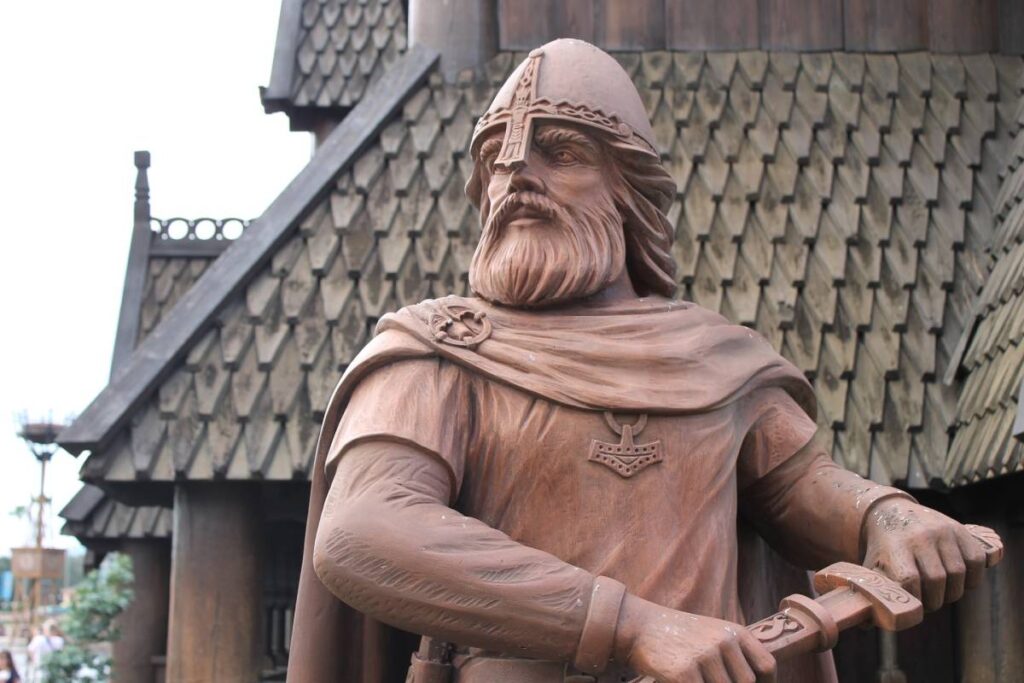
Hardrada’s departure from Constantinople was just as dramatic as his service there, with tales of imperial disfavor and daring escapes. He sailed northward, not to the fjords of Norway, but to the halls of Kyivan Rus’,. It was here that King Yaroslav the Wise greeted the once young lieutenant, now transformed into a wealthy prince and proven commander. Together, they forged a bond not of old comrades, but of politics: Harald was to marry Yaroslav’s daughter Elisiv.
Hardrada was by no means a romantic; he was a ruthless, calculating medieval powerhouse. Aspiring kings used every tool at their disposal to form, as historian Anders Winroth puts it, “social bonds as strong as family ties.” A royal marriage was the best tool for that job; it ritualized alliances that turned a foreigner into a dynamic insider, a part of the family. For Hardrada, it secured a powerful ally to the east, turned a former refuge into a strategic steppingstone, and most vitally, it legitimized him. It is vital to note that his first act as a king-in-waiting was not to draw a sword, but to forge a kinship.
It is vital to note that his first act as a king-in-waiting was not to draw a sword, but to forge a kinship.
From Kyivan Rus’, he traveled to Sweden and practiced pure realpolitik. He formed an alliance with his own nephew, Magnus the Good, son of his half-brother, the saint-king Olaf. Magnus held Denmark and a claim to the throne of Norway himself, but such claims are just as good as useless without the means to back them up. It is here that Harald’s years of looting the Mediterranean paid off. They struck a deal: they would pool their resources. Harald’s hoard of liquid wealth would be used to raise an army, and together, Harald and Magnus would co-rule Norway.
This pact reveals just how power worked in Scandinavia at the time. Ambitious leaders competed for warriors not by coercion or force, but through gift-giving. A prince with hoards of gold would find that followers would naturally gather around his banner. For Hardrada, the Byzantine treasure he brought with him would be the foundation of his political influence. By simply outspending his rivals, he was able to form the largest following. His partnership with Magnus was a temporary merger of assets: Magnus contributed his legitimate bloodline and already existing power. At the same time, Harald provided battle-tested military leadership and seemingly bottomless amounts of wealth. In 1046, the two entered Norway as Joint kings. This delicate power-sharing arrangement was a form of mutual necessity, not of trust.
The uneasy partnership came to an abrupt end when Magnus suddenly died in 1047, leaving Norway solely under Harald’s control. The exile had returned, and the real work of kingship had begun. The next two decades saw Harald earn the title of Hardrada in full unquestionable measure. Snorri Sturluson’s narrative, King Haralds Saga states as such:
“[Harald] ruled Norway by iron discipline and force of arms, and terrorized neighboring Denmark by constant raiding expeditions.”
His rule was that of consolidation and total control. He would go on to ruthlessly crush regional insurrections and impose heavy taxes; he believed that the gold spent to win the throne must be replenished. He constantly and relentlessly warred with Denmark, a fact that defined his reign. He applied the unforgiving discipline of the Varangian Guard to the governance of the realm. He moved far beyond the chieftain’s art of gift-giving, creating the authority of a Finnish state. Perhaps his most enduring legacy is the city of Oslo. It was to be a royal power center, a hub of trade and control, born of his idea for a unified Norway.
By the year 1066, Harald’s power was secure, yet he was still restless. The same ambition and drive that propelled him from a teenage fugitive to an emperor’s commander to a now-feared king sought a final, cumulative outlet. The death of the childless King of England, Edward the Confessor, saw the succession to the English throne thrown into chaos. Harald saw a thin thread of opportunity, a forgotten treaty between the late co-king, Mangus, and an earlier English ruler, Harthacnut. For a man of Harald’s ambition, a thread was enough.
King Harald’s Saga sets the scene:
“The year 1066 was a convulsive and fateful year for the destiny of England and western Europe.”
It would be the year that the three great titans of Europe would clash: Harald of Norway, Harold of England, and William of Normandy. Harald was now “the most feared warrior in northern Europe, the last of the formidable Vikings of Scandinavia.” At the age of fifty-one, he embarks on the most ambitious task of his life, the conquest of England.
The former exile, now a feared king, had at last turned his gaze beyond his own horizon. The drive that forged a mercenary into a monarch will now gamble it all on the beaches of a foreign kingdom. The stage was set for his final bloody act that would end the Viking age and score the name Hardrada permanently into the books of history.
Further Reading
Esposito, Gabriele. Armies of the Vikings, AD 793-1066 History, Organization and Equipment. Pen & Sword Military, 2023.
Snorri Sturluson, et al. King Harald’s Saga: Harald Hardradi of Norway: From Snorri Sturluson’s “Heimskringla.” Penguin Books, 1984.
Winroth, Anders. The Conversion of Scandinavia: Vikings, Merchants, and Missionaries in the Remaking of Northern Europe. Yale University Press, 2014.