By 1066, Harald Sigurdsson had achieved what few men had ever dared to dream. He had returned from exile, seized the throne of Norway for himself, and ruled for two decades with the ferocity and brutality his name demanded. His warriors had been the most feared in the North, his treasury was engorged with Byzantine gold, and his epithet—the “Hard Ruler”—had been proven true with unquestionable measure. For lesser men, a secure throne may very well have been enough, but for a man whose soul and entire being had been defined by ambition, it was not. Across the sea, England was seething with opportunity, and Hardrada would not hesitate to seize upon it.
Following the death of King Edward the Confessor earlier that year, the English throne had been catapulted into a succession crisis. Several claimants emerged, each with their own story. Among them was Hardrada. His claim rested upon an old and long-forgotten agreement made decades ago between his now deceased co-ruler, Magnus the Good, and Harthacnut, King of England. The deal stipulated that if either died without an heir, the other would inherit his kingdom. However, when Harthacnut died in 1042, Edward the Confessor took the throne for himself, despite the deal and Magnus’ claim. Hardrada later used the claim, arguing that it applied to him when he became Magnus’ co-ruler. From multiple interested claimants, three formidable contenders emerged–Harold Godwinson, King of England; Harald Sigurdsson, King of Norway; and William, Duke of Normandy.
For lesser men, a secure throne may very well have been enough, but for a man whose soul and entire being had been defined by ambition, it was not.
For Hardrada, the claim was justification enough. Nevertheless, ambition often requires a spark, and for Harald, that spark arrived in the form of Tostig Godwinson, the exiled brother of King Harold of England. Tostig had been stripped of his titles and land in Northumbria by his brother Harold and was fuming with revenge. After failing to gain any real support elsewhere, he decided to sail to Norway, to the court of Harald, where he told tales of northern discontent and English weakness. The sagas record that Tostig promised a host of English allies would, in the case of an invasion, flock to Harald’s banner. Whether Tostig Godwinson knew this to be true or was simply telling Harald what he wanted to hear is largely unknown, but ever the opportunist, Harald listened.
In September of that year, Hardrada embarked on the most ambitious campaign of his infamous career. He assembled a fleet that, according to the sagas, numbered some three hundred strong, carrying an estimated nine thousand warriors, and set sail for the British Isles. It was the largest Viking invasion force to knock on England’s doorstep in a generation. Hermann Pálsson and Magnus Magnusson, editors of King Harald’s Saga, state emphatically, “by 1066 he was the most feared warrior in northern Europe, the last of the formidable Viking kings of Scandinavia; and at the age of fifty-one he embarked on the most ambitious enterprise of his relentless career—the conquest of England.”
Hardrada’s fleet slithered its way down the coast of Yorkshire, and on the 20th of September, Harald met the northern army of England under the command of the Earls Edwin of Mercia and Morcar of Northumbria at Fulford, just south of the city of York. It would be a savage and decisive battle. The Norwegian poet Stein Herdisarson, whose verses Snorri Sturluson preserved, celebrates the great victory:
“Many were lost in the water,
They drowned sank to the bottom.
Warriors lay thickly fallen
Around the young Earl Morcar…”
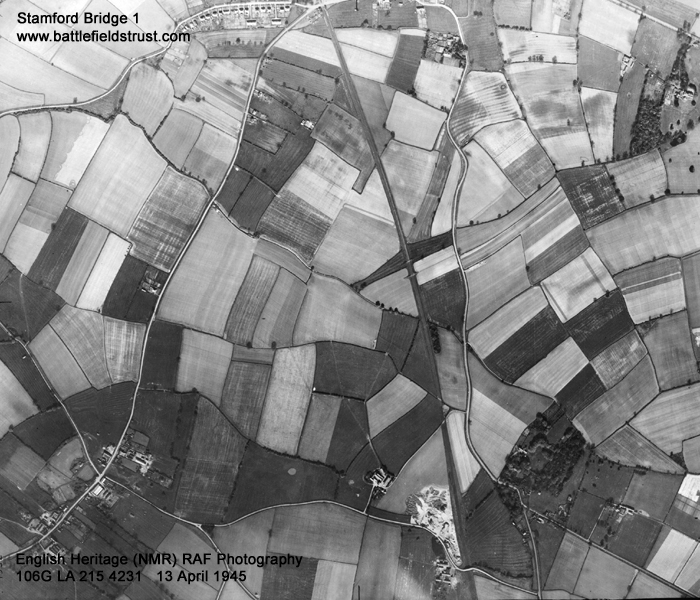
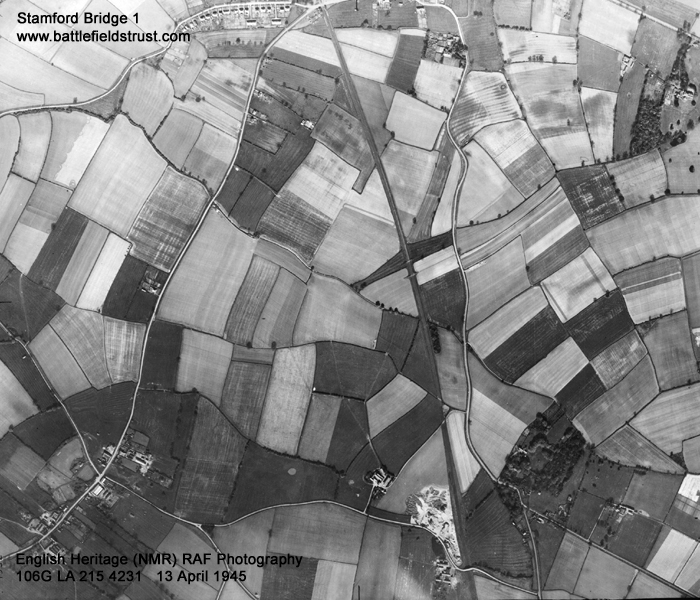
The English were routed. York, the great northern city, surrendered to Harald. He accepted the townspeople’s hostages and, intoxicated with the bliss of victory, retired his army to Stamford Bridge, some seven miles to the city’s east, to await the formal and total submission of the surrounding areas. It would prove to be a fatal decision.
Unbeknownst to Hardrada, Harold Godwinson of England arrived with an army on the eve of September 24th. In only four days, he had marched his army nearly two hundred miles from London—a monumental feat of endurance. The English army spent that night inside York’s walls, hiding their presence from the Norwegians camped at Stamford Bridge.
Hardrada and his men slept soundly that night, dreaming of glory. While across the river, just behind the walls of York, the man who would give him seven feet of English ground lay in wait, preparing his men for victory.
Hardrada and his men slept soundly that night, dreaming of glory. While across the river, just behind the walls of York, the man who would give him seven feet of English ground lay in wait, preparing his men for victory.
On Monday, September 25th, 1066, dawn was warm and sunny. Hardrada ordered his men to prepare for the short march into York to receive the final surrender. According to Snorri Sturluson’s account, the weather was so fine that “the troops left their armor behind and went ashore with only their shields, helmets, and spears, and girt with swords. A number of them also had bows and arrows. They were all feeling very carefree.”
As the Norwegian column approached the bridge spanning the River Derwent, they observed a large thundering force approaching. The dust kicked up from the horses’ hooves created a high-reaching cloud, and within it, Snorri writes: “the gleam of handsome shields and white coats of mail” glittered like “a field of broken ice.”
It was, in fact, the King of England, Harold Godwinson, and his army.
Ever the cool-headed veteran of countless victories, Hardrada did not panic. He had his men draw up in a long, thin line, curving the wings back into a circular shield-wall, with his own hand-picked retinue and his famous banner, “Land-Waster,” front and center. Additionally, he dispatched riders to return to the fleet for reinforcements.
Before hostilities began, an infamous exchange of words occurred. Twenty horsemen from the English side rode up to the Norwegian lines. A rider called out: “Is Earl Tostig here in this army?”
Tostig replied that he was.
The rider delivered a message directly from the King of England: Tostig would be granted a reprieve, peace, the entirety of Northumbria, and a third of the whole kingdom if he would simply abandon Hardrada. Tostig hesitated, then asked: “If I accept this offer now, what will he offer King Harald Sigurdsson for all his effort?”
The rider’s response will forever echo through history:
“King Harold has already declared how much of England he is willing to grant him: seven feet of ground, or as much more as he is taller than other men.”
Tostig refused, and the horsemen rode back.
Harald, after observing the exchange himself, asked Tostig who the speaker was. When Tostig revealed it was King Harold in the flesh, Harald was shocked. “I should have been told much sooner,” he said. “These men came so close to our lines that this Harold should not have lived to tell the deaths of our men.”
Tostig responded: “It is quite true, sire, that the king acted unwarily, and what you say could well have happened. But I realized that he wanted to offer me my life and great dominions, and I would have been his murderer if I had revealed his identity. I would rather that he were my killer than I his.”
As Harald gazed at the retreating King of England, he remarked, “What a little man that was; but he stood proudly in his stirrups.”
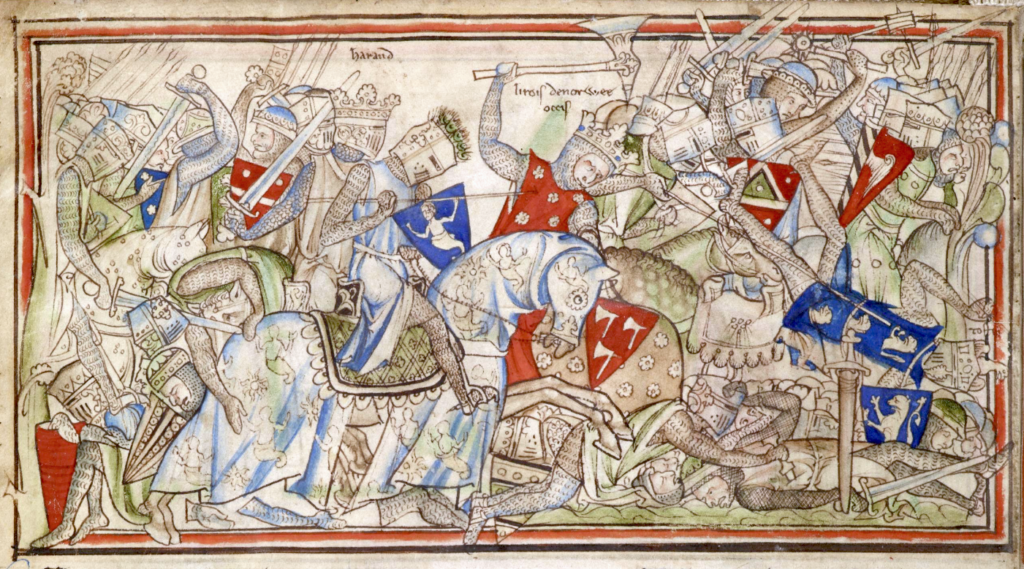
The battle that soon followed would be among the most devastating in the Viking Age. The English cavalry charged without discrimination over and over, but the Norwegian shield wall did not give. Harald, full clad in battle fury, rushed ahead of his troops, fighting two-handed.
The poet Arnor the Earls’-Poet captured the scene:
“Norway’s king had nothing
To shield his breast in battle;
And yet his war-seasoned
Heart never wavered.Norway’s warriors were watching
The blood-dripping sword
Of their courageous leader
Cutting down his enemies.”
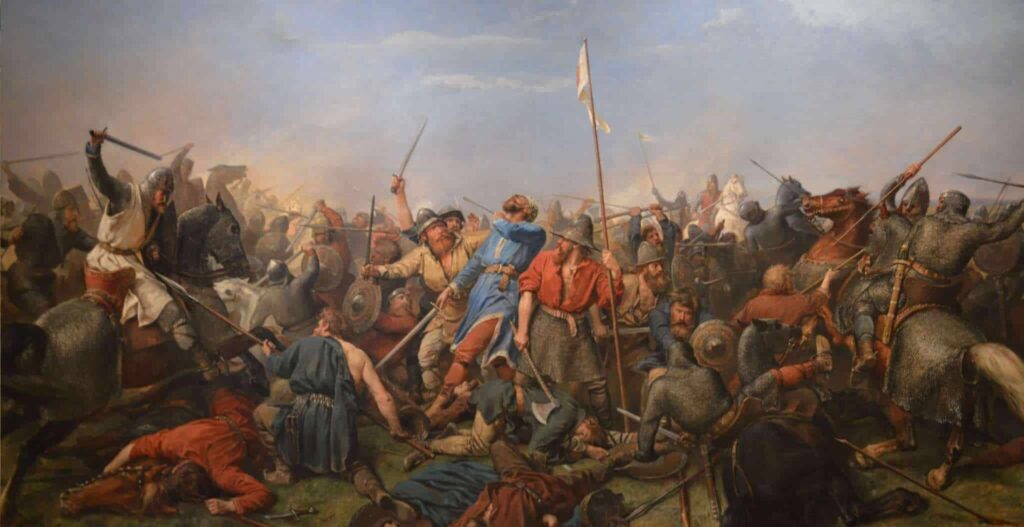
But as history has repeatedly proven, no man has a monopoly on luck. According to Snorri’s account, Harald caught an English arrow in the neck, and as Snorri writes, “and this was his death-wound. He fell, and with him fell all those who had advanced with him.”
The battle did not end there. The King of England again offered quarter to his brother and the surviving Norwegians. The Norsemen, in unified, epic defiance, “shouted back with one voice that every one of them would rather die than accept quarter from the English.” With that, the fighting resumed.
Then, reinforcements from the fleet arrived, brought by one of Hardrada’s best men, Eystein Orri. These men had run miles without stop in their heavy coats of mail and were nearly exhausted before even reaching the battlefield. Despite this, they threw themselves into the battle with such ferocity that this final phase became known as Orri’s Storm. According to saga tradition, so vicious was their fighting that they cast off their mail to fight unencumbered, leaving themselves completely exposed to the English. Many died without a single inflicted wound, rather from exhaustion.
By sundown, the bloodbath was over. Nearly all Norwegians lay dead where they fought. Tostig was killed. The army that bravely fared the North Sea in three hundred ships was no more.
Just three days later, on the 28th of September, William of Normandy, along with an army seven thousand strong, landed on the southern coast of England. And, as the story goes, William and Harold met on the 14th of October at Hastings. The King of England, exhausted from the carnage at Stamford Bridge, met his demise with a Norman arrow to the eye (though some historians argue he was cut down by cavalry). The Norman Conquest had begun.
With the successful invasion of William and his army, England was forever transformed, and perhaps with the exception of the Glorious Revolution in 1688, has never been conquered by a foreign force again—not by the Norwegians, not by the French, not by the Germans.
The death of Harald Hardrada was far more significant than the end of one man’s ambition. It was, as the saga’s modern editors Hermann Pálsson and Magnus Magnusson note, “the end, to all intents and purposes, of the Viking era that so coloured the politics of medieval Europe, the end of 350 years of Scandinavian harassment of England.” Harald Hardrada, the exile who fought with brutality from the golden halls of Byzantium to the fjords of Norway, who ruled with terror and an iron fist, fell in an English field. With his death, the Viking Age met its end.
The final resting place of Harald Sigurdsson remains unknown. Following his death at Stamford Bridge, his body was taken to Trondheim, Norway, where it was interred inside St. Mary’s Church. He was later moved to Elgeseter Priory, approximately 100 yards away. The priory burned in 1564, and the location of Harald’s burial chamber was subsequently lost. In 2019, archaeologists from the Norwegian Institute for Cultural Heritage (NIKU) uncovered what appears to be a burial chamber at the priory site. The institute reports that the chamber was placed near what once was the altar, suggesting the resting place of someone of high status. However, to date, no evidence linking the chamber to Hardrada has been published.
Further Reading
Esposito, Gabriele. Armies of the Vikings, AD 793-1066 History, Organization and Equipment. Pen & Sword Military, 2023.
Norwegian Institute for Cultural Heritage (NIKU). “Are the remains of the Viking king Harald Hardrade under the pavement in Trondheim?” August 13, 2019. https://www.niku.no/en/2019/08/ligger-harald-hardrade-under-asfalten-i-klostergata/
Snorri Sturluson, et al. King Harald’s Saga: Harald Hardradi of Norway: From Snorri Sturluson’s “Heimskringla.” Penguin Books, 1984.
Winroth, Anders. The Conversion of Scandinavia: Vikings, Merchants, and Missionaries in the Remaking of Northern Europe. Yale University Press, 2014.