The feast was chaotic, lively, fragrant with spices and smoke, and deeply human.
When I walked into our Celtic Feast (our final exam for History 464: Celtic Britain), armed with my slightly uneven Pictish-inspired stone and a tray of meat pies packed with more kidney suet than anyone should legally endorse, I felt a bit like a medieval apprentice craftsman who had skipped several days of training due to plague. And yet, like any good medieval saga, somehow everything came together. The feast was
chaotic, lively, fragrant with spices and smoke, and deeply human. In other words, it felt genuinely Celtic, or at least as Celtic as a group of college students in 2025 can reasonably hope to be.
But the feast (and the class) demanded a broader reflection: does “Celtic” even mean anything in the medieval period? After Rome packs up its sandals and leaves Britain to contend with its own political and cultural storms, does the term retain coherence? Or are we using “Celtic” as a convenient academic umbrella to justify a course that moves between saints, sagas, and Pictish symbol stones with the confidence of a medieval PowerPoint presentation? I attempt to answer those questions, anchored in my contributions to the feast and the medieval sources we studied that illuminate how identity, culture, and community were expressed across Ireland, Scotland, Wales, and northern Britain between the fifth and the
thirteenth centuries. Through meat pies, awkward spirals, and texts such as the Goddodin, Bede’s Ecclesiastical History, The Life of St. Brigid, and the Pictish King-List, I argue that while “Celtic” is an imperfect term, it still describes a loose but meaningful constellation of medieval cultural patterns. Enough, at least, to justify our class, and certainly enough to justify that feast.
https://www.undiscoveredscotland.co.uk/forfar/aberlemnokirk/index.html
My Pictish stone, though no museum would display it without substantial explanation,
was inspired by the Class II Kirkyard Stone in Scotland. Class II stones are remarkable works of
cultural synthesis, combining Christian crosses with older Pictish symbol traditions. These
monuments reflect societies negotiating identity through art, blending pre-Christian imagery with
newly adopted Christian motifs. The spirals I painted, though admittedly uneven, were an
homage to that layered visual vocabulary. Spirals, knots, and interconnected forms appear not
only on Pictish stones but in illuminated manuscripts and metalwork across Ireland and Scotland.
Even if my execution looked more “intro to Pictish art” than “master sculptor of the eighth
century,” the symbolic logic behind it reflected genuine medieval aesthetics.
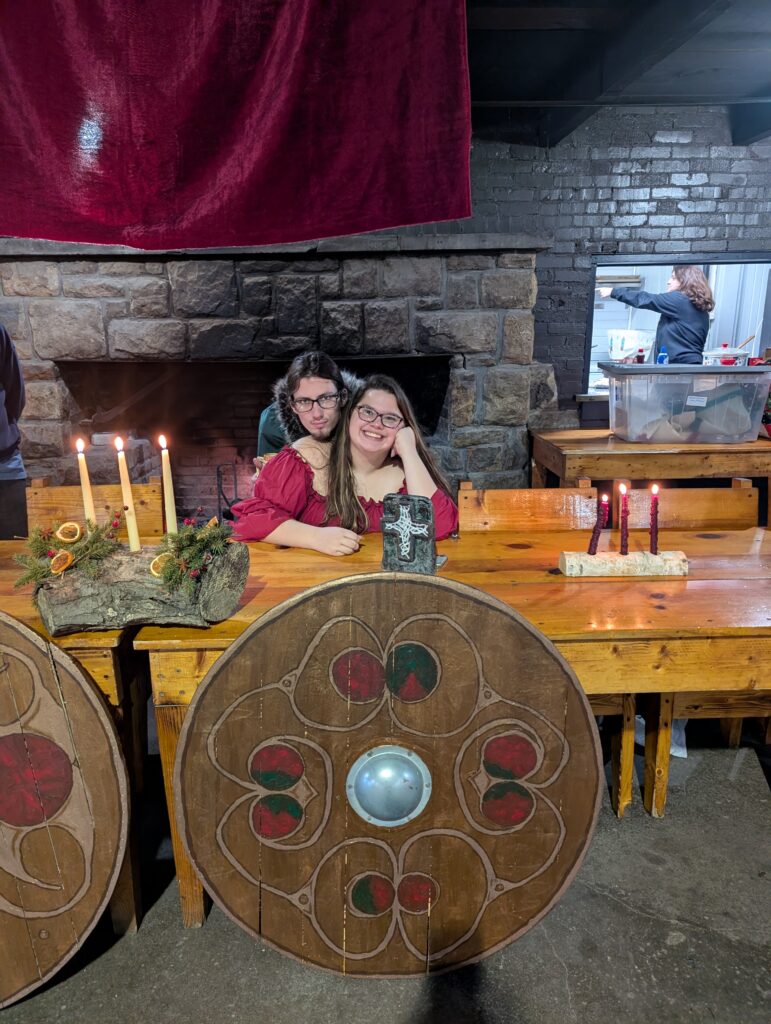
My second contribution, the meat pies, came from a recipe found in a Viking cookbook
whose title has since fled my memory, much like many medieval texts that survive only in
fragments. The pies used ground cube steak and kidney suet, ingredients that would not have felt
foreign in early medieval northern Europe. Suet, especially, is historically appropriate; high-fat
cooking was essential in colder climates, and archaeological evidence shows the importance of
beef and dairy in daily sustenance. I enjoyed that people ended up dunking the pies into the stew
at the feast. That moment felt strikingly medieval, echoing the communal dining scenes
described in Irish sagas and medieval chronicles. Even though the recipe itself was technically
“Viking,” the ingredients and communal consumption resonated strongly with documented food
practices in early medieval Ireland, Wales, and Scotland.
Beyond my own contributions, two aspects of the feast stood out as remarkably Celtic.
Mead is one of the most iconic beverages of early medieval northern Europe, mentioned across
heroic and monastic literature. Mead halls appear not only in Beowulf but in Welsh poetry and
Irish saga traditions. Mead served as a symbol of community, alliance, and storytelling. Drinking
mead at our feast echoed this tradition, connecting us in spirit to the communal spaces that
shaped early medieval culture.
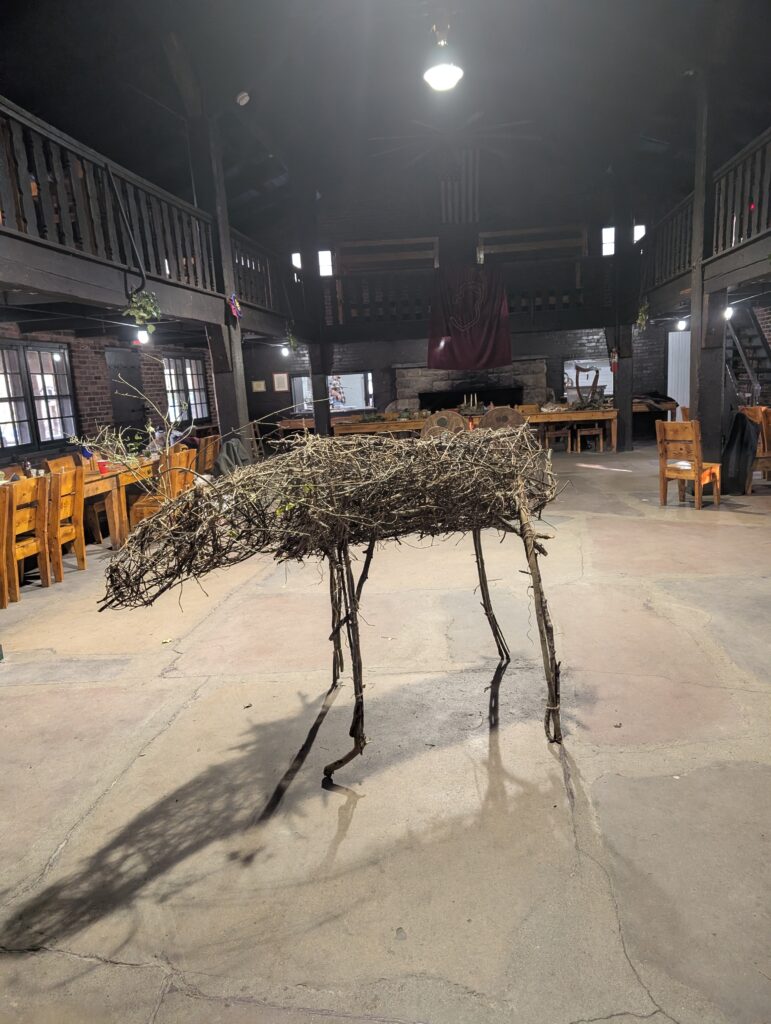
Someone constructed a stag out of sticks and burned it outside—a moment that felt
uncannily ritualistic. Animals, especially stags, appear frequently in Celtic iconography,
mythology, and Pictish stone carvings. Burning the effigy echoed both seasonal rituals and
symbolic associations between the natural world, fire, and community identity. Whether or not
we intended to reenact anything historical, the symbolism aligned with patterns evident in early
medieval material culture.
The question of whether “Celtic” remains a meaningful historical category after the
Roman withdrawal in 410 CE is complex. Identity during this period cannot be reduced to simple
labels; linguistic, political, and cultural landscapes were fluid. Yet the medieval sources we
studied illuminate shared cultural structures that justify comparing Ireland, Wales, Scotland, and
northern Britain under the “Celtic” umbrella.
The Goddodin, attributed to Aneirin, memorializes warriors who died at the Battle of
Catraeth. Although the poem is Welsh, it reflects northern British traditions and reveals cultural
similarities with Irish heroic literature, such as the Ulster Cycle. These include warrior elitism,
the ritual of feasting before battle, and the preservation of memory through bardic recitation. The
warriors in the Goddodin drink mead “sweet upon the lips” before charging to their deaths,
echoing scenes where Irish heroes feast before war. This shared heroic ethos does not prove a
unified Celtic identity, but it does reveal overlapping cultural practices that make comparison
useful.
Bede, an Anglo-Saxon monk, did not consider himself Celtic, but his descriptions of
Irish, Pictish, and British communities reveal shared features that support the usefulness of the
term. He writes about these groups as distinct but interconnected through monastic networks,
Christian practices, literacy, and disputes with Roman authority (especially over the calculation
of Easter). Though Bede attempts to categorize these peoples separately, his commentary
frequently exposes their cultural entanglement. His work shows that Irish, Brittonic, and Pictish
Christianity shared structural similarities that justify studying them together.
One element of the feast that grew more meaningful the longer I reflected on it was how
effortlessly modern students slipped into the social habits that medieval Celtic cultures
considered essential.
Brigid, one of the most influential Irish saints, represents the interweaving of Christian
and older cultural traditions. Her Life highlights the centrality of hospitality, generosity, and
food, features that appear across medieval Celtic societies. Her miracles often involve dairy
products, beer, or the multiplication of food, mirroring the agricultural realities and symbolic
values of early medieval Ireland. Saintly cults like Brigid’s also traveled across Britain and
Ireland, creating religious networks that unified disparate regions. These shared devotional
patterns contribute to the broader cultural category scholars label “Celtic.”
The Pictish King-List is a genealogical record that blends myth, memory, and political
legitimacy. Though fragmented, it reveals connections between Pictish and Irish groups through
shared names, intermarriage, and political alliances. The list demonstrates that kingship in
northern Britain was influenced by cultural exchange, further supporting the argument that these
societies existed within interconnected frameworks. Even when political boundaries were
distinct, cultural practices, especially relating to rulership, show notable similarities.
Shared drinking practices, visible in poetry and archaeological evidence, were central to
community identity. Mead at our feast echoed this tradition and illustrated how communal
consumption structured social relationships. Animal symbolism unifies the material culture of
early medieval Ireland, Wales, and Scotland. Stags appear in carvings, metalwork, and
manuscripts. Fire rituals and effigies reflect cultural associations between nature, power, and
seasonal cycles. Based on the sources examined, “Celtic” should not be understood as describing
a single ethnic group in the medieval period. Instead, it effectively represents a network of
interrelated cultural systems. These societies shared: linguistic root, heroic traditions, artistic
motifs, religious structures, symbolic landscapes, and material culture
The term “Celtic” is therefore valuable not because it defines a unified people, but
because it provides a comparative framework for analyzing medieval cultures shaped by similar
pressures, interactions, and imaginative traditions.
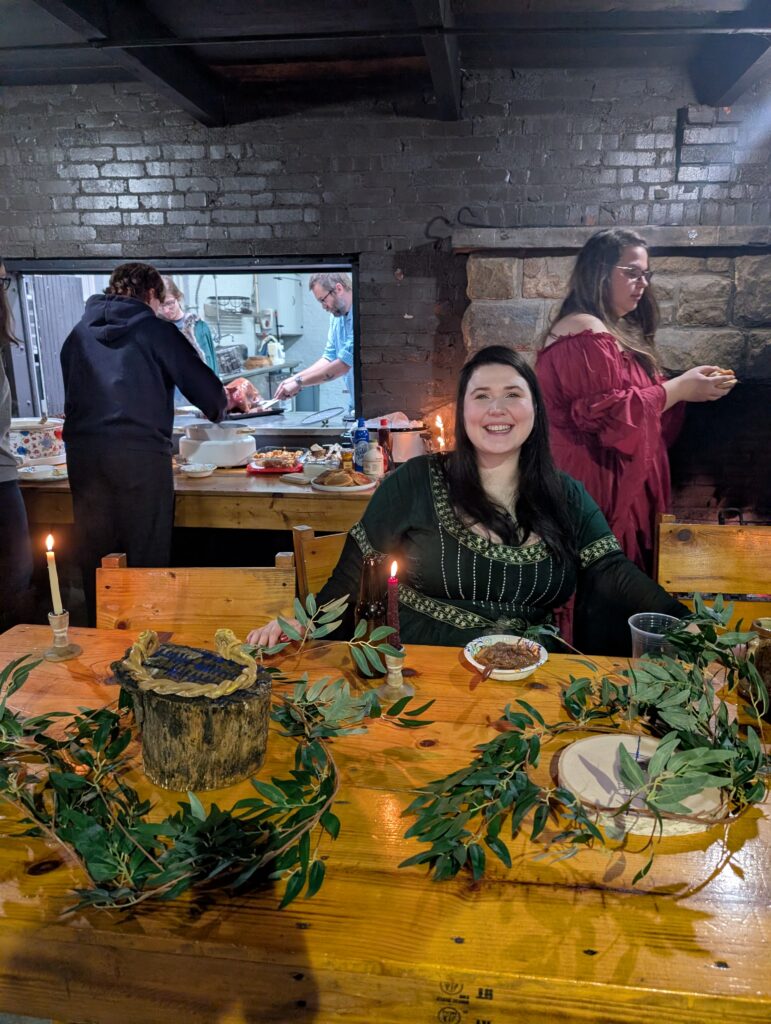
One element of the feast that grew more meaningful the longer I reflected on it was how
effortlessly modern students slipped into the social habits that medieval Celtic cultures
considered essential. Feasting, in early Ireland or among the Brittonic-speaking peoples of
northern Britain, was not only about calories or celebration. It was a system of social ranking,
alliance-building, and identity performance. The fact that our class instinctively created a lively,
communal, almost ritualized environment—complete with shared dishes, experimental recipes,
conversation, and even a symbolic burning—reveals how foundational the act of feasting is to
human community. In medieval literature like the Goddodin, the feast is both the prelude to
tragedy and the emotional heart of the warrior community. Warriors were not remembered for
their kills alone but for how they behaved at the feast: their generosity, their humor, their
bravery, and their ability to participate in social life before participating in battle. In this sense, a
feast operates as a microcosm of cultural values, and our feast, though intentionally playful,
unexpectedly mirrored that deeper function.
The fact that our class gravitated toward symbolic fire-making when given the freedom to
create reflects how deeply these patterns still appeal to human imagination.
Likewise, the way we approached handmade objects in class parallels medieval
relationships to material culture. When I attempted my Pictish-inspired stone, I realized how
much medieval artisans relied on repeated visual language to communicate meaning. Spirals,
triskeles, and knotwork were not merely decorative. They were part of a conceptual system that
medieval audiences understood intuitively. Even if my stone did not replicate the exact precision
of expert Pictish carving, the act of attempting it created a clearer understanding of how much
intentionality went into those stones. The Kirkyard Stone, like many Class II stones, functions
simultaneously as a grave marker, a Christian monument, and a continuation of older artistic
identity. By trying and failing to mimic its style, I encountered firsthand the blend of tradition
and innovation that defined early medieval art across Celtic-speaking regions.
Expanding the lens further, the concept of “Celticness” becomes particularly visible
when examining the landscapes that shaped these societies. The rugged geography of the British
Isles—its mountains, bogs, glens, islands, and coasts—played a central role in shaping cultural
identity. The isolation of some communities, such as those in the Hebrides or western Ireland,
fostered local traditions and unique dialects. At the same time, maritime travel enabled
surprisingly robust networks of communication. Monks, traders, poets, and warbands traveled by
sea more efficiently than by land. These ocean roads connected Iona to Ireland, Ireland to
Cornwall, Wales to Brittany, and Scotland to the Isle of Man. The sea, which we often imagine
as a barrier, served in the medieval period as a connective tissue. This is another reason the term
“Celtic” retains relevance: despite linguistic and political differences, these societies were in
constant dialogue.
Mead served as a symbol of community, alliance, and storytelling. Drinking
mead at our feast echoed this tradition, connecting us in spirit to the communal spaces that
shaped early medieval culture.
Even Bede’s writings, despite his occasional crankiness, reveal the extent of these
maritime cultural circuits. When he describes Irish monks arriving in Northumbria to evangelize,
or Pictish rulers negotiating religious authority with Gaelic clerics, he unintentionally paints a
picture of a culturally interwoven world. What strikes me most is that Bede documents
disagreements—such as the Easter controversy—only because the groups involved were
significant enough to argue with. Conflict, in this sense, proves connection. You do not fight
about liturgical calendars with people who do not matter to your political or spiritual life. The
very disagreements Bede records affirm the depth of exchange among medieval Celtic
communities.
Similarly, the Life of St. Brigid provides a portrait of Irish Christian practice that feels
both regionally specific and widely resonant across the Gaelic and Brittonic worlds. Brigid’s
miracles often involve food, animals, or natural elements—symbols that would have been
instantly recognizable to audiences across the isles. Her ability to create abundance from scarcity
fits into long-standing Celtic traditions that associate supernatural power with hospitality and
generosity. Yet her cult did not remain confined to Ireland. It traveled through the Irish monastic
diaspora, carried by wandering monks and pilgrims who helped establish her feast day and
devotional practices abroad. The portability of saints’ Lives is one of the most compelling
arguments for medieval Celtic interconnectedness. These texts, copied and recopied in
monasteries, created shared spiritual frameworks that transcended political borders.
The Pictish King-List, too, offers a window into shared cultural habits. Genealogy as a
political tool is common across medieval Europe, but it functioned in particularly interesting
ways among Celtic-speaking societies. Kingship relied not on strict primogeniture but on
complex systems of eligibility, often requiring rulers to claim descent from both maternal and
paternal lines. The blending of myth and memory, such as tracing ancestry back to legendary
founders, was not a quirk of Pictish recordkeeping but a widespread Celtic phenomenon. In
Ireland, for example, the Lebor Gabála Érenn weaves together mythic “invasions” of the island
to legitimize ruling dynasties. Wales does something similar with its own legendary histories.
The Picts’ version of this practice reinforces the idea that medieval Celtic cultures shared
conceptual frameworks even when their languages diverged.
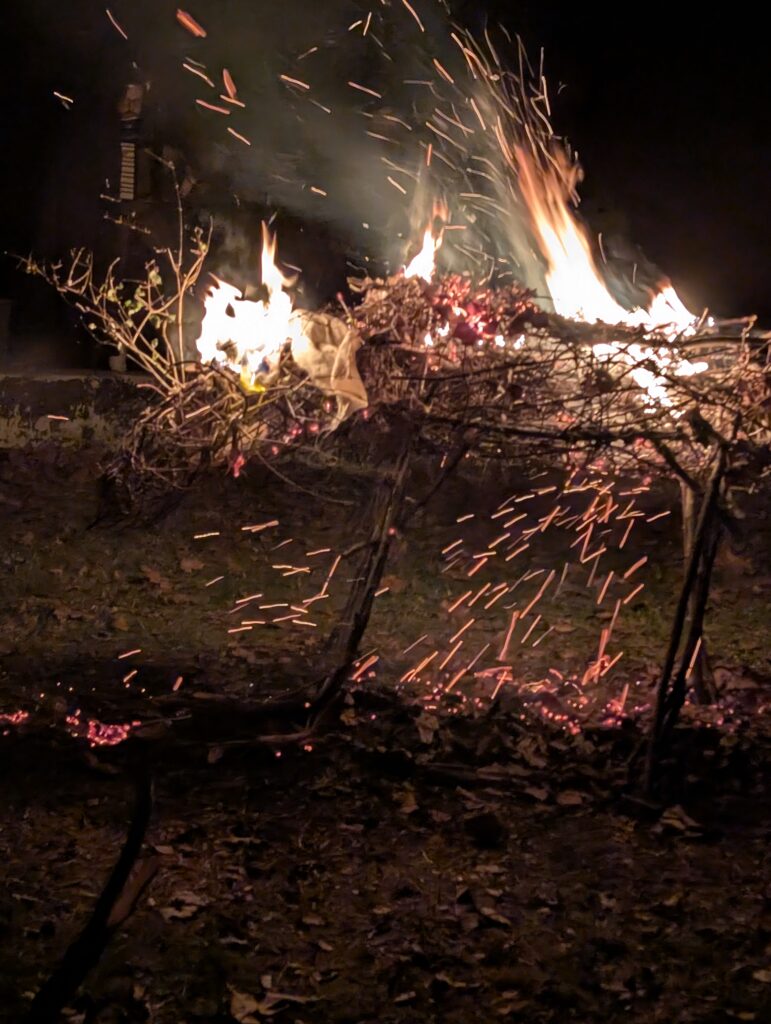
This brings me to landscape again: the stag effigy we burned, humble as it was, resonated
with traditions of marking seasonal change, honoring the natural world, and participating in
communal ritual. The stag itself is an animal that appears across Celtic art as a symbol of
sovereignty, liminality, and the untamed wilderness. Burning the effigy unintentionally echoed
Beltane and Samhain rituals where fire served as a purifier, protector, and connector to the
divine. The fact that our class gravitated toward symbolic fire-making when given the freedom to
create reflects how deeply these patterns still appeal to human imagination.
In this sense, a feast operates as a microcosm of cultural values, and our feast, though intentionally playful, unexpectedly mirrored that deeper function.
Ultimately, the feast demonstrated that “Celticness,” far from being an outdated or
artificial category, remains a productive means of understanding interconnected medieval
cultures. Whether expressed through food, art, poetry, religion, or ritual, the medieval Celtic
world was bound together by shared values and imaginative structures. These commonalities do
not erase regional differences; rather, they allow us to appreciate how societies shaped by similar
landscapes, languages, and traditions created distinct yet overlapping identities. Our feast, in its
own chaotic way, recreated that overlap, reminding us that identity is less about strict boundaries
and more about shared experiences.
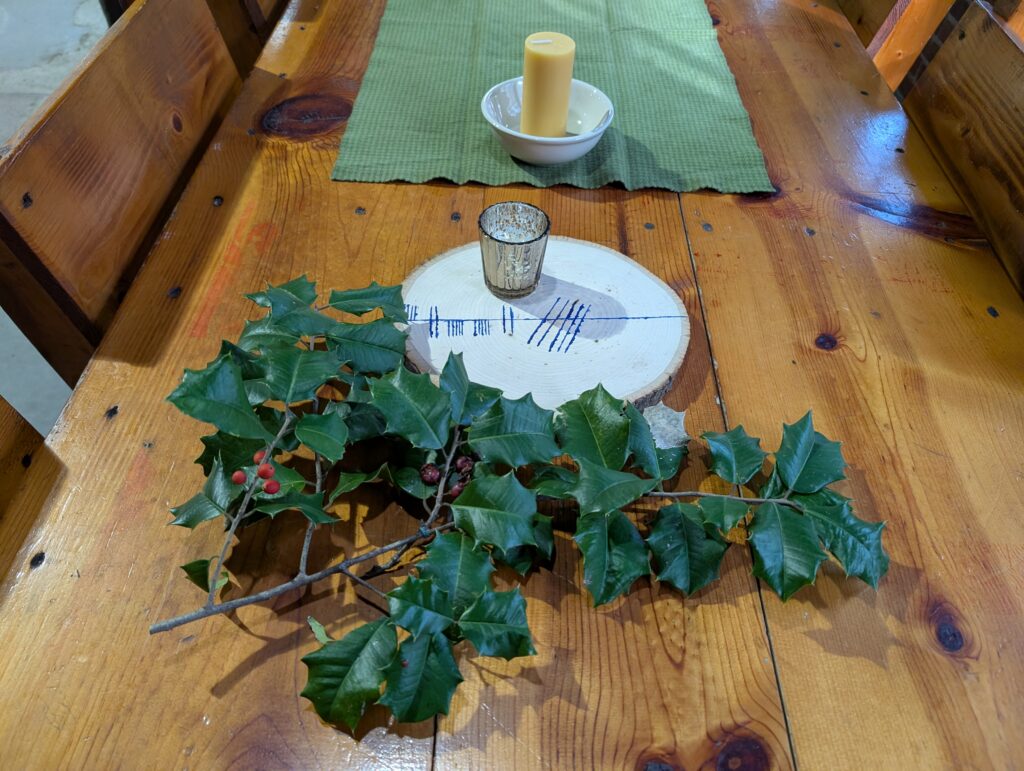
My meat pies, my crooked spirals, the communal mead, and the burning stag all helped
us engage, if imperfectly, with the cultural patterns of early medieval northern Europe. These
experiences became tools for exploring the larger scholarly debate about Celtic identity. Based
on our semester-long study of texts and artifacts, I argue that “Celtic” remains a meaningful category for studying the medieval British Isles. It captures shared cultural continuities and provides a lens through which we can understand parallel developments across Ireland, Wales, Scotland, and northern Britain.
The medieval world was fluid, interconnected, and joyfully chaotic, much like our feast
and much like the butter sauce that fueled half our class. If early medieval writers could see us
gathered around food and fire, telling stories and trying to understand who we are in relation to
the past, they might recognize something familiar. And recognizing that shared cultural impulse
is, I believe, Celtic enough.
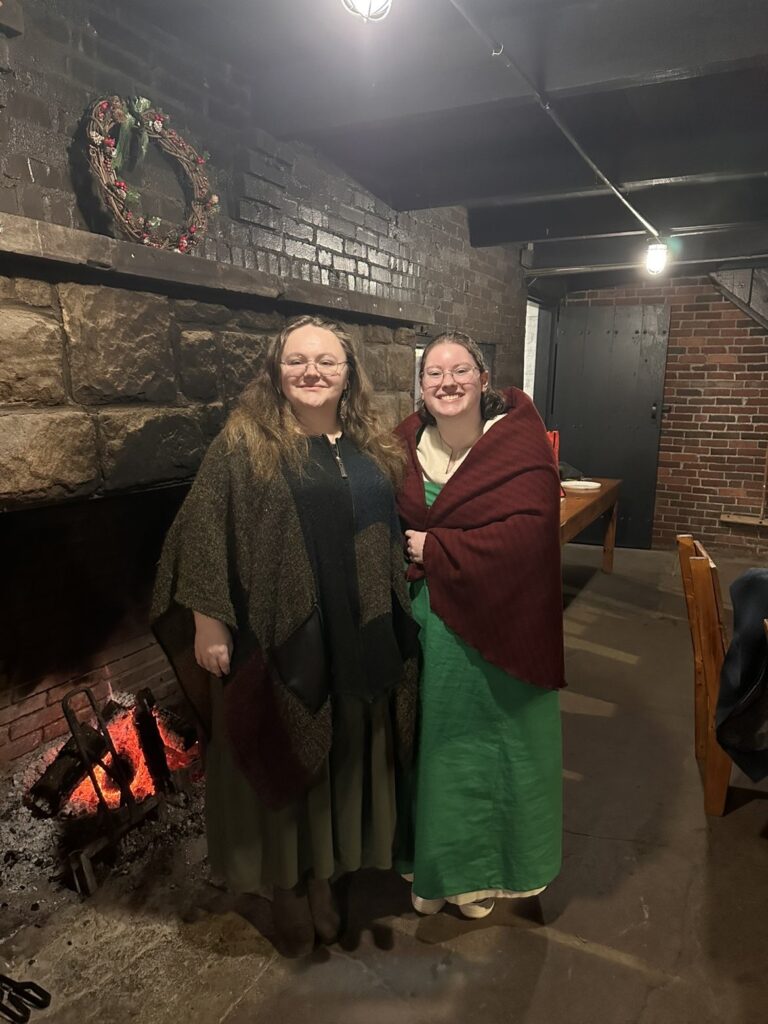
Hello! I’m Danielle Price, a senior at Marshall University double majoring in History and Humanities with a concentration in Religious Studies. I took Celtic Britain as a History elective in Fall of 2025. My academic interests include the Classical Period, the 20th century, historical artifacts, and the history of religion. My plan is to go for my masters in both of my degrees and work in a museum. I’m grateful for the opportunity to be a guest writer for Norse by God.