Welcome back!
For the past few weeks, we’ve been talking about the Luttrell Psalter. From the wealthy knighted patron to the manuscript itself and all the strange and wonderful things within, we’ve spoken at length about how odd yet useful the psalter could be for all kinds of different applications, from studying art history to religious studies to the study of manuscripts and farm implements. The problem here is that I’m a textile recreationist, and this is a textile blog. What does the Luttrell Psalter have to do with it?
I think the best way to explain it is to jump right in. Take a look at this.
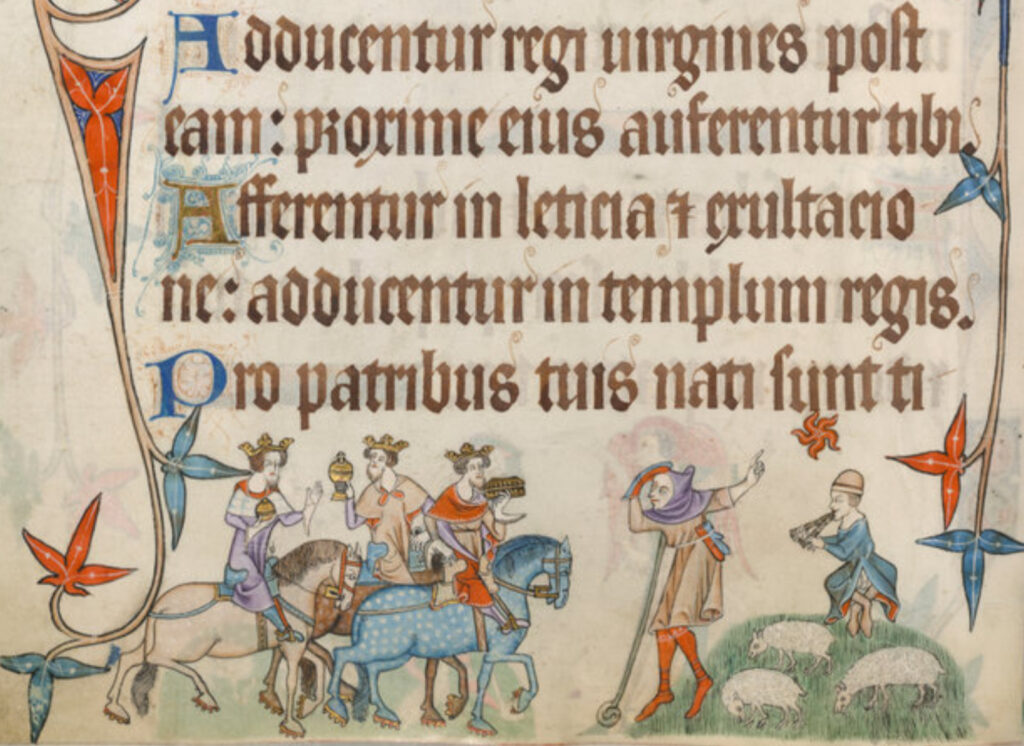
Oh, three wise guys. Not the Sopranos kind, the bible kind. There’s a shepherd gesturing to the star (hey, get a load of this guy, Merry Christmas) and a boy doing a little jig and playing a flute. This isn’t about him, though.
This is an image from the Luttrell Psalter, naturally. Let’s look at the guy in the middle, though.
A shepherd, wearing typical 14th century peasant clothing and some gloves. That weird green thing he’s holding is a cudgel. A shepherd walking around without something to beat the beasties with in 14th century England and expecting to get out of it in one piece is like going to Applebee’s after 9:30 on a Friday and expecting a drunk middle aged guy to not hog the touchtunes.
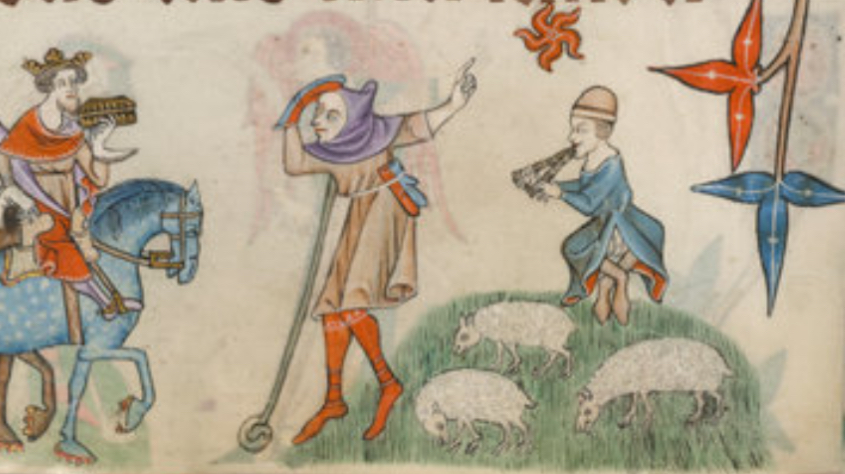
There’s a lot going on here. Bright colors, lots of detail… why am I showing you this, though? Well, it’s mostly because he’s going to make a great subject.
THE SUBJECT
If you read my about post, you’d know that I’ve recreated textiles from artwork and illuminations before, like Queen Emma of Wessex’s veil. Not only was this really fun and interesting, but as far as I’ve seen, it’s pretty lightly applied in the realm of textile recreation (most of us recreate things that actually physically exist in the archaeological record) so I wanted to do a similar project but much, much bigger in scope. We’re gonna be making this guys’ whole outfit.
Why him, then?
Well, for one, he’s posed nicely. Lots of other peasants in the psalter are working, farming, tending to animals. He’s just very excited about the star, so I can see his outfit a little easier. Also, I’m not too worried about the fact that this is a drawing of a biblical person- if you look at all the manuscript art of various minor biblical figures in the Luttrell Psalter, for the most part, they’re dressed like they live in the 14th century. So is this guy. I also picked him for his vivid colors (bright red and blue!) because that’ll be important later, keep reading.
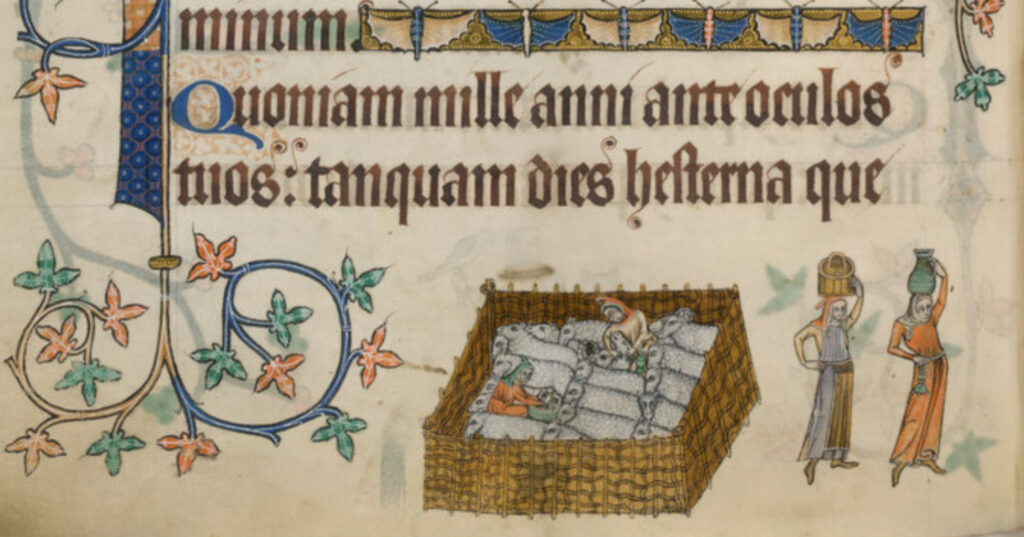
It’s like hide and seek out here. Get out of there. This is the most egregious one.
I also picked him because of how ordinary he is. He’s a shepherd- it’s not at all a reach to say he was a layperson, and based on his clothing, that’s about right. I wanted to choose someone pretty ordinary, as I wanted to re-create something typical to what an ordinary person would wear. You can’t get any more ordinary than a shepherd. Some were serfs, which meant that a local lord owned their labor and that they were bound to their land- they couldn’t travel or make big life decisions, like marriage, without the permission of their lord, and they had to give him the labor he owned. Villeins also had it pretty rough, but it was a step up from being a serf. You had more land, slightly better rights, and if you were lucky, you could get pretty wealthy and maybe even buy your way out. The best place to be socially and economically though was being a freedman, or a franklin- you had a little land, you weren’t bound in service to a lord, and you could do whatever, mostly, as long as it was legal. By whatever, I mean you could travel or get married as you please.
Free to travel as you please, but an orange dog bites your ankles. Maybe the mermaid makes up for it.
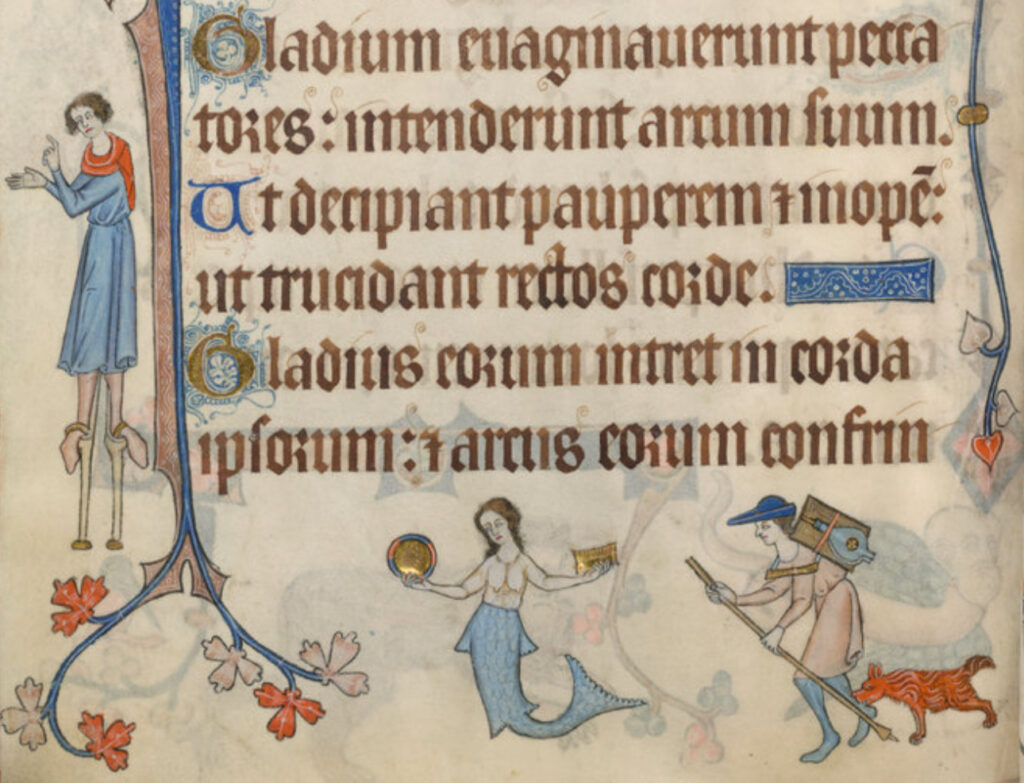
I also just find shepherds neat- they lived a little differently than other farmers, because they stayed with their flock and often had a dog. It’s kind of delightful, really, if you don’t think about the wolves or lambing season in March or winter and just think about something like… rubbing bacon grease on your dog to make him like you. Yeah, that was a thing. This delightful piece of information comes from the 14th centuryLe Bon Berger written by Jean de Brie, a French shepherd. It’s advice on how to be a shepherd, ranging from how you should be morally (don’t drink, don’t gamble, but merelles is alright) to how you should totally make your own mittens (“He shouldn’t buy these mittens, but should skillfully make them…” I’ll take his word for it!) and also how to train your dog (if he doesn’t politely cross his feet when he lays down after you show him a few times, he’s not worthy of being a sheepdog, also rub bacon grease on him).
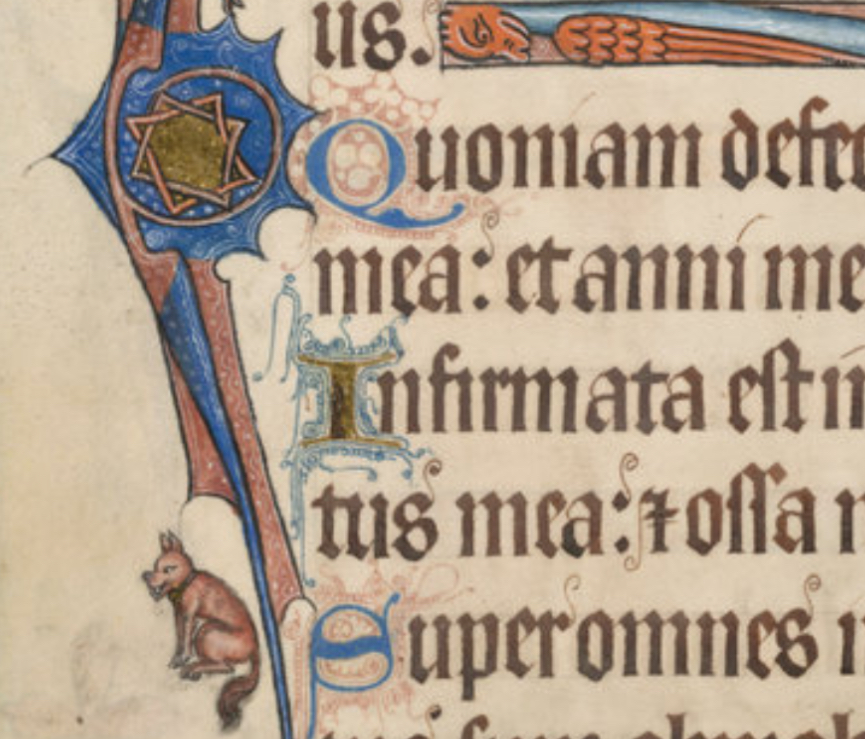
A little dog in the margins. I bet he crosses his paws when he lays down.
Anyway, I mostly chose him for his clothes, because that’s what I’m making. What’s he wearing, though?
Oh his head is a little hood. Everybody had one of these, really- especially farmers in the Luttrell Psalter. You might note that the hangy-down part on the back, called a liripipe, is short. It’s nothing to be ashamed of. Longer liripipe on hoods were more common and popular with richer people, not only because it was just really inconvenient to have it swinging around all over the place and getting stepped on by sheep or your polite, bacon-smelling sheepdog but because getting a piece of fabric that was that long and wasting that much just to be fashionable was expensive. It was probably made out of wool fabric- a simple kind, often undyed but sometimes dyed with simple and common dyes. We’ll come back to that.
He wears a long tunic, too. This kept him cool, and allowed for him to move pretty easily when he was farming or doing his job. The sleeves on this one are pretty short, too, so they’re kept out of his way when he works. These, like the hood, were made out of wool fabric. It had to be long because he wasn’t wearing any pants.
What?
An archer of sorts. Kind of rude, I know, but you can see his undies and that’s the important part. We’re talking about textile history. Don’t make it weird.
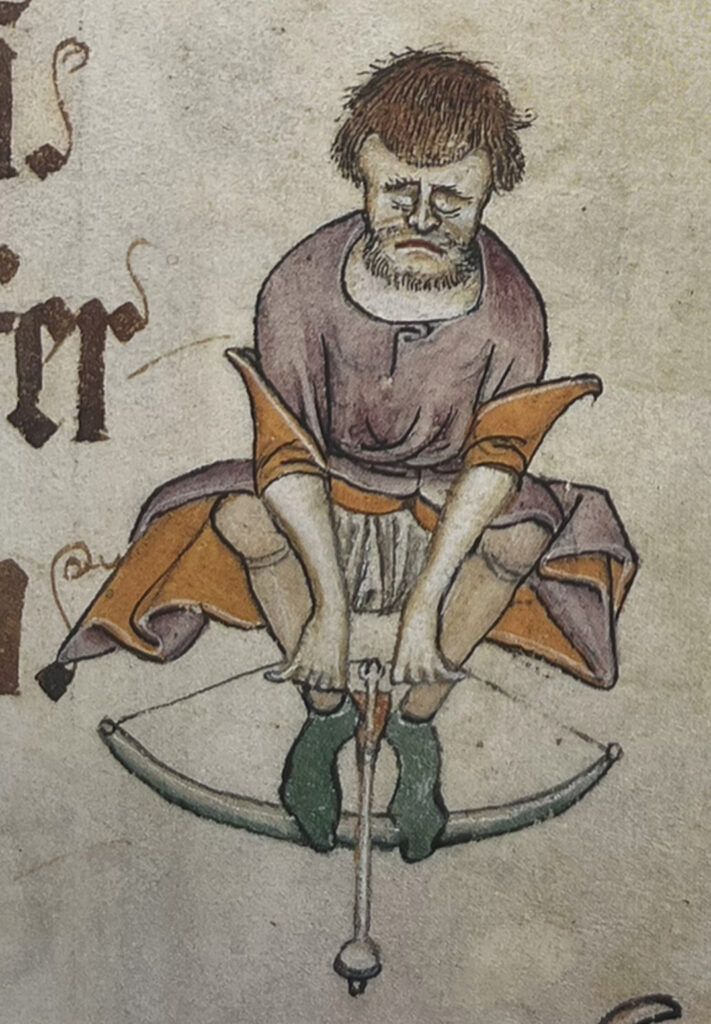
Yeah, no pants. Typically, undergarments at this point were made of linen, consisting of an undershirt and a little pair of shorts that functioned as underwear, basically, called braies. The red things you see on his legs are chausses, or hose. They’re tight, separate on each leg like socks, and they tie onto your braies. Why don’t we get pants, though? The Vikings had them!
It’s mostly a “stuff” reason. Fabric was expensive. The wardrobes of medieval peasantry were not at all similar to ours- people didn’t have a ton of clothes, they just washed and wore the ones they already had all the time. It’s easy to have a big wardrobe after the industrial revolution like us, but in the 14th century, textiles took hours and hours of difficult work from many people. With help spinning, it took me 4-5 months to spin and weave 5 feet of fabric with medieval tools. Months. I didn’t cut, sew, or dye it. Imagine how much work, then, goes into making one whole outfit. Pants take a lot of fabric, and they’re hard to fit. They need to be just long enough, not too tight in the wrong places and tight in the right ones. Also, they wear heavily- walking and sitting take their toll. With chausses or hose, it’s easier. Less fabric, a simpler pattern, and some touch-ups here or there keep them good for a while, even better worn with shoes. At this point, tunics were long enough that you wouldn’t be indecent from not wearing the pants, so… they didn’t.
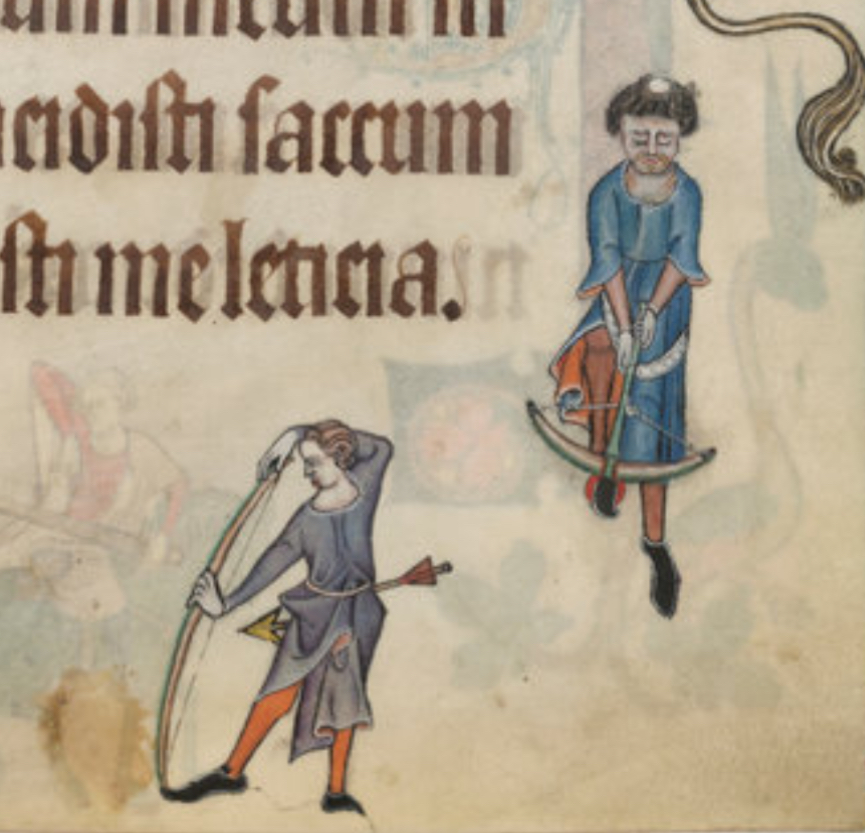
These guys are rocking the long tunics, too. More bowmen.
Alright, so no pants. What’s next? You don’t need pants to wear a belt, I guess. This is actually one of the reasons I picked him specifically- he has a white belt, and he’s a shepherd. It feels kind of self-explanatory. It’s wool! Belts at these times were either leather or woven wool. The woven ones used an ancient technique called tablet weaving, which has existed since the Iron Age. I am deeply and madly in love with tablet weaving because it’s incredibly cool. You take square tablets with 4 to 5 holes in each, run your threads through the holes in the tablets in a certain way to get the pattern you want, and then you weave by rotating the tablets a certain way, weave through, and then go again. The rotation of the tablets- something so simple- makes beautiful patterns in the wool, even undyed. It’s pretty quick, too.
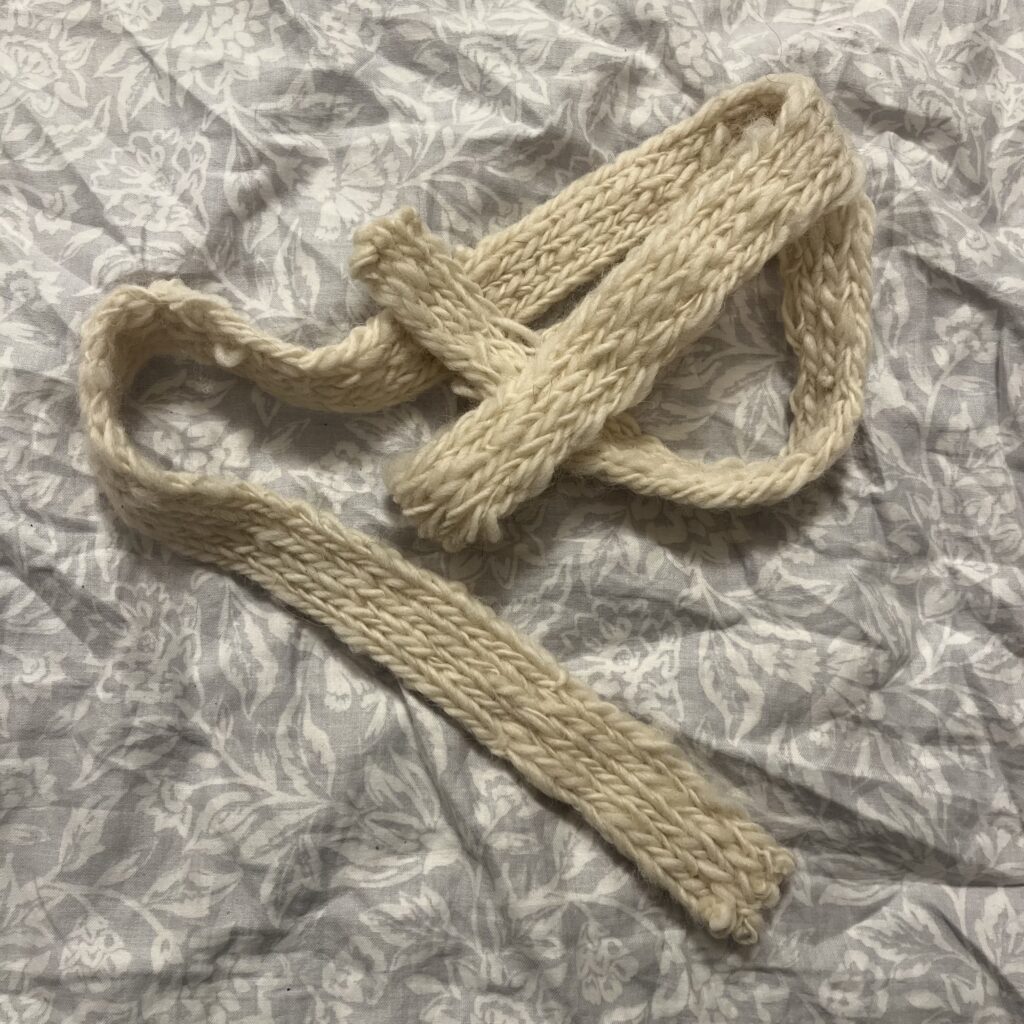
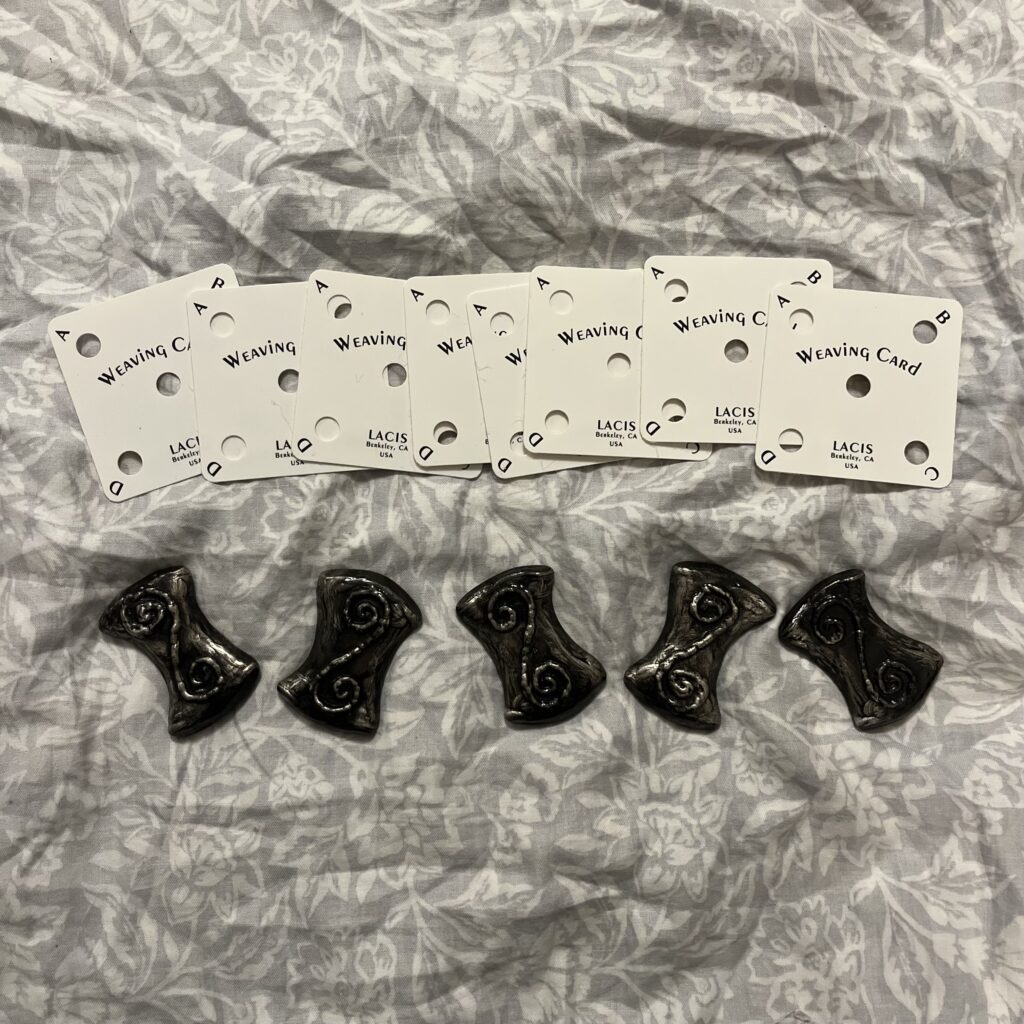
A tablet woven band next to some weaving tablets (top).
Speaking of tablet weaving, he has these little bands around his calves and ankles. Those are garters, and are also probably tablet woven. Though our shepherd’s chausses fit quite nicely to his Tour de France-esque calves, they were, in life, often very baggy. Wool doesn’t stretch too much, and our medieval fellow was never treated to spandex, so they wouldn’t fit like the picture. To fix that, they gartered, wrapping ties around the baggiest part of the hose to keep them fitting and looking nice.
Lastly, his mittens, which our friend Jean says we should make ourselves. Got it. If you’ve ever tried to make gloves before, it’s a pain in the butt. They never fit right and half the time they come out too small. It’s a lot easier if you just cut the number of fingers down, ninja-turtle style, for fantastic high-3s and simpler patterning. Jean would’ve liked these- he said that “When they are checkered, they are even prettier,” of course.
Finally, the fun part: dye. The medieval world was much more colorful than most think. While many serfs would have been used to undyed clothing in shades of brown, gray, and off-white, others, alongside villeins and freedmen, had access to a surprising amount of colors. Two big ones were madder root and woad. Madder is a root that, when crushed and added to hot water, crafts a wonderfully flexible dye. Producing a range of pinks, browns, reds, and oranges, you could get about half of the color wheel from here. Woad, on the other hand, produced a range of blue to indigo (not the dye, the color!). It grew naturally in England, so it was super accessible to even peasantry. By cutting the leaves and fermenting them in a popular mordant before dyeing with heat, one could craft beautiful blues.
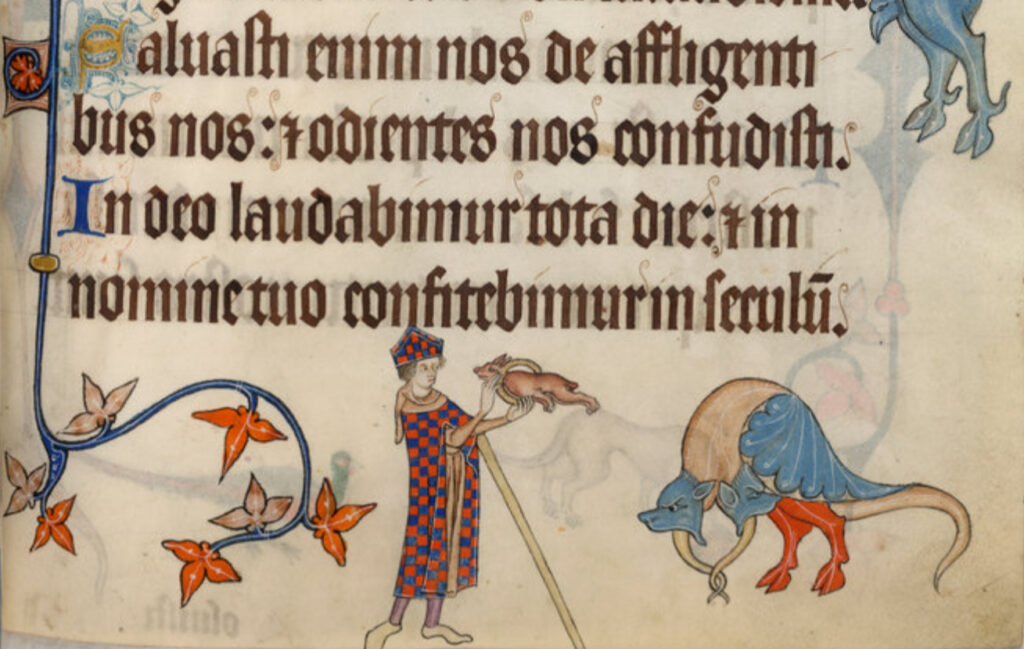
Colorful! A “bishop” (performer) in a checkered robe holds a hoop for a trained dog to jump through. I don’t really know what’s going on with that thing on the right, but I hope she’s having fun.
What about mordants? These work as fixatives or color-alterers for dye, and are part of what give the above dyes their range. Popular mordants include alum, iron like from nails, and, a very popular and accessible mordant used to ferment woad leaves… pee.
I’m so sorry. I hope this helps. Cat pictures always help.
Yeah. Pee. Everybody has it, at least! It’s the most accessible thing known to man, arguably! I am proud to state, however, that I have not yet used urine in my textile recreation journey, and very stern in saying that I will not. I’m gonna stick to like… nails, or something. Anything else is ideal.
On that note, I’m gonna have to get back to you next week. Come back and I’ll show you a thing or two about spinning, tablet weaving, and fashionable ways to hold up your pants in a world where you don’t wear them in the first place. Thanks for reading!
REFERENCE
Backhouse, Janet. The Luttrell Psalter. London: The British Library, 1989.
Brown, Michelle P. The World of the Luttrell Psalter. London: The British Library, 2006.
Camille, Michael. Mirror in Parchment : The Luttrell Psalter and the Making of Medieval England. Chicago: University of Chicago Press, 1998.
Carroll, Carleton W., Lois Hawley Wilson. The Medieval Shepherd : Jean de Brie’s Le Bon Berger (1379). Tempe: ACMRS Arizona Center for Medieval and Renaissance Studies, 2012.
Loven, Pauline. Historical Background : Fourteenth Century Dress and the Luttrell Psalter. London: Bloomsbury Publishing, 2024.