The story of Isabella Bruce continues from Isabella Bruce, Part I | Norse By God
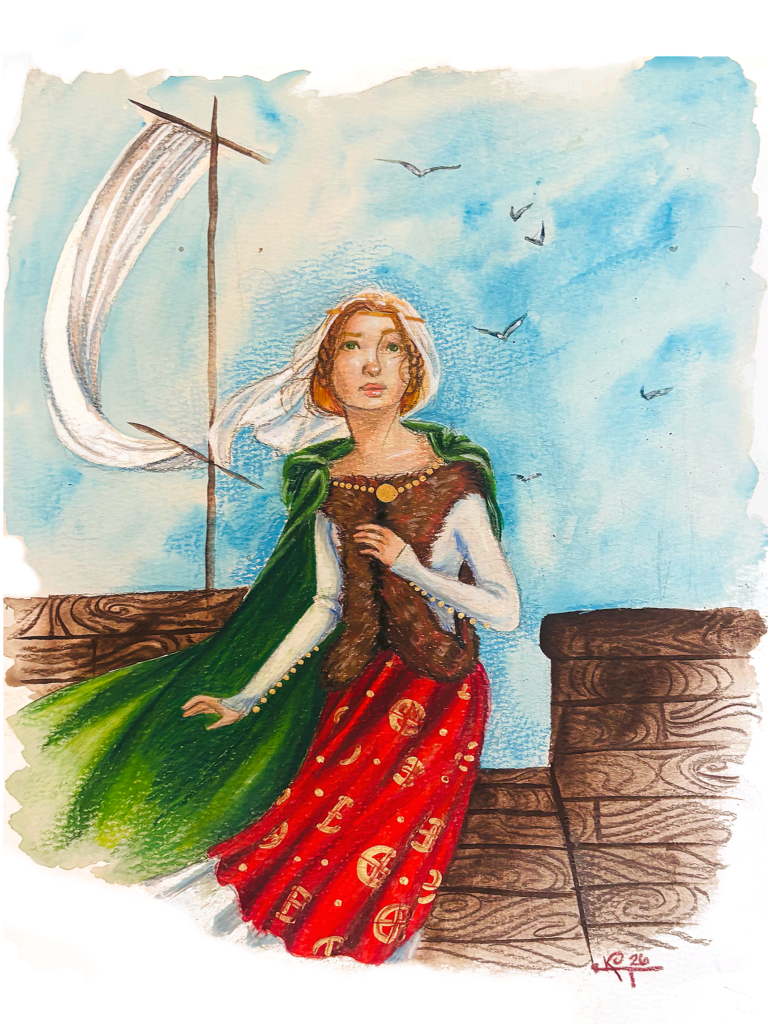
And it was at this moment that the Bruce family rose into ascendance, and Isabella stepped into history. Her grandfather, Robert Bruce (known as Robert Bruce V), forged the family’s claim to the throne. He had proved his mettle in battles from the Scottish moors to the Middle Eastern deserts. And until the Great Cause, he never aspired to the kingship but rather had served Edward Longshanks of England as a faithful vassal, believing the English kings were the key to consolidating his own power in Scotland. Isabella’s father, known as Robert Bruce VI, while supportive of the familial legacy, did not possess the same kind of drive as his father. It was Isabella’s oldest brother, another Robert, the VII, who would become THE Robert Bruce, the one who catapulted his dynasty to immortality and redefined an independent Scottish kingdom. Ambition may have skipped a generation, but perhaps the younger Robert needed a quiet and steady father to shepherd his brood through childhood and prepare them for the onslaughts of a lifetime of war.
Robert VI did make an extremely advantageous marriage—to the widowed Margary, only child and heiress of the Earl of Niall, the Earl of Carrick. Whoever married her became the Earl of Carrick, and controlled the Carrick lands of the Southwest, including their seat of the castle of Tunberry. Margary’s first husband. Adam of Kilconquhar, was a romantic figure who had fought during the ill-fated Eighth Crusade of Louis IX of France, as part the Scottish contingent under Prince Edward, crown Prince of England. One of his comrades-at-arms at the siege of Tunis was the Senior Robert Bruce, then Count of Annandale. The whole expedition was a disaster, and Adam had died at Acre in 1271. According to later stories, Robert was chosen to give the young widow the news of her husband’s death, and she refused to let him leave her castle until he married her. Fortunately for the young bridegroom, Margary and Adam’s only child was a daughter, an infant named Martha. He thus brought the title, Earl of Carrick, as well as the Carrick lands, into the family.
It was Isabella’s oldest brother, another Robert, who would become THE Robert Bruce, the one who catapulted his dynasty to immortality and redefined an independent Scottish kingdom.
Whether or not the couple were as wildly attracted as the sources claim, or merely pragmatic, they were certainly fruitful, producing five sons and five daughters. The eldest was definitely Robert. Isabella must have been the couple’s oldest daughter, or at least the first to survive infancy, as she bore the name of her paternal grandmother and aunt. We don’t know the exact birth order, or dates of birth, but the babies must have followed in quick succession, as eight more were born by 1292. Marjorie would have spent much of her married life in confinement, heavily pregnant or recovering from childbirth.
Robert was six years older than Isabella, and much of his education would have excluded a younger sister. The Bruce boys would have spent their time learning the skills of soldiers and strategists. They needed to one day act as knights, mastering swordplay and horse-riding. They served as pages in the retinues of their father and grandfather, and would have certainly been fostered by other Scottish and possibly even Irish lords.
Perhaps Isabella was only one of a gaggle of younger siblings her brother Robert occasionally nodded at in the Great Hall of Tunberry Castle. Or maybe, as the first sister to live past infancy, she held a special place in his heart, and they spent some time together in the same nursery before he left to pursue swordsmanship and Latin.
At the commencement of the Great Cause, Isabella was only ten years old, but she could hardly have helped but be aware of the stirrings of ambition that reverberated through her family. It began even before King Alexander’s death, when his heirs started dying. Powerful men of the realm couldn’t help but size up their chances and count the leaves on their family trees. And the two men with the clearest claims were— Robert Bruce, lord of Annandale and Carrick and John Balliol, lord of Galloway.
By this time, primogeniture ruled of the day—oldest son from oldest son—but with the end of the House of Dunkeld, so many daughters were involved that there was no clear heir. In order to find the closest heir to King Alexander, one had to go back to David I, a king whose reign had ended over a century ago. Robert Bruce was descended from King David’s youngest son’s younger daughter, Isabella (who had married the original Robert Bruce), while John Balliol, was descended from the older daughter, Margaret, whose daughter Devorgilla had married into the Balliol family.
At the commencement of the Great Cause, Isabella was only ten years old, but she could hardly have helped but be aware of the stirrings of ambition that reverberated through her family. Her grandfather and John Baliol became the two most potentially powerful men in the country. At Tunberry Castle, the seat of the Earls of Carrick, great men of the realm would arrive by night. Servants gossiped as they cooked extra meat and served untold amounts of wine. Strange horses appeared in the stables. And Isabella’s brothers were ushered into the world of men. On September 20, 1286, a group of Scottish barons secretly met there to support the Bruce claim to the throne. Robert was twelve, and a full participant.
But fate and politics swung in a different direction. With the death of the Maid of Norway, Edward I, King of England acted as the final arbitrator. And on November 17, 1292: Edward I decided John Balliol had the best claim. Within barely two weeks, John Balliol received the crown in the presence of his English benefactor.
1291-1292 was a rough year for Isabella. Her mother died. Her family lost the crown. It is possible that the loss of his wife mattered more to Isabella’s father, but for her wily grandfather, the insult to his family brought the greatest grief. He stepped down as head of the family in favor of his son, possibly in defeat, or more likely to plot from the shadows. Isabella’s father notably never remarried, at a moment when he could have formed crucial alliances. That year was recorded as one of the most wretched and frigid winters in memory—chroniclers bemoaned the winds that uprooted trees and unroofed houses.
And as her familiar world slipped away in the gloomy winter, she learned the most jarring change still lay ahead—she would be leaving Scotland entirely, possibly never to return. And she would achieve what her grandfather and father had not—a crown.
And she would achieve what her grandfather and father had not—a crown.
Whether the news struck her with anticipation or terror or both, it must certainly have been unexpected. Isabella would have expected to marry, although perhaps not for a few years yet. Twelve was still remarkably young. And she assumed that she would marry a landed noble of Scotland, an Earl who would bolster her family’s power—a Murray or a Seton or a Fraser. Perhaps someone she had met in the Great Hall of Tunberry Castle, or watched them in the castle yard practice sword fighting with her brothers during practice. It would have seemed highly unlikely that she would ever leave Scotland, and she would expect to see her family fairly frequently. And now she was going to be the bride of the King of Norway.
And now she was going to be the bride of the King of Norway.
Her bridegroom, on the other hand, was not the thirteen-year-old child who had greeted and appalled the sophisticated Princess Margaret. He was now twenty-five and a seasoned ruler and warrior. He had lost a wife, and his only daughter. This time he was the one married to a child. Isabella was barely born when the last Scottish lady had crossed to her fate.
This was quite a feather in the cap of the Bruces. Isabella was hardly a princess—a scion of a powerful family vying for the rulership of Scotland. One the surface, perhaps she seemed like a poor match for her royal husband. But her grandfather and Eric II were both failed contenders in the Great Cause, and that made them fast friends. In return for Norwegian support of the Bruce claim, Robert no doubt promised a return to Norwegian sovereignty of the northern isles.
Her father accompanied her on her bridal journey. Perhaps he was loathe to let his young daughter sail alone, with the tragedy of the Maid of Norway so recent. This trip across the storm-tossed Northern waters would be the last time, at least in recorded history, that Isabella would see any of her blood kin again.