Welcome back! Last week, we talked about patterning. It’s probably kinda predictable that we talk about what exactly we’re patterning with this week.
The British Isles is chock full of animals that naturally produce an excess of textile crafting materials: sheep. Though it is an older source compared to the Luttrell Psalter and isn’t exactly contemporary to it, this can be seen within the 11th century English Domesday Book. The Domesday Book (pronounced “Doomsday-” yeah, I know) is like a record of all the property within England and its owners, down to the number of sheep and pigs. It was kept and written for a lot of reasons, but basically it was made to help the new Norman king get his finances in order. It’s kinda like a record for the medieval IRS. Maybe that’s why it’s pronounced like that.
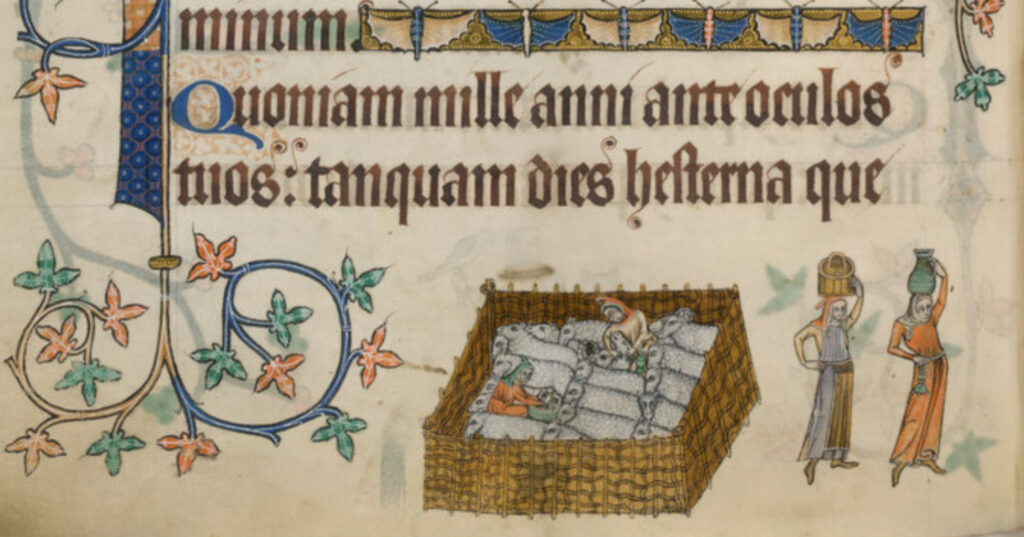
You’ve seen this before if you’ve kept up. Some people tend to sheep and walk away with spoils and produce.
Anyway, the Domesday Book records over 300,000 sheep within its precious pages, and this is only with regards to a miniscule fraction of the land and people, so there were a lot more than that, even more by the time of the Luttrell Psalter. Wool was one of England’s primary exports at this time, so it’s more than likely that sheep far outnumbered people. It’s only natural, then, that most people wore wool clothes.
To get wool to a wearable state, the sheep first had to be sheared- usually done around June in England- and then the wool washed and carded, a process that involved pulling the wool between two carders, which kinda look like slicker brushes for your dog or cat, to get all the fibers clean and going in the same direction. This process results in clean fibers that all run the same way, along with raw and skinless fingertips for every time you mess up and catch finger meat between the carders instead of wool. Once the carding is well and over with, and your fingers evenly degloved, the wool is ready to be spun.
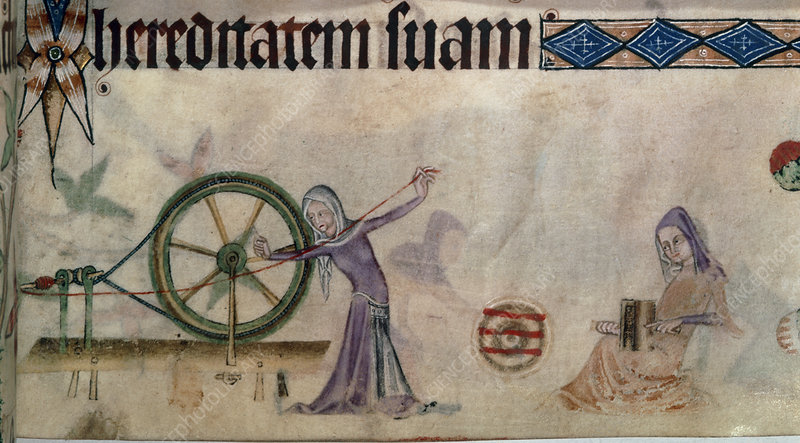
A woman spinning on a wheel (left) and a woman carding wool (right).
Once ready, the wool fiber is wrapped around a distaff, a stick you hold under your arm while you spin that also happens to be a popular medieval man-beating implement.
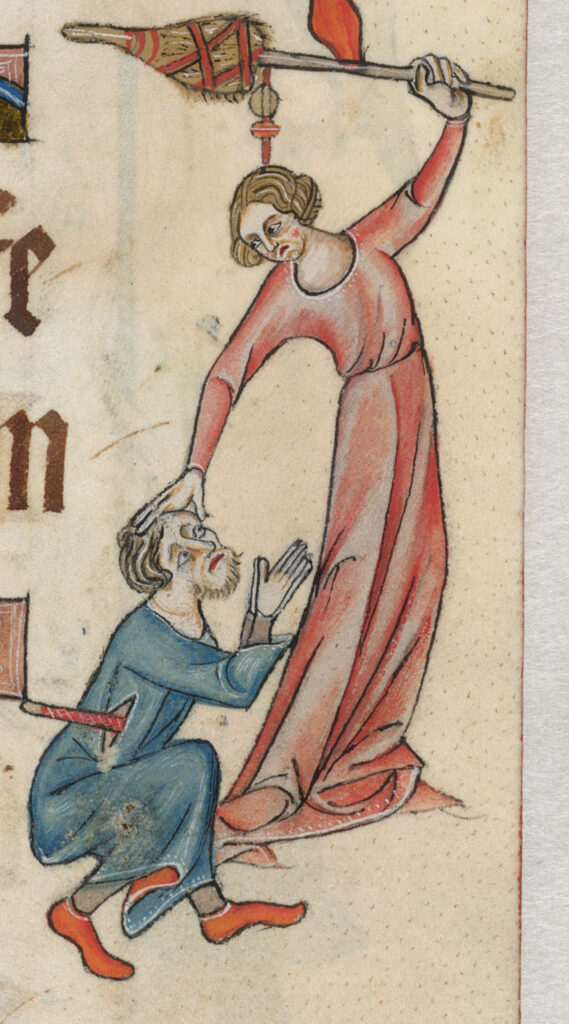
This is actually an incredibly common image in illuminated manuscripts. I feel like, based solely on the amount of times you see women using them as weapons, that it had to happen sometimes. Also, you can see that this is the hair side of the parchment from the little dots.
To spin, you use one hand to draft wool from the bundle on the distaff while using your other to spin and control the tension with your spindle. Drafting is basically controlling the twist the spindle causes- you choose how far it goes into the fiber, how tight it is, and what direction it goes, and this determines how thick your spun thread is and how it behaves. This is a lot like patting your head and rubbing your belly at the same time, and the main issue new spinners encounter when learning.
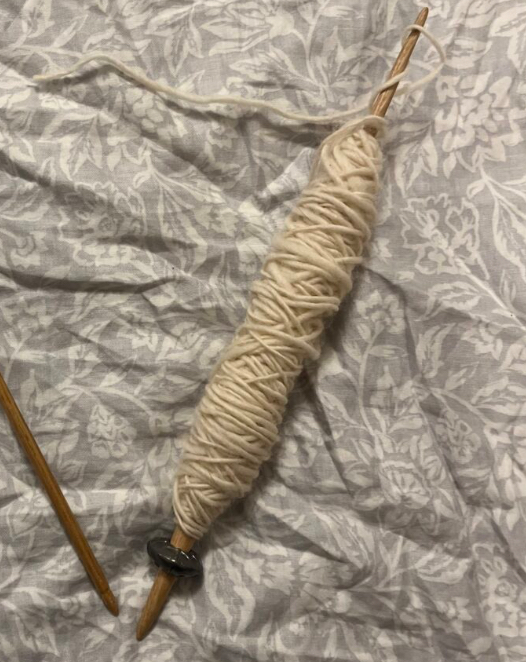
My spindle with whorl! This one is a lot like most medieval spindles, based off of a Viking/Anglo-Saxon design. I prefer to spin with my spindle in a glass spinning bowl just to keep it in one place or from moving around too much, but I’ve also just let it do what drop spindles do and hang freely. The notch is also not necessary, but it’s accurate to most spindles and it’s very helpful, giving the thread a place to sit.
Now, you’ve spun your thread. What comes next?
You have to weave it. This is a lot easier said than done. First, all those threads need to be cut to the desired vertical length of your finished fabric. These are called your warp threads. You need to then make your first weft thread (the horizontal ones), attach it to the top of your loom, and then weave your weft threads through. Next, you weight your warp threads by tying both ends around a weight. This is why it’s called a warp-weighted loom, a loom that dates as far back as the Viking age and beyond.
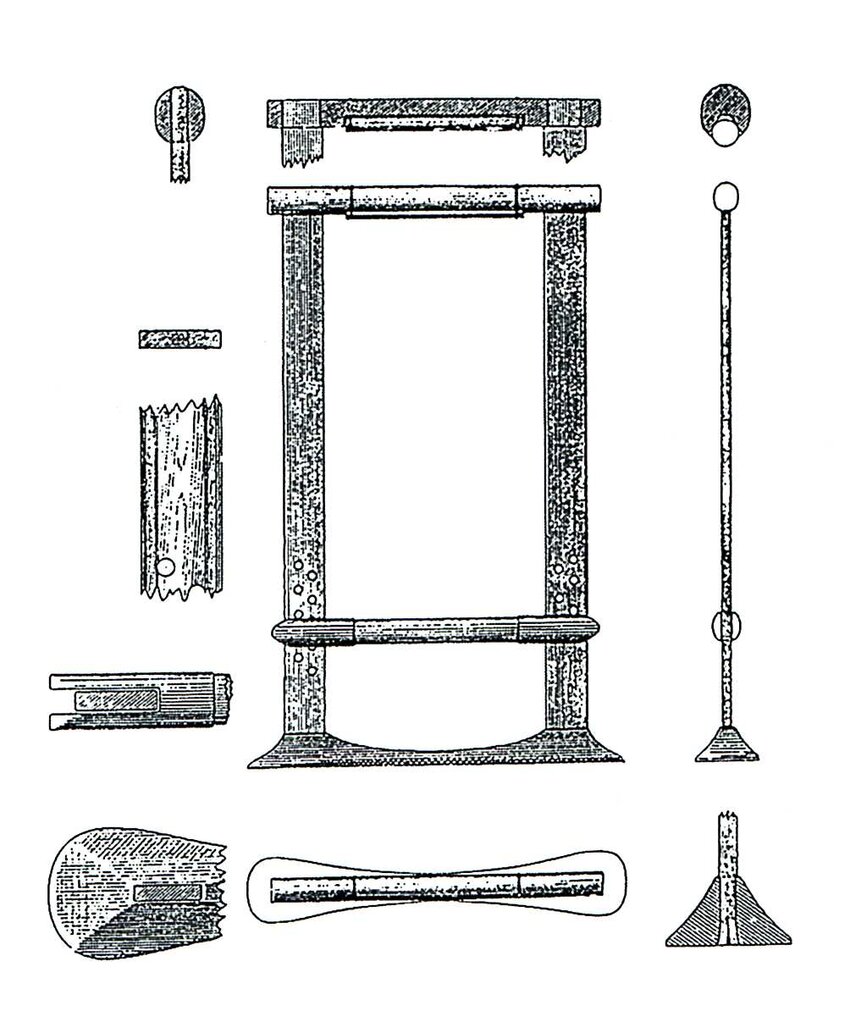
You’ve seen my loom before, so I’m gonna show you Osebergs. 9th century Viking ship burial, loaded with all kinds of textiles and crafting tools, amongst other treasures. This is a reconstruction based on what they found.
You also need to choose what kind of weave you want to do. You can make various patterns and colors appear in your fabric based on the weave, but the most common were 1:1 and 2:2 tabby weaves- over one, under one, and over two, under two, respectively. Did I mention that, at every point in the process, the threads are gonna get tangled and you’ll need to untangle them a million times? Yeah, there’s that. Wool is fuzzy and grabby, and wool threads retain this quality, meaning you’ll be fist-fighting hundreds of threads and losing every time you do a shed change or try to pry any of them apart. This wounds the ego as much as you expect.
This process can take forever. It took me months to craft a veil with it. Once you’re done, however, you have your own fabric, made by hand, to craft your own clothes with. With pattern pieces cut, all you have to do from here is sew with a bone (broke!) or metal (loaded!) needle and the same thread you spun, sometimes plied- twisted over itself to create a multi-strand thread that’s a little stronger than one on its own.
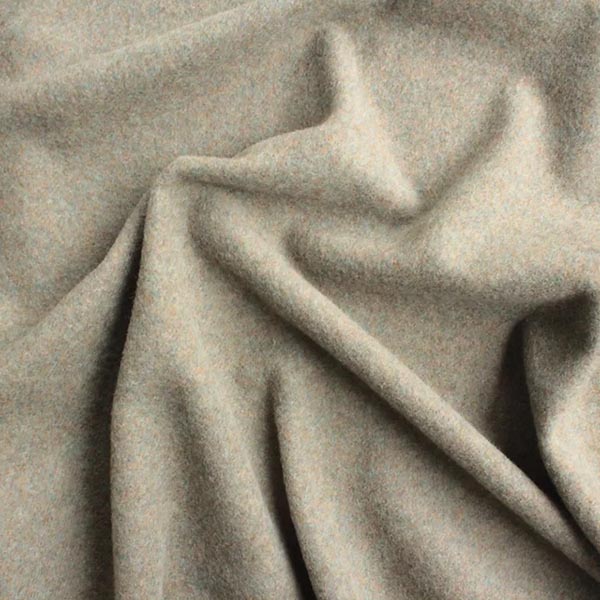
The wool fabric I’ll be using! 100% wool.
The other material that was popular in medieval England was linen. Linen was pretty much made in the exact same way as wool fabric, but with a fiber difference- instead of carding wool and spinning it, you would spin flax fibers together. Flax is a plant that’s been cultivated in the British Isles since people figured out how to smash tin and copper together. If you process the stems correctly, you get a really forgiving, easy to spin plant fiber that works pretty much the same as wool in terms of how you work with it. This created a far thinner fabric that breathed well in comparison to wool, and was popular for use in things like undershirts and braies, or underwear.
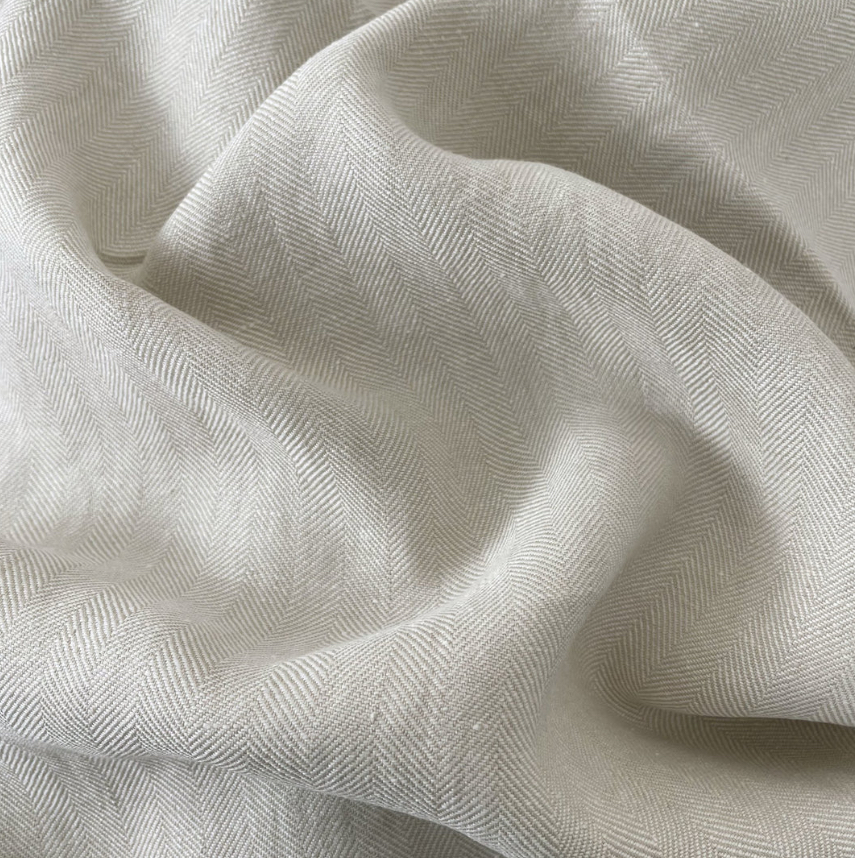
The linen I’ll be using.
While I do have a loom, I won’t be weaving for this project, aside from tablet weaving. Weaving my own fabric on the warp-weighted loom is a quick way to make a project go from a multi-month project to a years-long project, and I simply don’t have the time to do it that way.
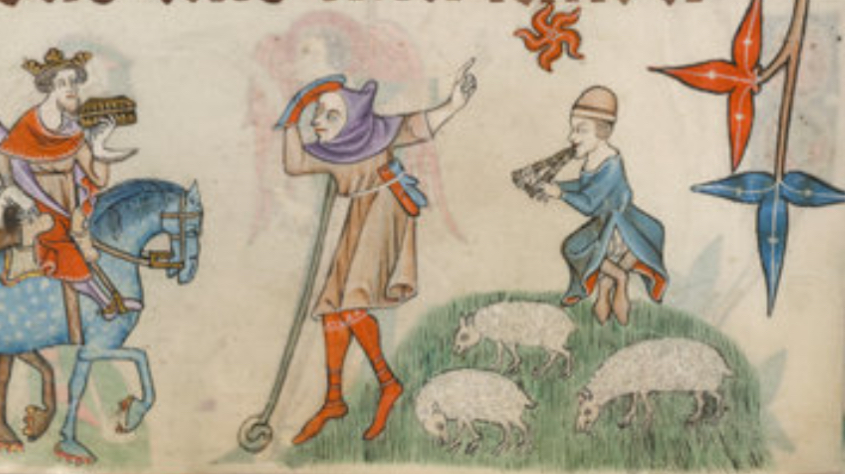
One key thing here that I’m missing so far is dye. Look how colorful this guy is, it’d be a shame to just leave everything the way it is, and it would be inaccurate at that.
Our subject again! Brilliant red, blue, and even purple. We’ll come back to that.
Dyes were usually plant-based at this point. The ones for the lower classes were, anyway- brokies got oak galls, roots, and leaves to dye their clothes with, and the upper classes got things like mediterranean lice (kermes, red) and mollusks (true purple). You’d usually take whatever dyestuff you were using and crush it somehow (usually in a mortar and pestle) or boil it with a mordant (like woad leaves and urine, I won’t be doing this) before boiling it in a pot. After this, you just add the fabric you want to dye, usually before you’ve made the garment. For certain dyes or to achieve certain colors you’d add a mordant- alum, iron through adding nails to the pot- and it would work as a fixative or shift the color of the dye via chemical reaction.
You’re probably wondering about the elephant in the room.
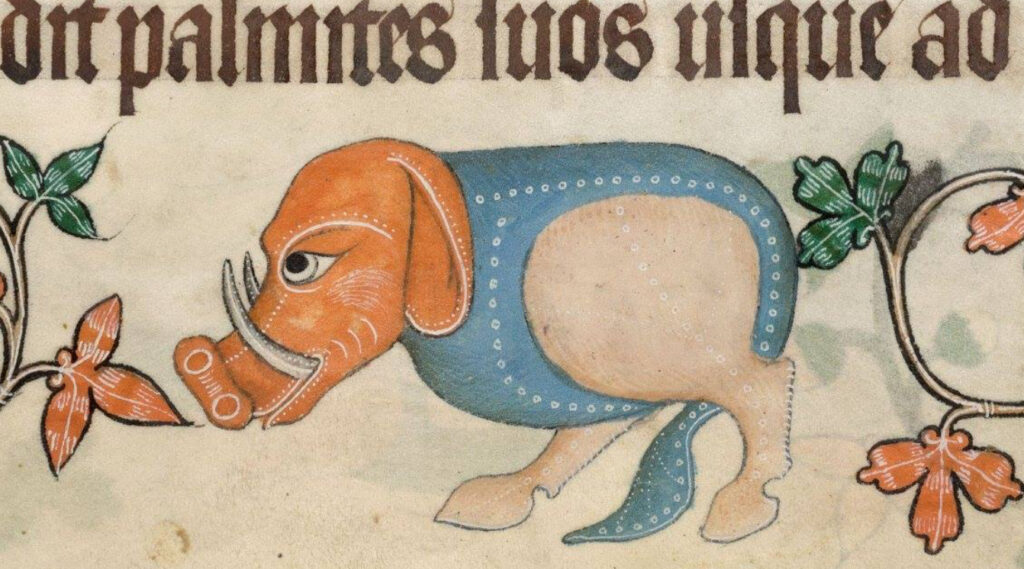
No, not that one.
The purple hood. “Isn’t purple illegal for everyone but nobles?” you say, and I reply “no, that’s later.” At this point, sumptuary laws weren’t really in effect in the ways we might think about when we think of purple in the Middle Ages. Sumptuary laws were laws that determined who could wear what clothes, down to color and material. At the time we’re talking about, the real restrictions were on the dye and the material and not necessarily the color.
True purple, achieved with the blood of crushed mollusks, looked a whole lot different from the purple that poorer people could get. The purple our shepherd is wearing is probably achieved with an overdye technique, meaning that it was dyed with madder (red) or woad (blue) first and then the opposite second to mix the colors. This wasn’t as vibrant as royal purple, and it wasn’t as colorfast, either- your fresh purple would fade pretty fast. So it’s not like anybody would be mistaking the two.
Anyway, that’s all we have time for this week. Next week, we’ll get back to the tablet weaving and spinning for the belt. Thanks for reading!
REFERENCE
Backhouse, Janet. The Luttrell Psalter. London: The British Library, 1989.
Brown, Michelle P. The World of the Luttrell Psalter. London: The British Library, 2006.
Camille, Michael. Mirror in Parchment : The Luttrell Psalter and the Making of Medieval England. Chicago: University of Chicago Press, 1998.
Carroll, Carleton W., Lois Hawley Wilson. The Medieval Shepherd : Jean de Brie’s Le Bon Berger (1379). Tempe: ACMRS Arizona Center for Medieval and Renaissance Studies, 2012.
Loven, Pauline. Historical Background : Fourteenth Century Dress and the Luttrell Psalter. London: Bloomsbury Publishing, 2024.