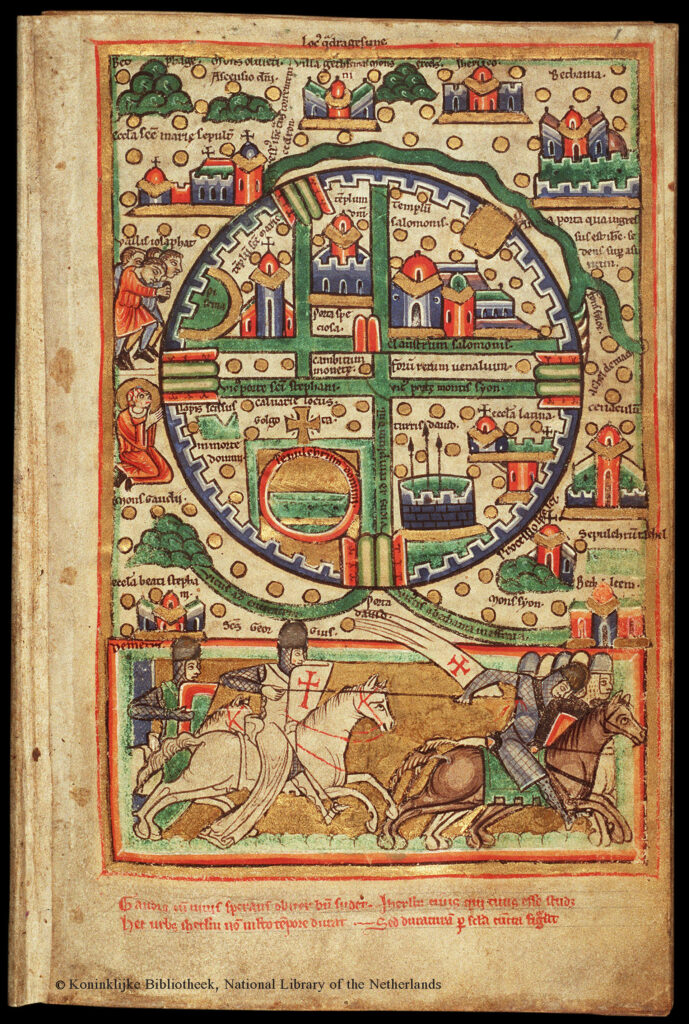
Finally in the summer of 1110 A.D., Sigurd arrived in the kingdom of Jerusalem during the reign of King Baldwin I, less than a decade after the city’s capture by the First Crusade. The Norse king was welcomed with great honor. To the rulers of the Latin East, Sigurd’s arrival carried immense symbolic weight: a crowned king from the far north, who had crossed seas and continents to reach the Holy City by his own hand. In Jerusalem, Sigurd fulfilled the spiritual purpose of his expedition. The saga recounts how he bathed in the River Jordan, just as Christ had once been baptized there. This act marked the transformation of the Viking king into something new, a ruler whose legitimacy rested not only on inheritance and conquest, but on pilgrimage and divine favor.
The saga says that “King Sigurd stayed a long time in the land of Jerusalem (Jorsalaland) in autumn, and in the beginning of winter.” He received gifts from Baldwin I who sought to encourage Sigurd and his Northmen’s budding zeal. The Levantine king gifted Sigurd what was believed to be a splinter from the true cross upon which Christ was crucified, granting the gift so long as Sigurd promoted Christianity whenever he could and erected an archbishop’s seat in Norway when he returned from his journey. But even after coming to the Levant with piety and reverence on his mind Sigurd did not come to Jerusalem merely to pray. When King Baldwin called upon him for aid, the Norse king answered without hesitation.
To the rulers of the Latin East, Sigurd’s arrival carried immense symbolic weight: a crowned king from the far north, who had crossed seas and continents to reach the Holy City by his own hand. In Jerusalem, Sigurd fulfilled the spiritual purpose of his expedition.
In 1110 AD, Sigurd joined Baldwin and a fleet from the Italian city of Venice in an assault on the coastal city of Sidon, one of the last Muslim-held strongholds along the Levantine shore. The city was heavily fortified, protected by thick walls and supplied by sea. Its capture would secure the coastline of the crusader kingdom and strengthen Baldwin’s control of the region. Sigurd’s fleet played a crucial role. The Norse longships helped blockade the harbor, cutting Sidon off from relief and preventing escape. On land and sea alike, the attackers pressed their advantage. After a hard-fought siege, the city fell. Sidon was taken in the name of Christendom, and its conquest stood as one of the major victories of Baldwin’s reign. For Sigurd, the victory at Sidon helped to bolster his already widespread reputation. He was no longer merely a pilgrim king or a distant curiosity from the north. He had fought alongside the ruler of the Holy Land and shared in their triumph, gaining recognition for furthering the cause of Christian rule in the region.
Finally, the Holy Land reached, now was to begin the long return journey for the Norse. Not ready to end the procession through new lands, the Norse did not retread the path they took to return to Scandinavia. Instead they decided to move through the Aegean Sea to the capital of the Eastern Roman Empire, Constantinople. Sailing up the Bosphorus, they were welcomed by the Greeks, “The Emperor Kirjalax had also heard of King Sigurd’s expedition, and ordered the city port of Constantinople to be opened…” In Constantinople the Northmen received an even grander welcome than in the Holy Land, Sigurd receiving many honors from their Byzantine host which were reserved for only those of high status within their realm. As the Norse stayed for a time in the city, The emperor offered Sigurd a choice between gold or public games held in his honor. Sigurd chose the games. Sigurd and his men would stay in Constantinople for a little time after this, tales of the friendliness between his men and the court of the Emperor abound, but eventually, the Crusader king had to make his way home.
Sigurd returned to Norway not merely as a king, but as a symbol of a changing world.
From Byzantium, Sigurd traveled through the domains of the Holy Roman Empire, passing from one court to another as a guest rather than a conqueror. The saga describes how he was received with respect by princes and lords along the way, his reputation preceding him as news of his crusade spread across the continent. Though his host was smaller now than the fleet that had departed Norway years before, the men who followed him were veterans, seasoned by war and pilgrimage alike. Sigurd eventually came before the Holy Roman Emperor himself, who the saga names as “the Roman emperor, Lotharius,” before continuing his journey into Denmark. Finally, after a brief visit with the Danish king who is said to have “received him in the most friendly way,” Sigurd and his remaining men boarded a ship in Jutland and made for Norway. “It was the common talk among the people, that none had ever made so honourable a journey from Norway as this of King Sigurd. He was twenty years of age, and had been three years on these travels.”
Sigurd returned to Norway not merely as a king, but as a symbol of a changing world. His journey marked the moment when the old Viking horizons fully gave way to medieval Christendom, when longships that had once carried raiders now bore crusaders, and when a Norse ruler could stand among emperors and kings as a recognized Christian sovereign. In Sigurd’s wake, Scandinavia was no longer a distant fringe of Europe, but an integrated part of its political and spiritual order. His expedition, remembered in saga and song, became not just a tale of conquest and pilgrimage, but a milestone in the transformation of the North itself.