Hello again! Remember the strange creature from last week?
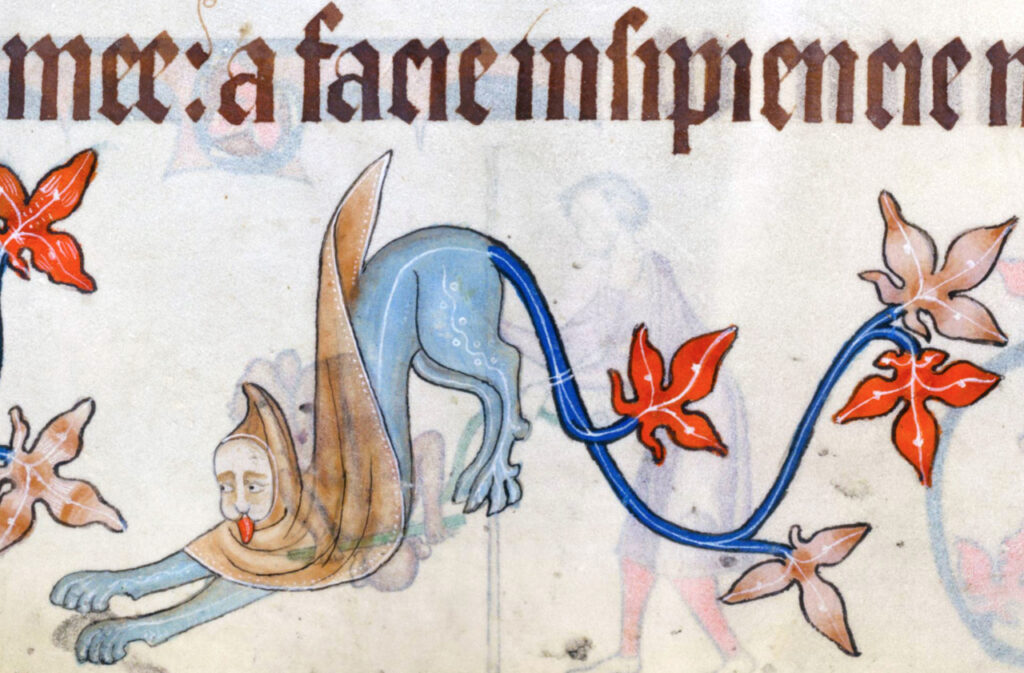
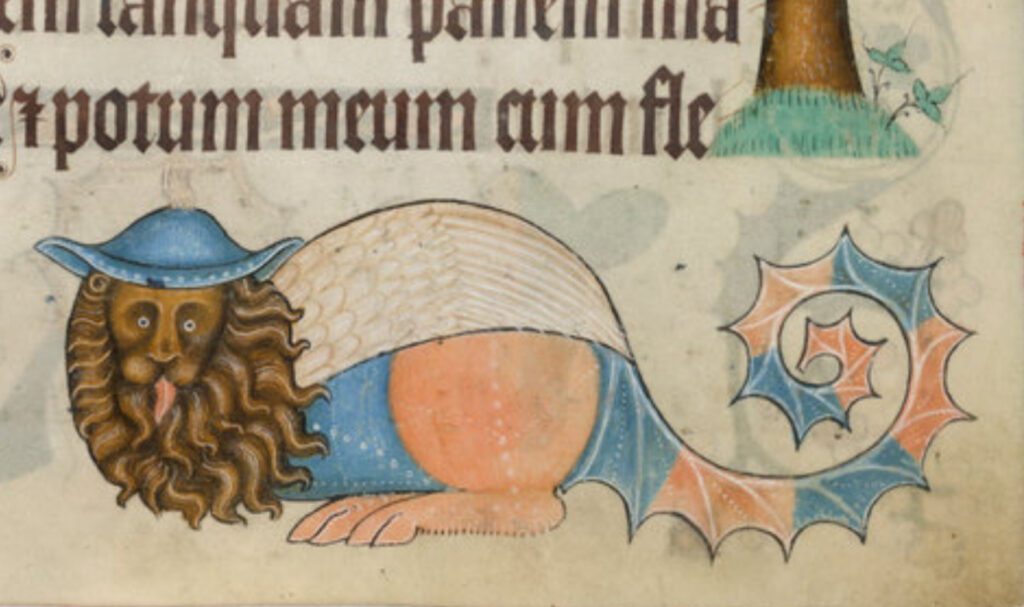
A strange hybrid, with the face of a man and the body of a lion-like beast. It wears a 14th century hood with turn hems and a rather long cape compared to what was typical. Its tail branches off into leaves like those you may see as decorations in line filler or in marginalia. It bows as if to play, sticking out its tongue.
This odd grotesque is one of many weird hybrids and delightful illuminations found within the Luttrell Psalter.
Commissioned by Sir Geoffery Luttrell in the early to mid 14th century CE, the Luttrell Psalter is one of the most richly and strangely illustrated illuminated manuscripts from its period. Who is Sir Geoffery Luttrell, however, and why would he, as a knight, commission an illuminated manuscript?
THE PATRON
Sir Geoffrey Luttrell is most well known for… well, commissioning the Luttrell Psalter. We don’t know a ton about him apart from this, but what we do know, combined with what was typical for commissioned illuminated manuscripts in this age, paints a wonderful picture of why it is that the psalter is so unique.
Sir Geoffery Luttrell, son of Robert Luttrell, was a knight in service of King Edward III. Having fought in border wars with Scotland and having been summoned to fight over 12 times, Sir Luttrell proved his title not only in status but in battle.
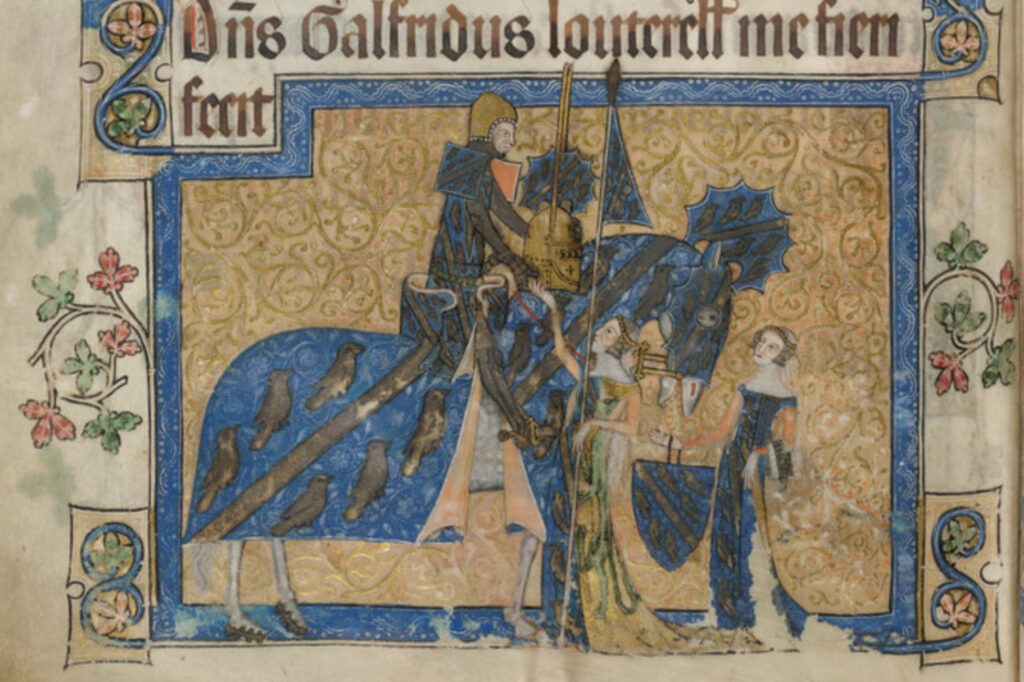
The dedication page of the psalter. Seated on the horse is Sir Geoffery Luttrell, with his wife giving him his helmet and his daughter-in-law standing before the horse with his shield. Note the elaborate and rich dress of everyone pictured, including the horse. All pictured also bear the Luttrell coat of arms on their clothing, a bend between six martlets, mythical legless birds in flight from birth until death that feature regularly in heraldry at this time.
Sir Luttrell was rather rich. He was a knight, after all. At the time of his death, he had been lord of his estates in Yorkshire, Nottinghamshire, Leicestershire, and Lincolnshire for nearly 48 years. These estates included hundreds of acres of farmland and meadow, some of which was not put to use and simply excess, gardens, woods, game parks, quite a few householders, windmills, halls, fishponds, stables, barns for storage of hay and to house livestock, kitchens, various dwellings, churches, chapels, cathedrals, numerous horses and farm animals, and more.
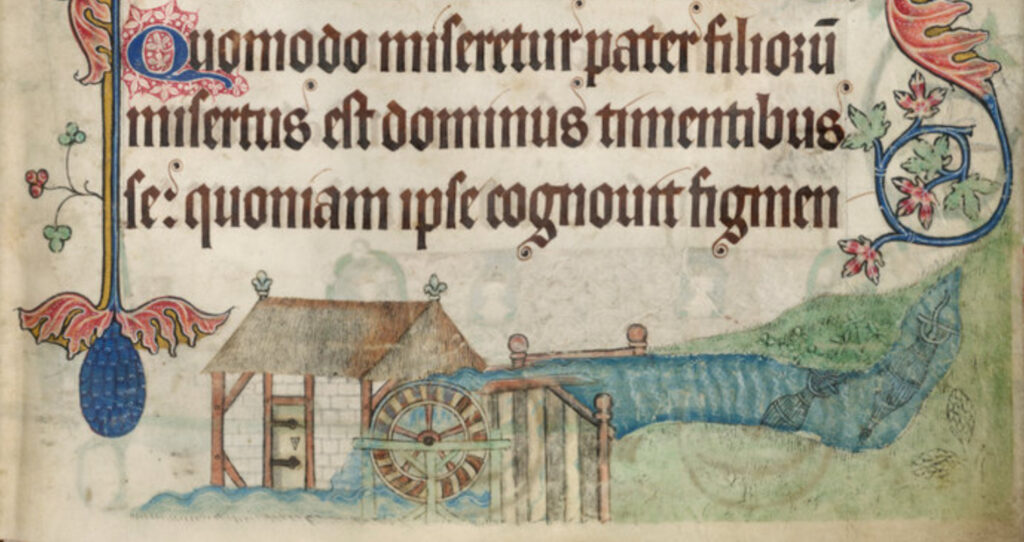
An image of a watermill near a dam, from the Luttrell Psalter. There are traps for catching eels and nets for fish further up in the water. He very well may have had one at one of his vast estates.
Each of these estates paid out taxes, and many of them housed bondmen who owed Sir Luttrell work regularly. At some of these estates were villages that hosted weekly markets and multi-day fairs in honor of feast days, specifically Hooton Pagnell for St. Lawrence in August and Irnham for the week of Pentecost and some days after.
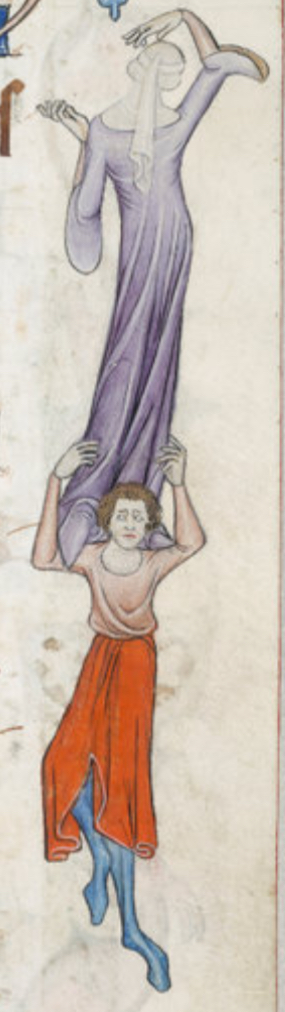
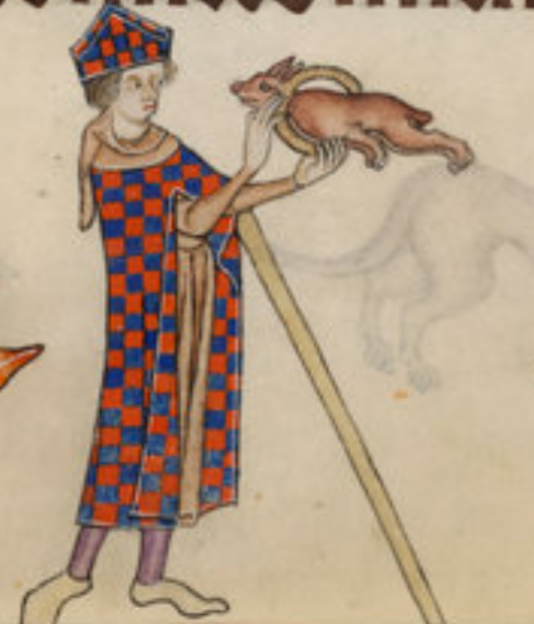
Delightful illustrations of performers, including acrobats and a performer dressed as a colorful bishop with a dog trained to jump through hoops.
We know this through a variety of sources, but a rather detailed one is Sir Luttrell’s will. We see here something unique in what he left not only his family and neighbors, but his servants. Several servants were to receive substantial amounts of money and furniture, some receiving all of the furniture from the places they were regularly set to take care of; for example, the cook received all the cooking utensils and vessels, and the maid everything in the bedchamber, including the bed. What stands out the most here is that Sir Geoffrey Luttrell bequeathed more money to some of his servants- some of whose children were his godsons- than he did to distant and non-immediate relatives. It’s important to mention here that medieval households were different; it wasn’t just a bunch of servants serving a noble family like we see sometimes in pop culture, but rather a home with extended family and family-by-marriage where people associated with your family members were your servants. It’s kind of like your cousins having to clean up after Christmas dinner, and a family friend’s daughters helping cook. In spite of this, the kind of stuff Sir Luttrell specified in his will wasn’t typical- near-relatives usually got more money than servants out of the will.
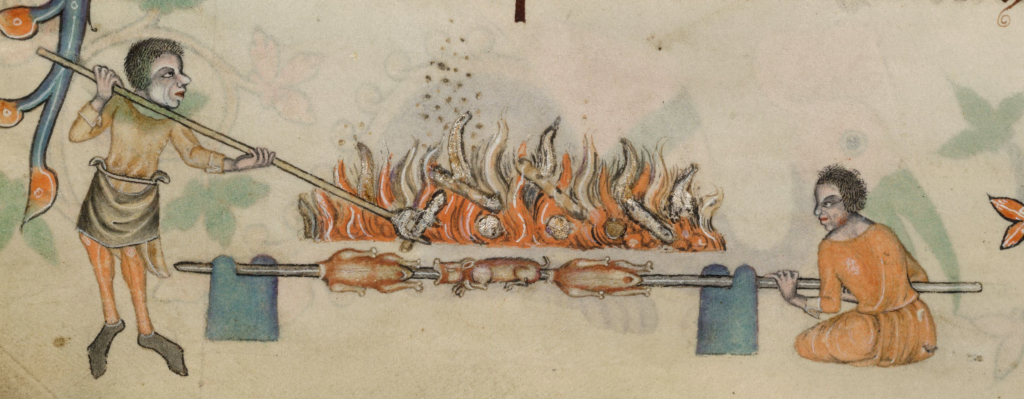
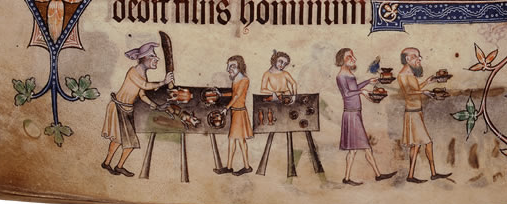
Images from the feast sequence of the psalter. Two men roast meat over a spit, and servants work to prepare and serve food.
Why is this stuff about the will important? Well, it’s mostly because it probably influenced some of the imagery and illuminations in the Luttrell Psalter. Remember how I said images of laypeople and servants that were to this level of detail and of this number weren’t super common? Well, there’s certain people that look pretty distinctive and have a specific demeanor to them in images of servants and laypeople, and it’s theorized that marginalia artists might’ve had certain people in mind when illustrating- likely a request from their patron.
Also, Sir Luttrell focused a lot on protecting his family and his stuff- his land, his people, his churches, farms, and livestock. For a few years before his death- around 5-10 years, and keep in mind he commissioned the psalter 5 years prior to his death- he sought to legally protect and consolidate his estates and to arrange for what would happen to them and his family when he died. This could also be a signifier of his wealth and to show that he spent time in his estates, as the images might have been a sort of physical record of both the land he owned and the people who worked it.
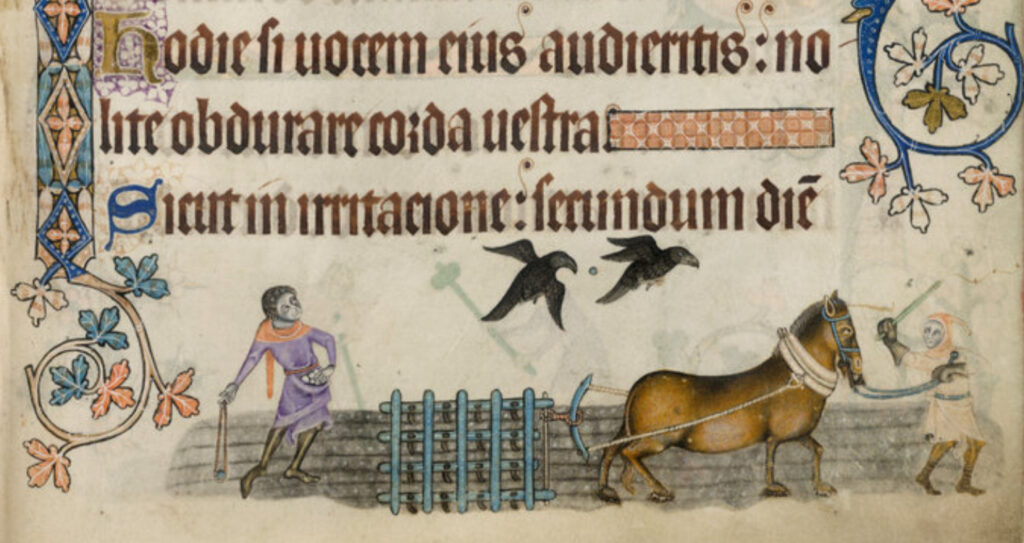
An image of laypeople working the land from the psalter. A lot of these are farming images.One man drives a horse, ploughing, while another hurls stones at a bird with a sling. This was probably really common, and really annoying. There’s various images of farmers and planters shooing off birds, and some very well may be satirical.
Why would somebody like Sir Geoffrey Luttrell spend so much money on a book? The yearly combined income of all his properties was around £22, and it’s theorized the Luttrell Psalter cost closer to £30 or more. It has 309 leaves (huge for a personal prayer book!) made of vellum- calf’s skin- and it wasn’t cheap by any means for that alone.
Let’s talk about the contents.
See you next Wednesday, and as always, thanks for reading!
A creature truly grotesque. He worked for that title.
There’s more where that came from.
REFERENCES
Backhouse, Janet. The Luttrell Psalter. London: The British Library, 1989.
Loven, Pauline. Historical Background : Fourteenth Century Dress and the Luttrell Psalter. London: Bloomsbury Publishing, 2024.
Camille, Michael. Mirror in Parchment : The Luttrell Psalter and the Making of Medieval England. Chicago: University of Chicago Press, 1998.
If you’d like to view images of the Luttrell Psalter, try the British Library. There used to be a full scan online, but they experienced a cyber attack and it’s not available. It isn’t a full version of the real thing, but it includes a wide variety of good scans of many of the pages, and beats spending $3000+ on a beautiful but prohibitively expensive facsimile. Check it out here, on their online image archive.