Isabella Bruce’s name rings out with the declaration of Scottish independence and the proud declamations of dynasty. Her older brother, Robert, lives on in legend and song as the salvation of Scotland from the English, the hero of the Battle of Bannockburn, and the reclamation of Scottish royal power. But for the majority of Isabella’s lifetime, the triumph of the House of Bruce was not inevitable, and generally, quite precarious.
She was born into a world of instability and violence, from which women, even highborn ones, were certainly not exempt. Her generation, cast into the struggles between the English king and the Scottish lords, was one of the most unstable, scarred with civil wars, foreign wars, and insecure thrones. Positioned so close to power, Isabella, her sisters, and her brothers were under threat almost from birth. At one moment, women might be crowned and in the next, imprisoned, and their very survival seemed to depend entirely on the prowess of men on distant battlefields.
She was born into a world of instability and violence, and women, even highborn ones, were certainly not exempt.
In 1293, at twelve years old, Isabella became the first truly royal Bruce, when she travelled across the Northern Sea to marry Eric II. She was his second wife, and the second Scottish lady to make the same journey. The first one, Princess Margaret, the firstborn child of King Alexander III of Scotland, had died giving birth to the Maid of Norway, the little girl whose death would set in motion the wars that would shape Scottish history. Isabella would certainly have been aware that the dark waters and distant shores were not always kind to young women. She also knew that her future happiness depended upon the goodwill of her new family and the fortunes of her new country.
Yet, while Isabella’s fortunes took unpredictable turns, her destiny was also shaped by marriages, births, and wars that all occurred generations before her birth. The marriage she would soon celebrate was forged through the intersection of multiple rivalries—between Scotland and England, between Norway and Denmark, and between Scotland and Norway.
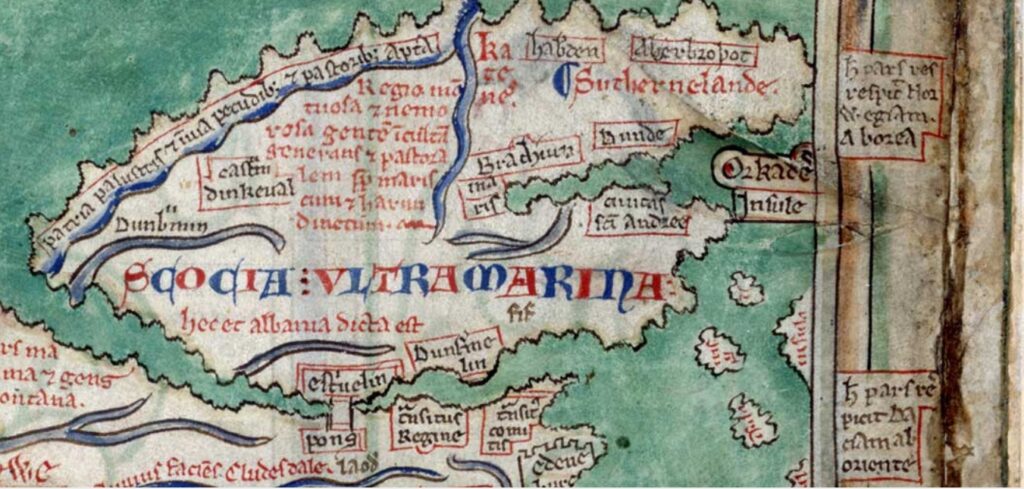
A close-up of several North Sea isles, including the Orkneys, from Mathew Paris’s map of Britain, c. 1250. The margin note reads “hec pars respeicit Norwegiam aborea,” “this part looks northward towards Norway.” Explore this interactive map (and others) here:
Today we think of Scotland and Norway as inhabiting separate worlds—the one British, the other Scandinavian—but the northern waterways connected all those frozen tiny islands at the world’s end—and rival kings had battled for them over centuries. Island groups such as the Shetlands, the Hebrides, and the Orkneys were traditionally of Celtic origin, but during the ninth century, Viking warriors claimed them and formed independent sea kingdoms. As powerful kings rose up in Norway and Scotland during the high Middle Ages, they each sought to claim those rocky windswept outcrops for their own. During the mid-thirteenth century, King Hakon IV expanded the Norwegian kingdom into an overseas empire, exerting power over Greenland and Iceland. Winning the Scottish islands pitted him against Alexander III, but Hakon died while wintering in the Orkneys, leaving the Norwegian throne to his more peace-minded son, Magnus Lawmender. Rather than continue his father’s campaigns, Magnus happily negotiated the Treaty of Perth in 1266, relinquishing the Hebrides and the Isle of Man to Scotland. Although in return, he received Alexander’s recognition that the Shetland and Orkney islands belonged to Norway, as well as an annuity of a hundred marks of silver, no doubt his battle-hardened father was turning over in his grave. As his name implies, Magnus had other priorities, but for Alexander, the Treaty was just one strategic move in his game of empire.
In 1281, the children of the reconciled kings would marry, a union which Alexander hoped would reassert Scottish domination of the northern islands. Alexander’s daughter Margaret was twenty years old, half Scottish, a bit English, and quite French. Her mother was the daughter of Henry III of England and Margaret of Provence. Her maternal uncle, Edward I of England, was fond of her, and the Scottish and English courts maintained close connections, as well as with continental European courts—Alexander’s own mother, Marie de Coucy, was the daughter of a powerful French baron.
Despite his royal status, Eric was barely thirteen, an unbecoming age in any era. Margaret was less than thrilled with her prepubescent bridegroom. According to the Scottish Chronicle of Lanercost, she was married unwillingly and “raised him to a more honorable level in regard to clothes and food.” One can read that with a bit of skepticism, as the chronicler was no doubt suggesting a comparison with the saintly queen Margaret of Wessex, who tamed the barbaric court, and heart, of King Malcolm Canmore. The Norwegian court in the thirteenth century was certainly not a cultural backwater. Yet, it’s not difficult to imagine that Margaret, with her English and French connections, had hopes for a marriage closer to home at a familiar court. And she did not fare well in her Northern kingdom. Before Eric had turned fifteen, he found himself a widower with an infant daughter. And that tiny girl became his trump card as fate cast its shadow upon Scotland.
With the death of his daughter, Alexander III must have wondered if the fickle wheel of fortune had decided to cast him off. His son David had died the year of Margaret’s marriage. And within one year of Margaret’s death, his oldest child and heir, Alexander, died. He began to scramble for an heir, marrying a young French girl and hastily trying to conceive one. But until he did so, his only surviving successor was his new Norwegian granddaughter. When in 1286, Alexander died after falling from a horse galloping towards his new bride, Eric II realized that he held the new Queen of Scotland in his royal nursery. Eric II delighted that his only child would inherit the crown of his greatest rival, no doubt dreamt of empire—not only the northern Scottish isles, but the entirety of Northern Britain and beyond. Six Scottish guardians were chosen to rule in her name (two bishops, two barons, and two earls), and powerful men across three kingdoms started plotting as to how they could get their hands on the Maid of Norway, as she became known. Certainly the senior Bruce thought she would make a grand match for one of his young grandsons. Whether or not Eric II was a loving father is unknown, but even the most mercenary parent hesitated to send a three-year-old girl into a nest of barons aiming either to capture or kill her, and thus his daughter remained in Norway. In 1290, the crafty Edward I of England stepped in to guarantee her safety and negotiated a betrothal with his own son and heir, six-year-old Prince Edward. The royal couple would rule the two kingdoms together, albeit with the caveat that he and Alexander agree to a betrothal between Margaret, the Maid of Norway, and Prince Edward, the heir to England (future Edward II), with the provision that Scotland would remain an independent kingdom.
And at seven years of age, the Maid set sail.
And at seven years of age, the Maid set sail. Her ship wrecked off the ferocious Orkney coast, the only part of her new kingdom the motherless child would ever see. She never met her new betrothed or her father-in-law—she died on the same island, possibly from having eaten spoiled food onboard the ship, alone, and no doubt terrified. And thus with the death of one little girl, the great House of Dunkeld came to an end and so commenced the Great Cause—the legal dilemma that led to a war that brought about Scottish independence.
Further Reading
The Wars of Scotland, 1214-1371 by Michael Brown, Edinburgh University Press, 2004.
Valeria Di Clemente “The Trousseau of Isabella Bruce, Queen of Norway (The National Archives, Kew, DL 25/83)” in Medieval Clothing and Textiles 18 edited Cordelia Warr ,Boydell Press, 2024.
Queenship in Medieval Europe by Theresa Earenfight, Red Globe Press: 2013.
Robert the Bruce: King of the Scots by Michael Penman, Yale University Press, 2018.