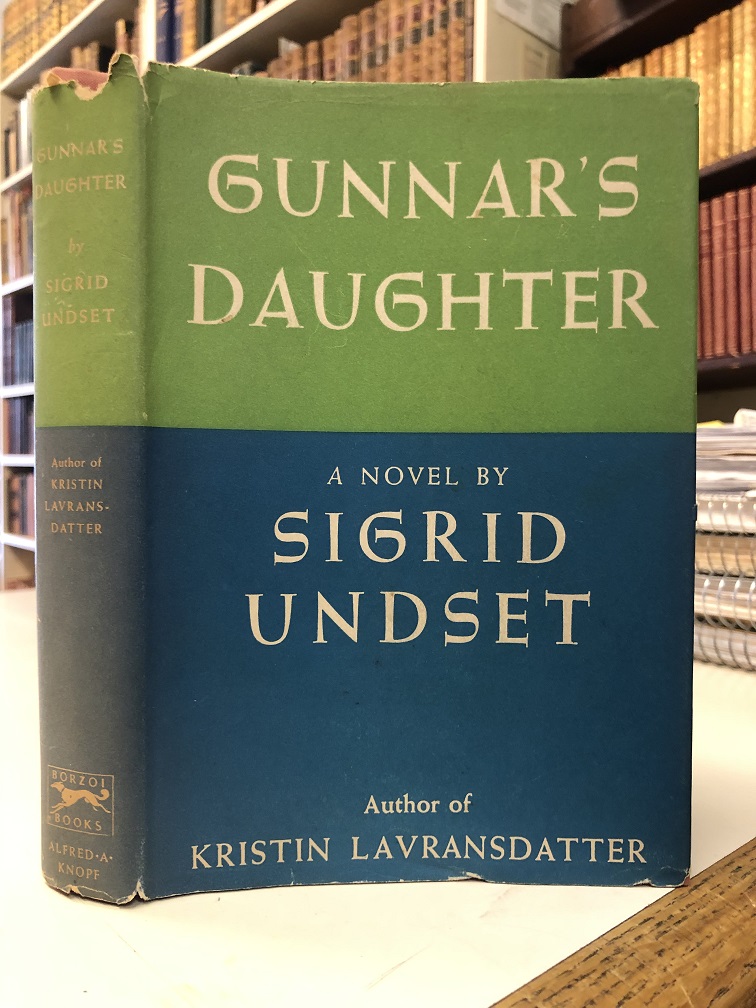
The first in a series of reviews on classic historical novels set in the Middle Ages.
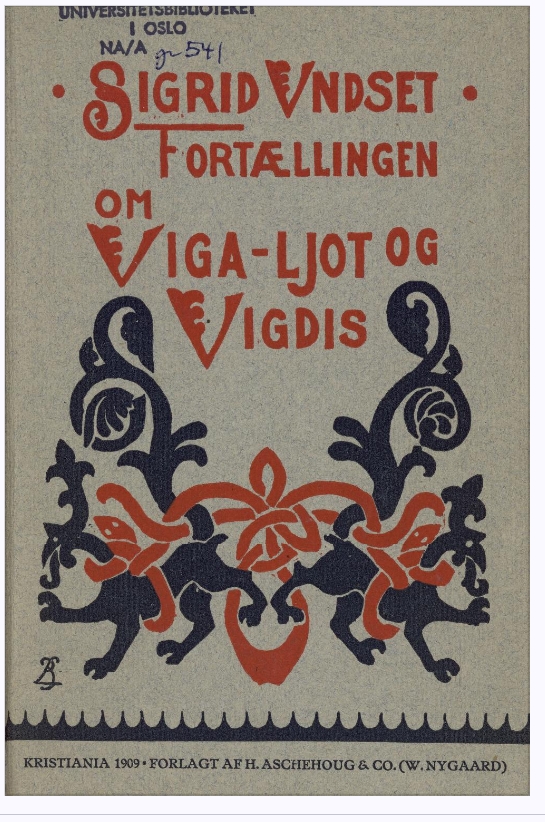
It always seemed to me that epics, especially those of Western origin, were written for men almost exclusively. They were stories that explored the nuances of father-son relationships, inheritance, brotherhood, war, and the demand to prove oneself in a culture of honor. The women featured in the narratives were often merely obstacles in the protagonist’s journey – a stick that inflicted suffering or a carrot promised at the end of a quest. Their feelings of love, betrayal, anger, and grief served to confuse the heroes. Thus, when I first began Sigrid Undset’s 1909 historical novel Gunnar’s Daughter (originally published in Norway as Fortællingen om Viga-Ljot og Vigdis) and read in the first chapters of the cocky, darkly handsome Ljot becoming infatuated with the Norwegian chief’s daughter Vigdis, I expected a familiar kind of story.
Perhaps Ljot would steal Vigdis away like Helen of Troy, starting a war that would stretch across the Norwegian sea. Maybe he would win her hand through a heroic trial like Perseus did Andromeda. Possibly, he would promise devotion only to leave in the end, pulled away by some demand the weak hearts of women were too emotional to understand, like Jason had with Medea or Aeneas with Dido. What I found instead, however, was an inspiring story that provided literary validation for the violations against women’s bodies and agencies.
What I found instead, however, was an inspiring story that provided literary validation for the violations against women’s bodies and agencies.
Through the epic tale of Vigdis, Gunnar’s Daughter engages with the psychological and emotional dimensions of rape, victim blaming, and abortion; these are matters that contemporary society and politics too often ignore or handle with disregard, with the experiences of women continually subordinated to male narratives.
Ljot is absolutely awful, lacking any of the charismatic charm associated with epic heroes. He is disrespectful to Veterlide, who took him on as his charge after the death of his parents, loving him “as his own son” (03).* Despite Veterlide’s attempts to instruct him in the proper manners of trade and travel, Ljot’s short temper and arrogance constantly cause diplomatic fiascoes that Veterlide is forced to clean up. Among Ljot’s most despicable acts is his killing of the horse of Kaare, a childhood friend of Vigdis. Ljot is extremely jealous of Kaare and challenges him to a horse fight, only to kill his steed in a fit of anger after losing. He later laughs as Vigdis was “crouching by the dead horse and patting him, weeping sorely,” (36). Ljot is so incapable of self-reflection and empathy that he still does not understand why Vigdis does not want to marry him. If she is not wooed by acts of cruel strength and harsh wit, Ljot decides that childbearing would make her more receptive to his feelings – he rapes her. This revolting plan is ruined when he returns, and she appears not to have the baby. True to his established behavior, Ljot responds to this by throwing a fit and returning to Iceland to brood.
However, as the story progresses, Undset undertakes the challenge of allowing Ljot a form of character growth, engaging with the moral debate of whether someone who commits sexual assault can be reformed and, if so, whether this diminishes the trauma experienced by the victim. After returning to Iceland, Ljot marries Leikny, a Lavinia archetype whose affection was only partially reciprocated. Just as the Latin princesses’ relationship with Aeneas was forever haunted by the memory of Dido, so too was Leikny continuously reminded that she was nothing but a shadow to the leading woman in Ljot’s story. Ljot only married her because he needed a wife to attend to his estate, and despite her attempts to be the perfect partner, he remains lovesick over Vigdis, stating:
But I love the black spot she had between her breasts more than all Leikny’s beauty. I loved her more when she struck my throat with her knife than I love Leikny when she puts her arms around my neck. I was less sorrowful as I rode over Dovre in wintry weather thinking of her curses than when I ride to Skomedal knowing Leikny will meet me with kind words at our door. I would rather be hugged in the clutch of the white bear than to think of Kaare holding her in his embrace (183-184).
Even after overhearing this cruel confession by her husband, Leikny remains devoted to her position as Ljot’s wife, promising, “It must be as you wish – with me you will always find life as you will have it, (188). Over the following years, Ljot forms a deep connection with Leikny, founded on the domestic peace and simplicity of family life. Just as he is starting to live a life in which the memory of Vigdis is fading in the midst of time, tragedy, and perhaps karma, strike, as all the children Leikny and he have die suddenly from a terrible accident or waste away from illness. Leikny shrinks to a skeletal figure of grief before she, too, passes after her last childbirth, leaving Ljot surrounded by the emptiness following the loss of those for so long he dreamed of replacing. In the midst of his sorrow, Ljot seemingly contemplates how his selfishness and heinous cruelty have destroyed so many beautiful people in his life. Sigrid Undset writes Ljot as almost a vampiric figure, sucking out the joy, love, and goodwill in both the women in his story, using them for his own needs and desires. For the first time in the epic, Ljot feels guilty and ashamed, and the question then becomes, can a vampire ever lose his monstrosity?
Sigrid Undset, nevertheless, does not forget whose epic this book is, nor does she shy away from vividly portraying the horrors suffered by women whose bodies have been invaded and continue to be invaded as their attacker’s child feeds and grows inside them. After Vigdis is blamed by her father for “allowing herself to be seduced” and bringing shame into his house, Vigdis falls into a suicidal depression that mirrors the emptiness felt by so many survivors, with Undset writing:
Vigdis now sat at home at Vadin and was so full of sorrow that nothing could cheer her; she hardly cared to take food or drink, to dress herself or comb her hair; never could she take her thoughts from the wrong Viga-Ljot had done her . . . She said to herself: ‘Now I am like a bird that lies on the ground fluttering its broken wings; it cannot move from the spot where it has fallen, and it cannot see farther than the stream of its own blood,’ . . . Often she thought it would be best if she went and lay down in the river . . ., (63-64).
This delicate, heart‑wrenching simile is a testament to Undset’s extraordinary talent for using imagery to convey feelings of loneliness, gentleness, and brokenness—emotions that cannot be fully expressed through direct articulation alone. Another example is when Vigdis, withdrawn in the woods giving birth to a child she cannot tell if she loves or loathes, looks to a horse for solace. She finds in the animal the comfort people have withheld from her. Undset describes, “Each time the pains came on she threw her arms about his neck and leaned against him, and then he turned his head, nibbled at her shoulder and back and stood quite still,” (70). Even as Vigdis goes on to be the defender of her father, her son, and her land, the imagery never allows the reader to forget that while the rape almost became forgotten by Ljot, its memory was never far from her.
Despite being written over a century ago, I think readers will find it relevant and transformative.
Undset’s epic is extraordinarily contemporary in its themes while remaining rooted in the traditions of the genre. Despite being written over a century ago, I think readers will find it relevant and transformative. She explores the nuances of one of the most difficult and harrowing experiences that have long haunted women: rape. Whether it concerns the nature of the attacker—man or monster—or the conflicted emotions of the woman, such as the fine line that exists between hatred and love or mothering a child who has the face of her abuser. There is no clear answer about what is justified or how one should respond. Rather, the epic embraces the complexities of human nature, showing us that we can be both horrendous and resilient. In this, it stands as a profoundly human epic that can stand next to the greats.
* All quotations from Sigrid Undset Gunnar’s Daughter Translated by Arthur G. Chater New York: Alfred A. Knopf, 1936,
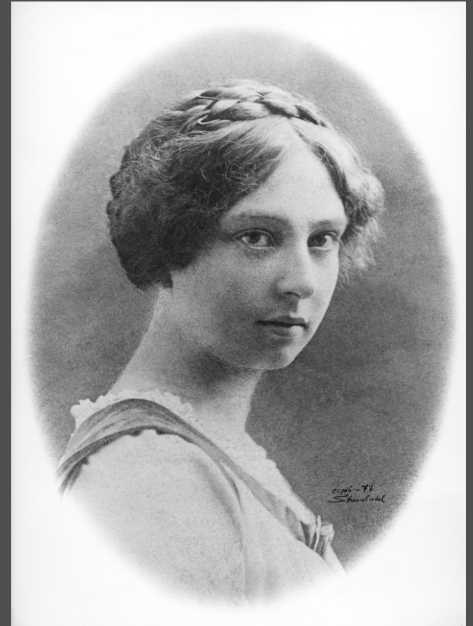
Sigrid Undset was a Norwegian novelist who won the 1928 Nobel Prize in Literature. She is best known for her emotional realism, historical focus on medieval Scandinavia, and the experiences of women.Undset embodied the need to never look away from or remain silent about the horrors done to others in both her books and life. Her public opposition to the Nazi regime caused her name to be on the first list of those to be arrested by the Gestapo following the German occupation of Norway, and she was forced to flee to the United States, where she continued to speak out.