by Amanda Larch Hinchman
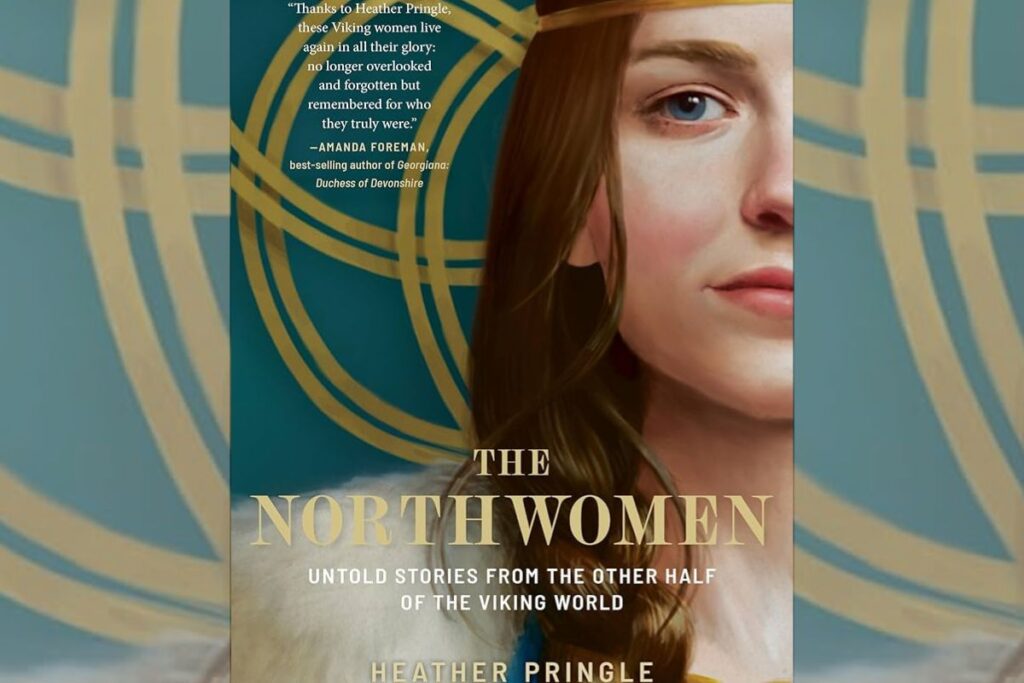
The Northwomen: Untold Stories From the Other Half of the Viking World by Heather Pringle explores the exciting and often forgotten lives of Viking women. Pringle, a freelance science writer, turns to historical exploration in her latest book, in which she expertly weaves a comprehensive investigation into the women of the Viking world. Not all women were confined to the home, contenting themselves with daily domestic affairs. Instead, readers can learn just how vital women were to the famous successful seafaring missions, how women served as a conduit to the supernatural, and how female explorers, traders, and merchants made fortunes and names for themselves. Women, she demonstrates, were able to use their skills and talents to carve out happier lives for themselves.
Broken up into different subjects, ranging from sorceresses and ancestors to weavers and voyagers, each chapter begins with a short original fictional piece, imagining the life and characteristics of various women and young girls of the Viking Age. This filling in of the gaps is a standout feature of this book, and truly, it feels as if this is where Pringle’s strengths as a fiction writer shine through the most. She relies on archaeological evidence to lay out the rest of the available knowledge.
And yet, it seems not every famous—or infamous—Northwoman was included in the book. Understandably, Pringle wanted to stick to tangible evidence as much as possible and not solely present figures from myths and popular stories like the Icelandic sagas. While some of these women or their fictional counterparts are included, it would not have been an unwelcome addition to her book, even in a short section, to incorporate a few additional fabled Norse women. The Valkyries, for example, were glossed over without exploring any potential real-life equivalents. Even the concept of shield-maidens, familiar to most people, is not discussed.
Plenty of stories of Viking men make their way into the book, though. Certainly, Pringle needs to set the stage and provide necessary context, but sometimes the context begins to feel like filler, especially when stories of men seem to take the forefront. One wonders if there was enough solid material surrounding Norse women to fill an entire book, as some of the book’s content also seems to be conjecture, either from the author or from those expert archaeologists and historians she interviews.
That’s not to say readers won’t learn anything. This book is perhaps one of the best resources that includes stories of so many Viking women in one place. Pringle also focuses on bringing provable source-based stories to light as opposed to popular myths of modern culture and media.
The most fascinating story and evidence relayed in the book is that of the Oseberg women; it’s clear this enthralling Viking burial—one of the most complete and complex uncovered so far—is the central theme of Pringle’s work and the true inspiration behind the book itself.
Equally entertaining and informative was the section detailing just how much physical labor went into weaving protective clothing for Viking expeditions and ship sails ideal for all conditions at sea. Without the women’s dedication to weaving, which involved countless hours, the Viking world and its imprint would have, in all likelihood, been much different. Readers will surely enjoy learning about modern experiments to reconstruct Viking era sails, as well as woolen armor, using traditional methods.
We don’t often think of the Vikings trading their wares in the midst of Eastern bazaars or walking the streets of Constantinople, but Pringle helps us realize the true breadth of their trading and exploring beyond the North and West.
Another aspect to be appreciated is Pringle’s explorations of the tantalizing connections between Viking Age Scandinavia and the East. When we think of the Norse, our imaginations tend to drift toward Iceland and Greenland, perhaps to North America and Newfoundland. We don’t often think of the Vikings trading their wares in the midst of Eastern bazaars or walking the streets of Constantinople, but Pringle helps us realize the true breadth of their trading and exploring beyond the North and West. The archaeological evidence is astounding; it’s made apparent how much the East influenced the Viking settlements and vice versa.
As to be expected, there is some heavy material here; Pringle doesn’t shy away, because if she were to do so, these women’s stories would not have been done justice. We can’t and shouldn’t turn away from the cruel treatment of enslaved women whose lives were full of violence and cruelty in favor of a different, less well-rounded view of the Norse. These are the realities of the Viking world that need to be told, and comparing the experiences of Viking slave women, from both at home and abroad, to modern day women captured by ISIS and sold as sexual slaves felt especially poignant.
Pringle herself is relaying what others have found and discovered. She assumes the role of the writer who captures and relays the insights she gains from others. She is not actively employed as an archeologist and so is not conducting new research herself. Nor is she providing new insights aside from helpful conjecture.
So, while her background helps the tone of the book feel more approachable to the layman, nonexpert or casual reader, those who already know much about the subjects might feel this book doesn’t present anything new or groundbreaking. That is to say, the target audience is most likely those curious about stories of female Vikings—maybe not those already immersed in or familiar with these tales.
Well-known experts in the field, such as Charlotte Hedenstierna-Jonson and Neil Price, are invaluable voices in this book. All the different settings come to life, and thanks to the comprehensive map, readers won’t get lost. There is no doubt about the amount of research that went into this work. With its conversational writing style, it’s truly accessible, though at times the writing feels a bit repetitive (the amount of times the word “indeed” is used per page is a good example).
The Viking world will always fascinate us, and with more archeological finds surely waiting to be discovered, it will continue to capture the imaginations of generations to come. Norse women deserve to be studied just as much as their men. The Northwomen is a great jumping off point.
The Northwomen is a necessary work of nonfiction, proven by the outrage surrounding the identification of one famous warrior as female. Viking women were more complex than many realize. That is Pringle’s point. Her book is just the beginning.
This book’s greatest feat is how it reframes some context and poses new questions. Perhaps the most complete work out there so far geared towards a non-academic audience, it opens the door for more women, both real and fictional—the inspiration behind the mythological—to also be brought to light.
A lifelong reader and creative, Amanda Hinchman graduated Marshall University in 2020 with a degree in print journalism and minors in English and Women’s Studies.
She is the copy editor for Highland Outdoors magazine and has edited many books. As a freelance writer, she regularly reports on her home state of West Virginia. Her areas of expertise include outdoor recreation and the arts.
Read more about her writing and travels at