History wasn’t my favorite subject during the earlier grades. Fill-in-the blank dates and bullet-point lists never seemed to capture my interest the way stories did. That was until I was introduced to Lois Lowry’s Number the Stars in a middle school course. This tiny book brought to life the terror that was embedded in the everyday moments of the Holocaust as well as the tenderness of child kinship through the lens of the school age girl, Annemarie Johnson. It was through historical fiction books like Number the Stars and the dozens more I began fervently pulling off the self that I absorbed more empathic insight than I ever did from textbooks.
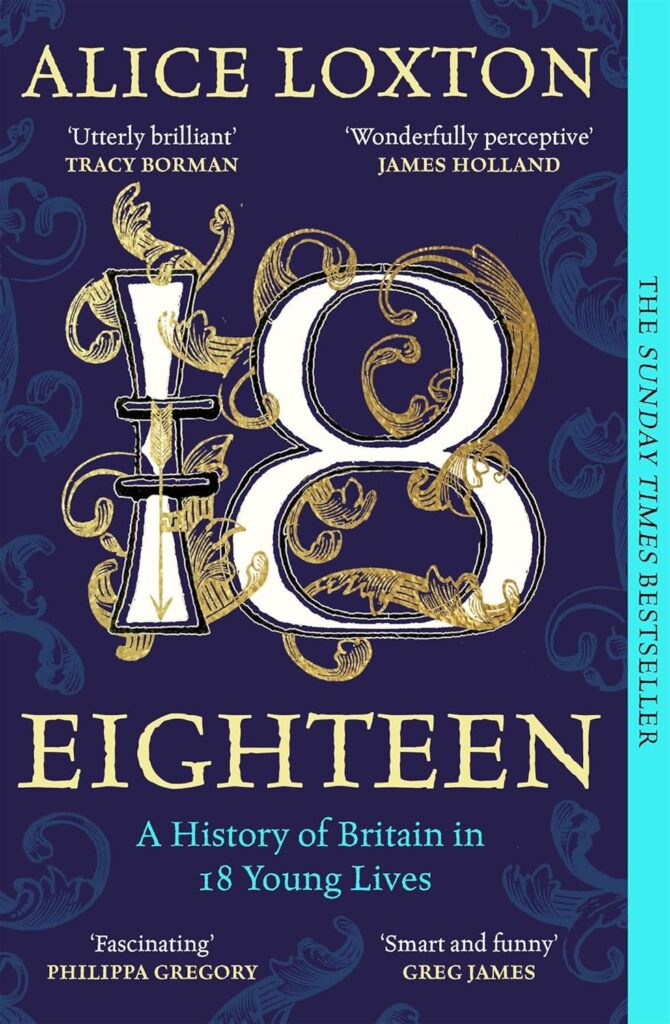
I start with this explanation of personal preference to better explain why I found such enjoyment in Alice Loxton’s book Eighteen: A History of Britain in 18 Young Lives. Loxton takes on the formidable challenge of outlining the history of Britain from the seventh century to the 1990s. She does not, however, follow a more traditionally academic method of dedicating each chapter to a century with paragraphs describing events, people, and societal culture. She instead selects a particular individual and uses their story to consider what it was like to live in the distinctive world of that moment in time, giving her book a thoroughly human perspective. Loxton discusses how the direction of her book stemmed from a starting question of what it was about the age of eighteen that makes it so special in today’s Britain.
“That’s the riddle we’re trying to solve. To understand our modern perceptions of what it means to be eighteen, we must break away and examine what being eighteen has meant for over a thousand years . . . This is snapshot of Britain through the eighteen-year-olds who have sculpted it. This is what it means to be British. This is what it means to be eighteen,” (7-13).
Loxton maintains a witty and interactive narrative flow as she uses documented evidence to postulate the personality, emotions, and voice of each figure. She even includes a playful snippet, dare I say fanfiction storyline, of the people coming together to have a shared birthday party, complete with spinning the bottle, dancing, and conversations between those who never walked the earth at the same time. As she explains, “These are, on one level, extra sprinkles of fun. But there is a serious, important point to this. By bringing these figures from the past into the room with us, they become flesh and blood, not just names in a book,” (12).
Loxton is brilliant at creating an immersive experience for the reader, using descriptions of simple details such as weather, smells, and noise to render vividly the world of each person. Her verbal illustrations portray scenes I could see being physically depicted in the beautiful, hand-drawn animation of studios like Cartoon Saloon. Seven-year-old Bede travels across the grey landscape of Northumbrian to a monastery, stepping over the ruins of Roman walls. The table at which he spends quiet meals surrounded by his brethren is engulfed by the sound of desolation as he and the Abbott are the only ones who do not succumb to the bubonic plague.
Loxton is brilliant at creating an immersive experience for the reader, using descriptions of simple details such as weather, smells, and noise to render vividly the world of each person.
Dressed in a Scottish arasaid, Fionnghal nic Dhòmhnaill (better known as Flora MacDonald) trudges across hills carpeted in heather and strange stones that shadow the warring land. Renowned writer Geoffrey Chaucer, author of The Canterbury Tales, grew up the son of a wine tycoon near the portside wonders of boats unloading treasures like Spanish leather, German beeswax, Italian glass, and far east spices. It is not a coincidence that his church St. Martin in the Vintry held an altar dedicated to St. Thomas Beckett, whose shrine in Canterbury was a destination of pilgrimage. Clive Staples, author of The Chronicles of Narnia, served in World War I. Amidst the wet trenches and crushed, “beetle-like,” bodies of World War II France, he escaped to his memories of the Castlereagh Hills, Dunluce Castle, his red-brick house ‘Little Lea,’ and the ‘paradise’ of his brother’s toy garden.
Loxton includes stories that highlight individuals born with physical disabilities, such as Sarah Biffin, born with a condition that left her without arms or legs. Her parents attempted to protect her from the world, but she refused and taught herself to sew and paint using her mouth. A natural entrepreneur, she marketed her skill and became one of the most distinguished artists of her time, with patrons that included the Prince of Orange and Sir Thomas Lawrence.
Other stories of inspiration include Rosalind Franklin, a Jewish girl who became a leading figure in the study of DNA despite the spread of antisemitism from Hitler’s Germany, and Richard Burton, the son of an alcoholic Welsh coal miner who became a renowned Shakespearean actor as well as a Hollywood movie star.
I have to praise Loxton’s inclusion of many female powerhouses. Lady Elizabeth, despite being brought up in a household of religious division, patriarchal murder, sexual abuse, and familial ostracization, became the queen who ruled over the golden age of Gloriana. Those today who mock Taylor Swift for being thirty-give years old without a husband or kids would have a heart attack over Queen Elizabeth. Mary Anning, merely continuing a private passion she began with her father, analyzed fossils on the coast of Dorset and constructed theories on evolution forty years before Charles Darwin would write his work On the Origin of Species. Deservingly, she was applauded as the “princess of paleontology.” Vivienne Westwood, who from her earliest age wanted to do something that mattered and saw no reason that being a girl meant she couldn’t, went from a receptionist in-training to a punk-age fashion icon, rightly dubbed the “grandmother of punk.”
In my praise for Loxton’s unique style of discussing the extensive history of Britain, I do not mean to diminish those who favor a good academic essay or factual book. I think these are important pieces for historical study. Rather, I want to advocate for a more narrative-based style of historic retelling It is certainly more than fluff. Not only can a properly done historical fiction story teach correct information, but it can reach a broader audience range, especially those who find it difficult to understand traditional textbooks. While Loxton’s work is not a full historical fiction novel, it does introduce a unique blend of storytelling and documented timelines of cause and effect. In the final chapters, Loxton emphases the human behind each name, describing them as individuals who endured hardships of trauma, loneliness, the burden of meeting expectations. and the ever-persistent anxiety of making enough money to survive. They were youths who desperately clung to the praise and encouragement of parents, teachers and mentors to validate their potential. Also, they were almost all bookworms.
Those today who mock Taylor Swift for being thirty-give years old without a husband or kids would have a heart attack over Queen Elizabeth.
Perhaps this mix of struggle, dreams, and love of reading is the formula for success. She dedicates chapter eighteen to “REA DeDARRE,” or “Dear Reader,” encouraging whoever has the pleasure of picking up her book to see themselves as someone who could one day join the group at their shared birthday party and tell them what they have done with their lives.
If you want to catch the historical fiction bug and remain in the British Isles is Ken Follett’s The Evening and the Morning and A Column of Fire. To read more about Alice Loxton and her upcoming publications, see