On the 14th of December 1911, a party of five Norwegians planted their flag at 90° South—the bottom of the world. Their leader had done what had seemed impossible for centuries; he had led a team to reach the South Pole and lived to tell the tale. In the process, he defeated his English rival, Robert Falcon Scott, in what the press dubbed “the race to the final frontier.” Such races are commonplace in history, with each tribe or nation led by ambitious men who desire to be the first: first to cross the Rubicon, first to circumnavigate the globe, first to fly across the Atlantic, first to climb Everest, first to space, and first to the moon. For Amundsen, though, becoming an explorer was a lifelong dream, a dream that electrified the world in an age when vast swaths of the planet remained uncharted. Polar exploration was the last frontier, a test of national pride, and a feat of human endurance and technological ingenuity.
Amundsen was no adrenaline-seeking daredevil. He was a genius of logistics—he viewed exploration as a science rather than a gamble. Many others had died in this extraordinary endeavor for various reasons, whether it was by scurvy, starvation, or simple lack of planning. Amundsen had put in the effort where it mattered most; he had studied, he had learned from Indigenous communities, he had embraced new technologies, and he had obsessed over the details and logistics of the entire expedition. His success in being the first in history to reach the planet’s southernmost point was no mere stroke of luck; rather, it was the result of painstaking planning and design.
Roald Amundsen was born in Borge, Norway, on July 16, 1872, to a family of sea captains and shipowners—the sea was in his blood. Despite his grandiose adventures in later life, he was a lousy student, disengaged and perhaps bored with his studies. He even goes on to discuss in his autobiography, My Life as an Explorer, that he was “worse than an indifferent student.”
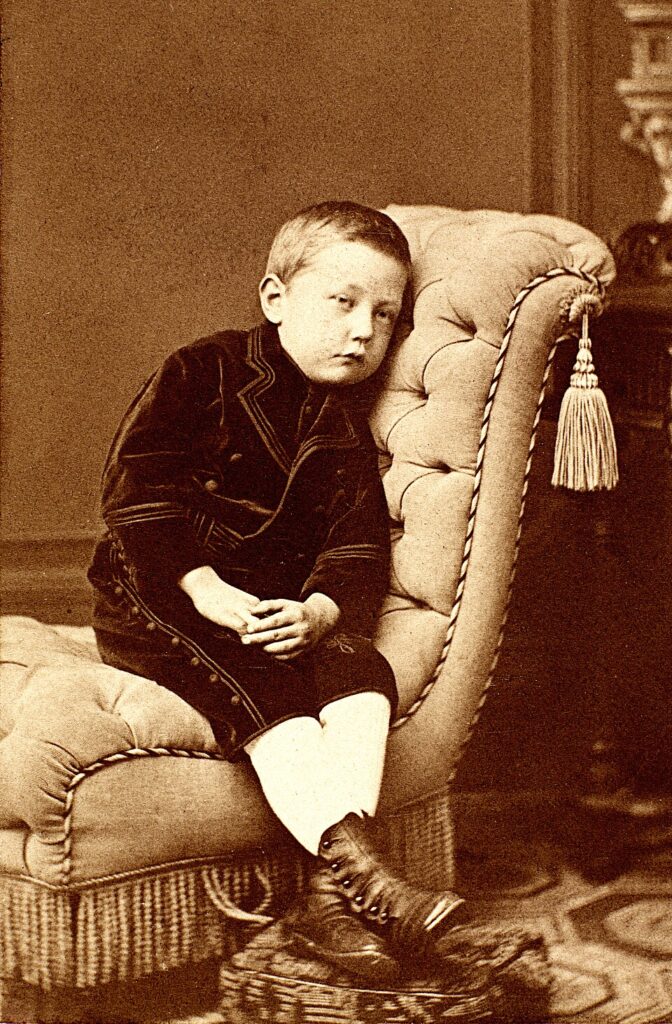
When he was fourteen, his father passed away, and his mother, who was concerned about his future, urged that he study medicine. Amundsen honored his mother’s wish until her death in 1893. The day of her passing, he dropped his medical studies and never looked back. At twenty-one years old, the sea was calling, and like his sea captain forefathers and Viking ancestors, he would answer.
Many stories of polar exploration sparked the ambition in the young Amundsen. One story that particularly caught his attention was that of the fate of Sir John Franklin, which tragically resulted in the entire expedition vanishing in the Arctic, never to be heard from again. This story haunted Amundsen, and he was determined that his would not end the same way. This same child who read tales of doomed expeditions would one day become the first man to traverse the Northwest Passage, the first to fly over the North Pole, and the first to set foot on the South.
From a young age, he began preparing for his career as an adventurer and demonstrating signs of his astute discipline. He forced himself to play soccer, even though he didn’t care for it, doing so for the exercise and the discipline involved. He took up skiing and was a self-proclaimed natural. During the winter months, young Amundsen would trek the Norwegian wilderness, developing a keen sense for travelling over ice and snow. Much to his mother’s horror, he would even sleep with his window open to prepare his body for the cold.
This brutal training nearly sent him to an early grave. At twenty-two, while attempting a winter crossing of a Norwegian plateau, he became caught in a snowstorm and ran out of provisions. Desperate to find any refuge from the elements, he dug a snow cave to sleep. When he woke up, though, he found himself paralyzed and practically frozen into a block of ice. He recalls struggling for what seemed to be hours to escape until his companion found him and dug him out.
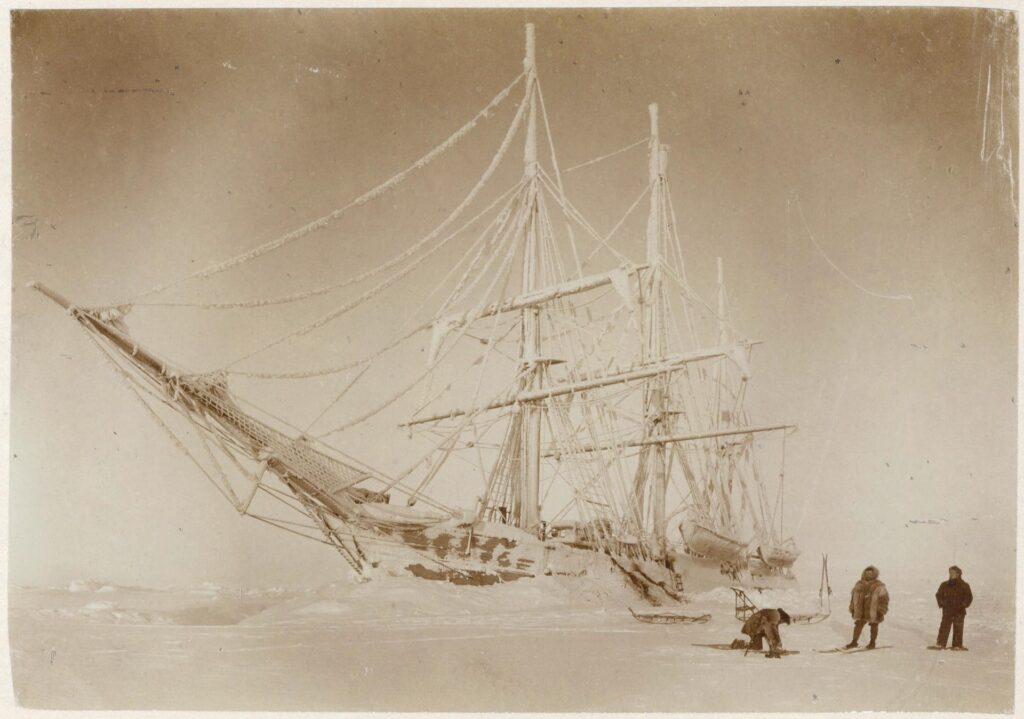
His first taste of exploration came in 1897. He had signed on to be the first mate of the Belgica, an ill-fated Belgian expedition that would become the first to overwinter in Antarctica as the ship accidentally became stuck in the ice. The voyage saw horrible conditions; the crew dealt with insanity, scurvy, and near starvation, but Amundsen benefited from this tumultuous journey. He had previously read that fresh meat, such as seal and penguin, was the most reliable defense against the bane of scurvy. During the expedition, his commander had promoted him, and his first directive was that the crew eat previously harvested seal meat. According to Amundsen, within a week, the scurvy-stricken crew began showing drastic improvements.
Surviving the disastrous trip to Antarctica, he set his eyes on the coveted shortcut route connecting the Atlantic and Pacific Oceans through the Arctic by way of Canada had for centuries eluded explorers. Many have tried, and many had died in the process. Amundsen decided to take a different approach.
In 1903, he set sail with a small crew of six on a converted 47-ton fishing ship named the Gjøa. Rather than utilizing a massive vessel with a large crew and tons of supplies, he chose a smaller, shallow-drafted vessel that could better maneuver narrow, ice-choked channels where larger ships would otherwise become trapped.
They spent two winters anchored off King William Island in northern Canada. While at port, they lived adjacent to the Netsilik Inuit tribe, and Amundsen took no hesitation in noting their techniques with the mindset of a scientist. He adopted their usage of dogs for sled travel, he wore animal pelts rather than wool parkas, and utilized igloos for shelter from the harsh environment. His mindset was not that of European superiority over indigenous groups, but one of understanding that survival in the Arctic would depend upon these peoples’ wisdom.
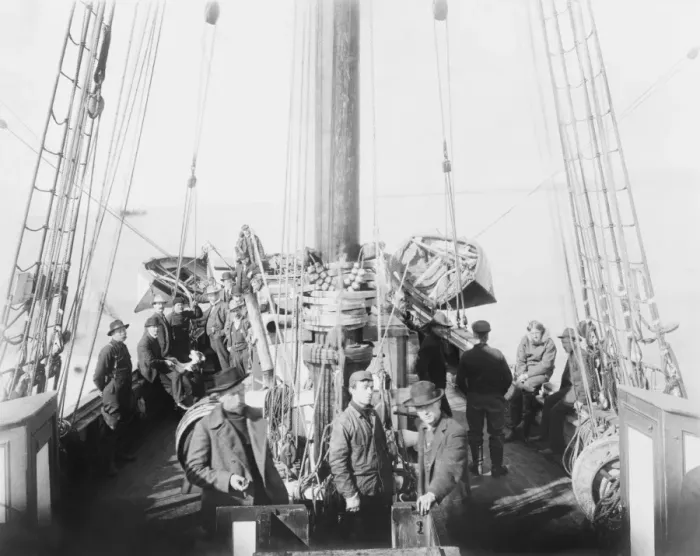
And so it was that after two years in the ice, they finally broke free in August of 1905 into the Beaufort Sea. Amundsen had now finished the first of his trailblazing expeditions: he had been the first to sail the Northwest Passage from end to end. To announce this great feat, he traversed some five hundred miles overland by dogsled to send a telegram. With no money, he had to send it collect. It discussed his “conquest of the Northwest Passage”; its recipients were his fellow explorer and friend, Fridtjof Nansen, the new King of Norway, Haakon VII, and the world. In doing so, he had cemented his reputation as one of the world’s foremost polar explorers.
For Amundsen, though, the glory lay not in the Northwest Passage, but in the North Pole.
He had originally planned to drift across the North Pole, much like he did with the Northwest Passage. He was, however, beaten by Americans Robert Peary and Fredrick Cook, who both claimed (disputably) to have been the first to reach it. With that prize no longer available, and without telling the world (and his crew for that matter), he turned his ship, the Fram, south. He then sent a simple telegraph to his own rival, the English explorer Robert Falcon Scott:
“BEG TO INFORM YOU FRAM PROCEEDING ANTARCTIC.”
Scott was completely taken aback by this, and the race to the pole had begun.
Amundsen’s logistical planning was legendary. He established his base camp, dubbed Framheim, some sixty miles closer to the pole than Scott’s camp. He laid supply drops every degree of latitude (about sixty nautical miles); these drops supplied equipment, fuel, and food. This logistical solution meant that even if they encountered bad weather or delays, they would never be far from a lifeline.
Perhaps the most vital decision on this endeavor pertained to transportation. Again, drawing on what he had learned from the Native Inuit, he relied on dog sleds. These animals were capable of pulling heavy loads, enduring the Antarctic freeze, and, if required, would serve as fresh meat for the crew. His opponent, Scott, used Siberian ponies, which proved to be unsuitable for the Antarctic environment, and many needed to be dispatched early in the expedition. Scott brought what was familiar; Amundsen brought what would work.
As is common among Norwegians, Amundsen and his crew were expert skiers, giving them a decisive edge in covering large swaths of ground quickly and efficiently. Furthermore, they decided to focus the totality of their energy and skills on actually reaching the pole rather than taking photographs or conducting scientific surveys. In this case, they were not scientists or tourists; they were racers.
On October 19th, 1911, Amundsen, with a four-man crew, fifty-two dogs, and four sleds departed. They reached the South Pole on the 14th of December—some thirty-five days before Scott would exhaustedly stagger to the same spot. He named the site Polheim, or “Home of the Pole,” and left Scott a letter, addressed to the King of Norway, as proof of his arrival and a courtesy to the men who would follow. His letter read:
“Dear Commander Scott, as you will probably be the first to arrive here after us, may I ask you to forward the enclosed letter to King Haakon VII of Norway? If the equipment we have left in the tent can be of any use to you, please do not hesitate to take it. With my best wishes. I wish you a safe return. Yours sincerely, Roald Amundsen”
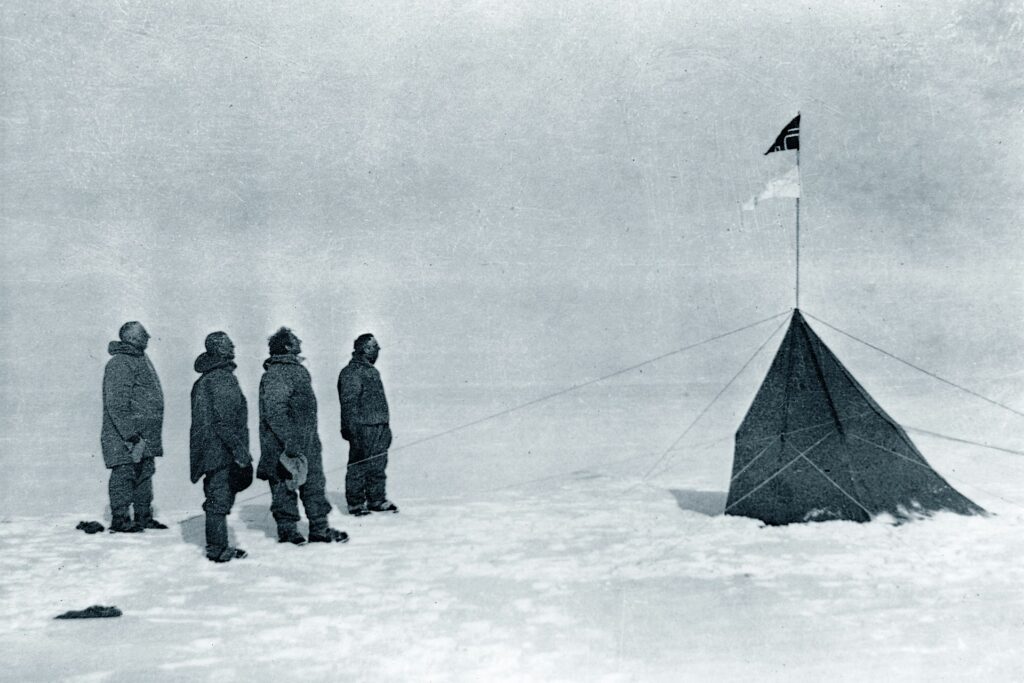
Roald Amundsen, Helmer Hanssen, Sverre Hassel, and Oscar Wisting at the South Pole, December 1911. Courtesy of Wikimedia Commons.
Despite being the first to cross the Northwest Passage and the first to the South Pole, Amundsen was not content; indeed, he was restless. In 1918, he set out on the Maud to drift across the North Pole. This expedition, however, would be ripe with difficulties—injury, ice, and tensions surrounding the First World War. He never would achieve that goal, but he remained undeterred.
With the advancement of aeronautics, he pivoted his interests from the sea to the air. In 1926, he, along with American millionaire Lincoln Ellsworth and Italian airship designer Umberto Nobile, set out to fly the dirigible airship Norge from Svalbard to Alaska, passing over the North Pole in the process. This would not be the first time Amundsen would fly over the Pole, as a previous expedition with two Dornier airplanes had made Amundsen the first man to reach both poles either by land, air, or sea.
Unfortunately, the extraordinary feat became marred with a bitter end. Nobile averred that Amundsen had diminished his role in designing the airship and his role as pilot. Their friendship soured into a bitter public conflict. It was a very unfortunate end to a partnership that had accomplished so much.
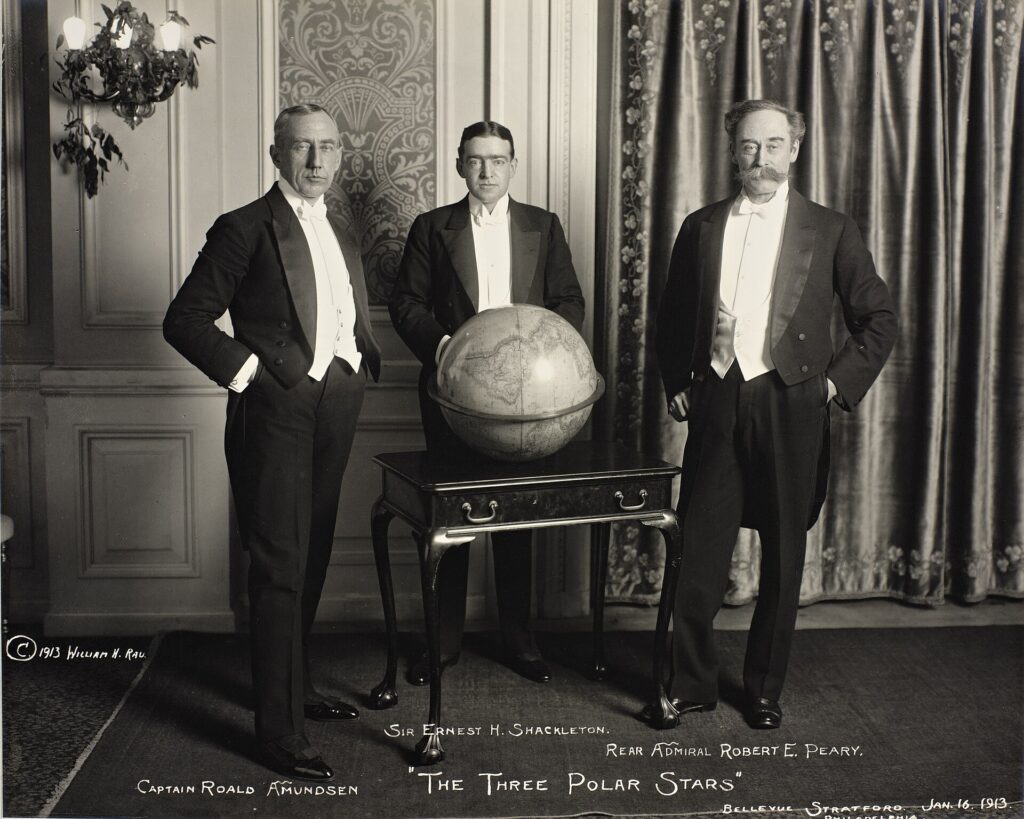
On the 28th of June, 1928, Alberto Nobile’s new airship, the Italia, crashed into the Arctic. Despite their bitter and public falling out, Amundsen immediately rolled up his sleeves and joined the rescue effort. He boarded a seaplane and flew into the frozen abyss. An honorable man cannot ignore a call for help, even from a rival.
The seaplane vanished over the Barents Sea, never to be seen again. To date, Amundsen’s body has never been found.
There is something strange and fitting about an explorer forever lost at sea. For when the frigid waters took him, and his body slipped into the great drink, it was right and just. All of his life, the sea had called for him; he now simply answered.
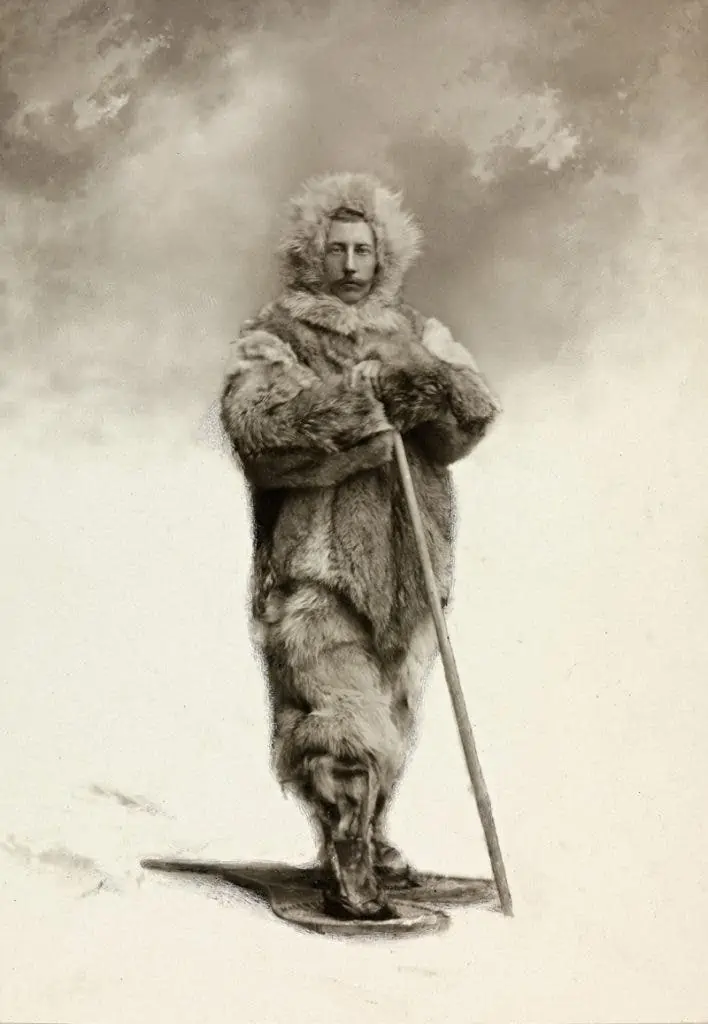
“Victory awaits him who has everything in order—luck, people call it. Defeat is certain for him who has neglected to take the necessary precautions in time; this is called bad luck.” -Roald Amundsen
Further Readings
Amundsen, Roald. My Life as an Explorer. Garden City, NY: Doubleday, Page & Company, 1927
Amundsen, Roald. The South Pole. London: John Murray, 1912
Bown, Stephen R. The Last Viking: The Life of Roald Amundsen. Boston: Da Capo Press, 2012