If you’ve been keeping up with Norse By God for a while, you’d know we have some annual and bi-annual happenings we post about. Specifically, I’m talking about our tradition of feasting at the end of every semester, to celebrate the conclusion of an academic class. From semester to semester, the time period changes to match the class; I’ve been there for a few, from the burning ship of the Viking feast to the also-burning wicker stag from the Celtic feast. I’m partly responsible for those. While fire is fun, we did realize both that the major group feast contributions had been particularly burn-y and also that finding something else to burn for the combination Medieval Britain and Medieval Queens feast was proving difficult. Maybe it was time for a change of pace?
Enter the trebuchet, one of the most recognizable medieval siege machines apart from the catapult (which the trebuchet is not, mind you).
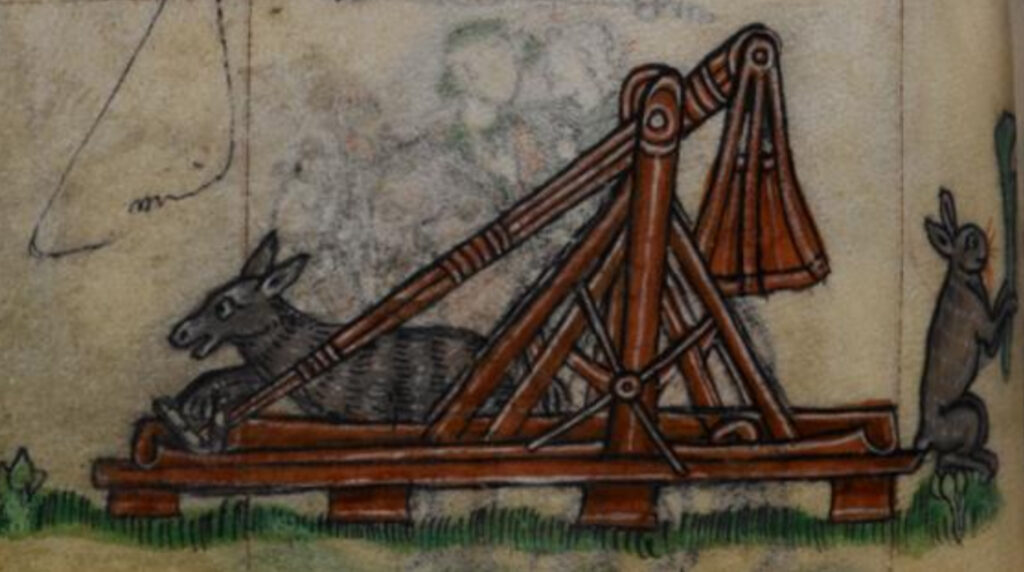
The reason the donkey looks so scared might be related to the “allegedly launched a live ass” thing.
14th century Maastricht Book of Hours, unknown, Netherlands. BL Stowe MS17 fol. 243v
The trebuchet, or in the case of this project the counterweight trebuchet, was a medieval siege machine made to toss projectiles incredible distances at breakneck speeds. The projectiles ranged greatly in terms of size and kind, from lead balls and rocks weighing only a few pounds to hundreds of pounds to, allegedly, much stranger things like human heads and perhaps a live ass (their words, not mine). The trebuchet does this via a sling attached to the end of a throwing arm via a length of rope. A counterweight sits at the end of a throwing arm opposite said sling. The projectile goes into the sling, the tension is held by a release pin or a wheel, and when said tension is released the trebuchet throwing arm rotates forward. The length of rope that the sling is on allows for a ton more power to be generated than, say, launching it at the end of the throwing arm like a catapult (the trebuchet’s lame cousin, I will fight about it), and when the sling releases at the perfect angle, the projectile flies.
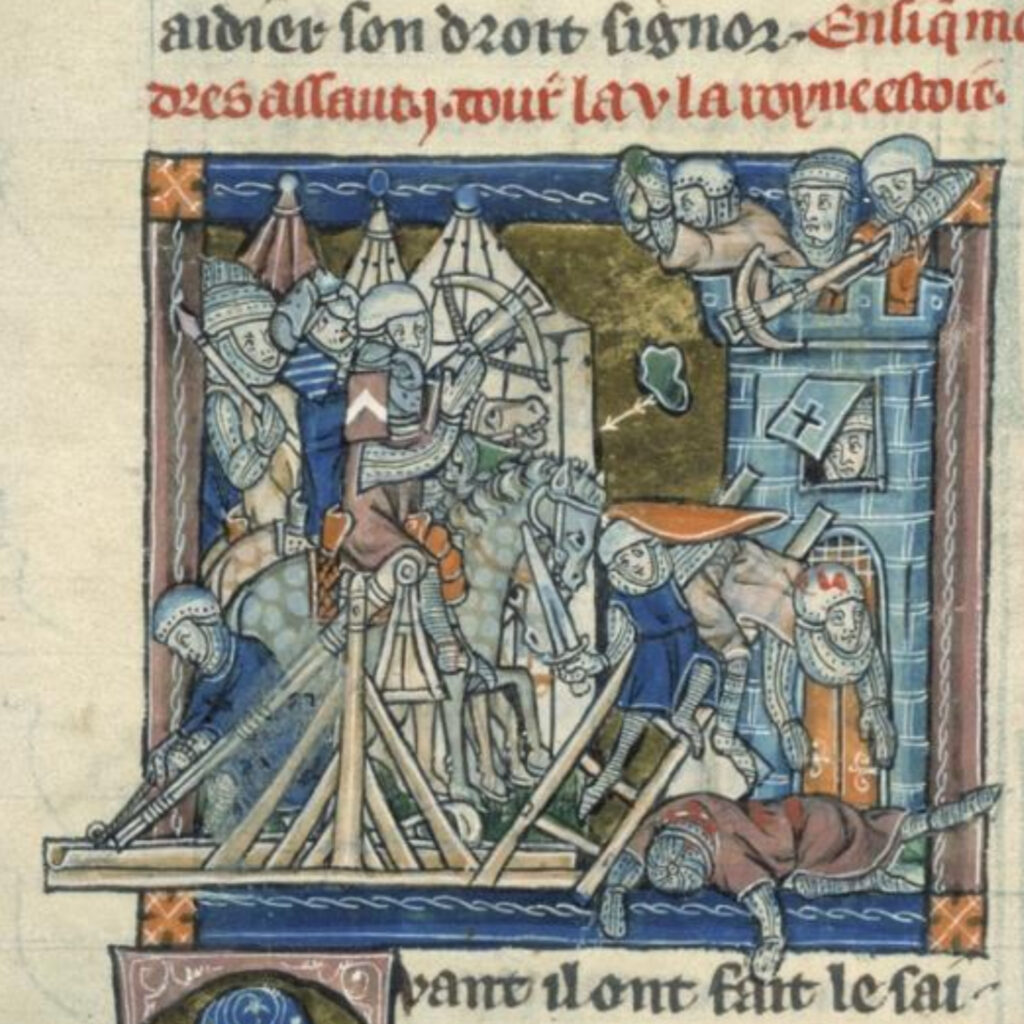
Some Arthurian lore for you- the lady in the tower is Guinevere, and that’s the Tower of London. There’s a lot you could focus on, but take a look at how detailed that trebuchet is! There’s a quick release mechanism shown here- the loop at the end of the throwing arm- that inspired one on ours.
14th century La Mort le Roi Artus, unknown, French. BL Add MS 10294 fol. 81v
When tuned correctly, a trebuchet could potentially launch multi-pound projectiles like rocks so hard that the most powerful of them could allegedly penetrate the stone walls of medieval castles in a single blow, such as Edward I’s Warwolf. Contrary to popular belief, however, this was not the usual result of attacking a castle wall with a trebuchet only once. Most commonly, counterweight trebuchets launched projectiles into castle walls repeatedly over time to weaken and eventually collapse them, launched projectiles over castle walls entirely, or in other cases they were used to launch projectiles into crowds of enemies.
This thing is an engineering miracle, not a marvel. Relying on materials that hopefully withstand the immense amount of stress and pressure brought on by each and every launch, tens of individual variables that all need to agree with each other for the machine to work ranging from weight to size to mass, and a counterweight that needs to be ridiculously heavy in comparison to your projectile, everyone that worked on this project was constantly dumbfounded at how medieval people could’ve crafted something like this without the tools and materials available to us in the modern day. We had the luxury of buying boxes of screws and nails by the hundreds from the hardware store, wood that was always precut to a consistent size and shape, and various steel pieces to work as reinforcements or as important pieces to last under stress, along with power tools such as drills and table saws, amongst other modern instruments. Medieval people couldn’t take twenty minutes to drive to Lowe’s in Southpoint Ohio to replace a broken arm or joint. Medieval people had to craft their own nails. Medieval people did not have air conditioning to work in, or the internet or simulators to consult when they got stuck, nor did they have online calculators or well-studied, widely available publications to help with the math and ratios.
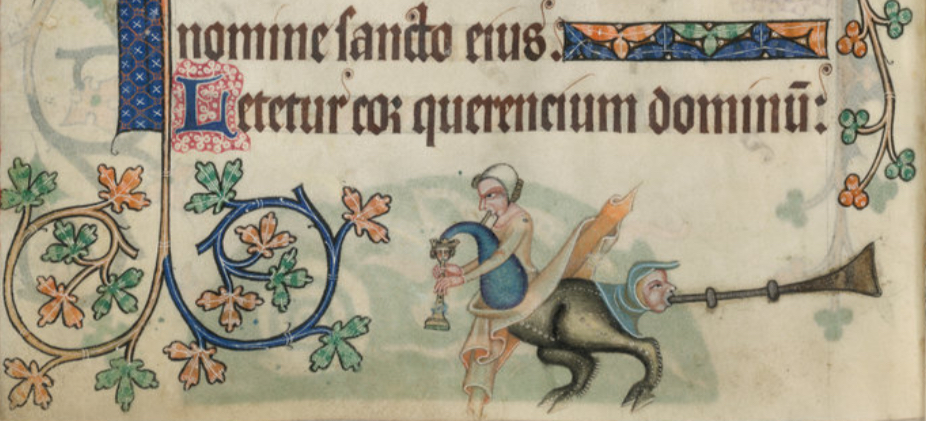
No, not those kinds of instruments… whatever kind of instrument that is. Luttrell Psalter, 14th c.
So… how did they do it? Where did they learn how? This is something that a lot of people like to argue about, actually. Everyone tends to agree that the some form of the trebuchet very likely originated somewhere in China, made its way through Western Asia and Northern Africa, and then fell into the hands of the Byzantines and Muslims by the sixth and seventh centuries, evolving over time and eventually becoming known to medieval Europeans through the Crusades.
This brings us to the reason for building the trebuchet, and how it was related to the feast: Crusades-era warfare, and the prevalence of siege machines like the trebuchet during the Crusades specifically. Occurring during the High Middle Ages- roughly 1091 to just before 1300- the Crusades primarily saw the use of two types of trebuchet: the traction trebuchet and the counterweight trebuchet. Traction trebuchets are killing machines, both to foes and also potentially to the people operating them. Free from any counterweights, they function similar to a counterweight trebuchet but use manpower instead, relying on a team of people pulling on ropes with all their might at the same time. The pros are that they’re efficient, easier to build and move around than a counterweight trebuchet, and you don’t have to source an insanely heavy counterweight. The cons are that it puts everybody operating it directly in the path of the projectile for a period of time when you fire it successfully, and it outright lobotomizes them with a giant rock when things go wrong. After watching people valiantly risk their lives throwing boulders with their buddies using one built on an issue of EXARC journal, a few trips to Lowe’s, and a prayer, I was delighted to learn these were much less common than counterweight trebuchets during the Crusades. This is because they could be hastily built in a pinch and were used more for lobbing things over walls or at people instead of through them. Considering that the Crusades were pretty rich with the besieging of Medieval masonry, it’s self-explanatory why they were less common.
Technically a traction trebuchet, don’t come for me… this also explains why the guys pulling the ropes to the right look so concerned.
13th century Historie d’Outremer, William of Tyre. MS 828 fol. 33v
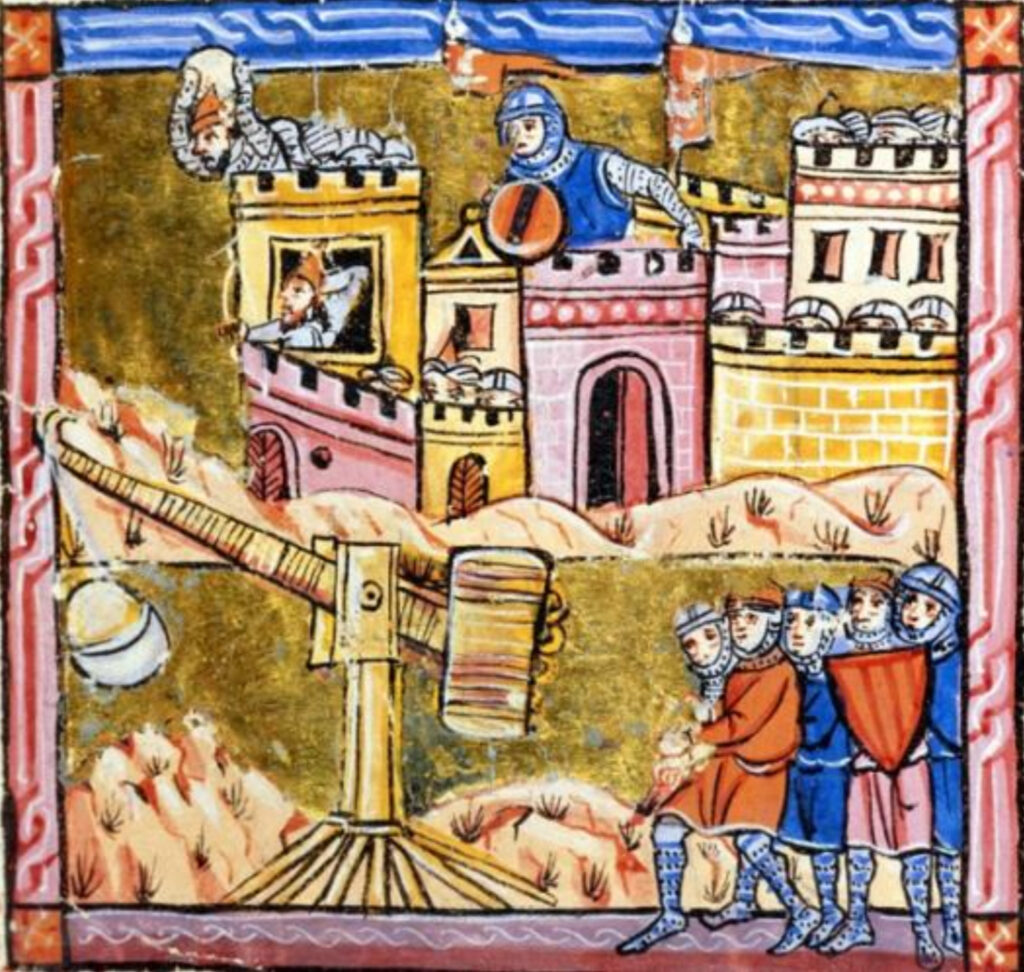
My contemporary inspiration for this project mostly consisted of reference photos- illuminations in various manuscripts, like the ones you’ve seen throughout this article. The most influential were those from William of Tyre’s 13th century Historie d’Outremer, which technically depicts a traction trebuchet at the Siege of Antioch but was the image I saw in class that initially inspired me, as well as one from 14th century La Mort le Roi Artus (Death of King Arthur) showing a counterweight trebuchet during the siege of the Tower of London. While it shows a fictional scenerio, the depiction of the trebuchet in the image is superb, showing all parts clearly and in great detail.
The research portion of this project consisted mostly of finding contemporary images of trebuchets to use as visual reference, searching online for the correct ratios and the equations, and seeing how other people built their trebuchets. I quickly learned once I got to the math part that this was way more complex than I originally thought, and I originally thought I was going to have problems doing way less than I ended up having to do in terms of equations and balancing. There are more than 30 different variables that go into building a trebuchet, from the length of the throwing arm to the height of the pivot point to sling length, counterweight size, and projectile weight and size, and there’s more where that came from. Online calculators and simulators helped, but at the end of the day a simulator doesn’t come close to physical tests and grueling trial and error, so all the math was connected to a lot of experimenting that would happen when the trebuchet was finally assembled.
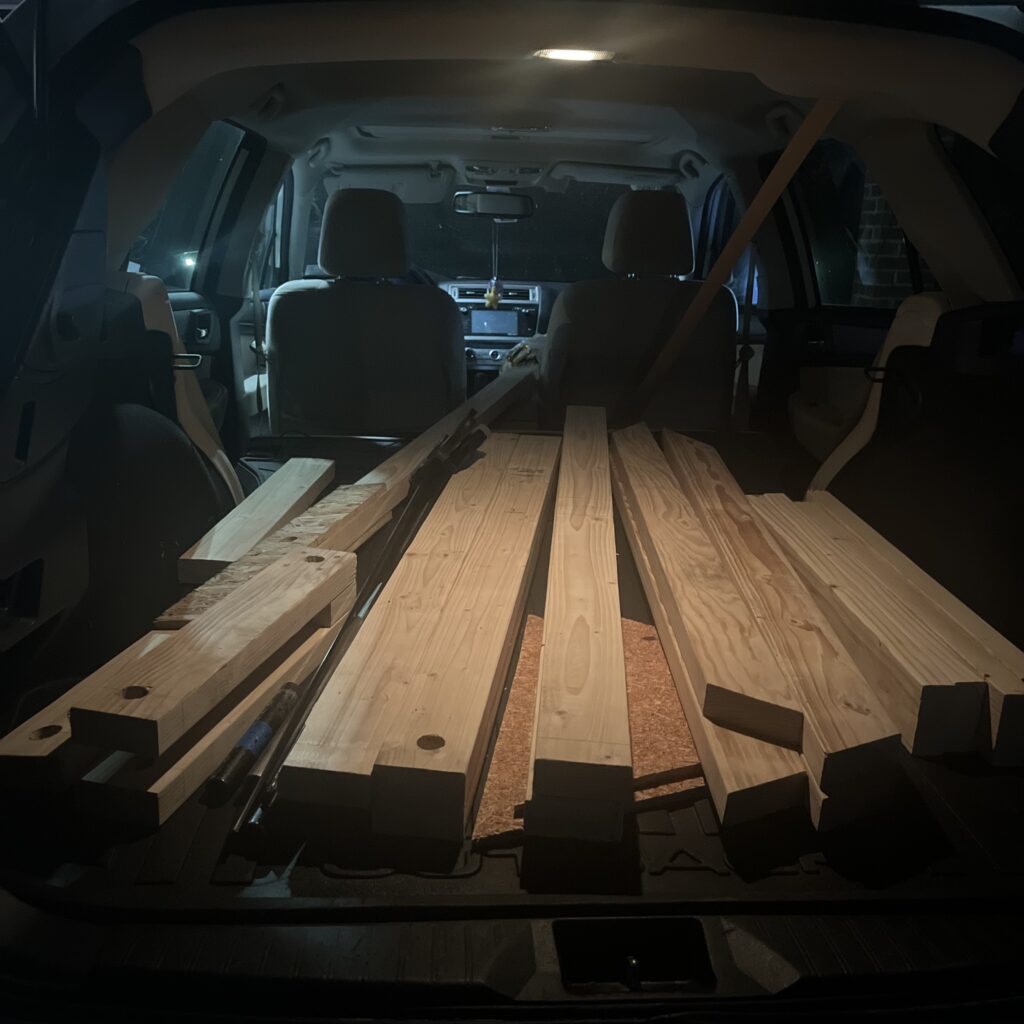
The parts that I pre-cut, drilled, and, in some cases, pre-assembled loaded into the back of my car. Most people probably could’ve guessed that I drive a Subaru before I uploaded this picture.
On top of that, I had to figure out how I was going to build this and where, how I would move it, and how I would get as much weight into the space I had for a counterweight that I could. There was a very important part of the learning and research process where I realized the correct counterweight ratio, or rather the lowest ratio I could use and the thing would still work, was around 100:1. This means that I would need a 500 pound counterweight to launch the five pounds I originally wanted to launch. This was absolutely not going to happen, because my group and I discussed it and I found that unfortunately I cannot ask to reimburse $1,500,000 USD in tungsten cubes plus shipping. We decided to look for 100lbs via Facebook Marketplace for as cheap as possible. The rest of the materials were rather mundane, too- 550 paracord, some steel rings and hooks, galvanized steel pipe, canvas for the sling, and various 2x4s and pieces of plywood, along with obvious things like screws. There are some other things I’m not mentioning, but that’s because I’ll mention them directly later.
This was an incredibly difficult but rewarding project, and I have much more to tell you, but I’ve talked enough for this week. Come back next week to hear about the whole build process- every failure (of which there were many…), every success, and every launched and smashed melon and grapefruit.
Suggested further reading: Fulton, Michael S. Artillery in the Era of the Crusades: siege warfare and the development of trebuchet technology. Berlin: Brill, 2018.